



|
Getting your Trinity Audio player ready...
|
By: Fern Sidman- Jewish Voice News
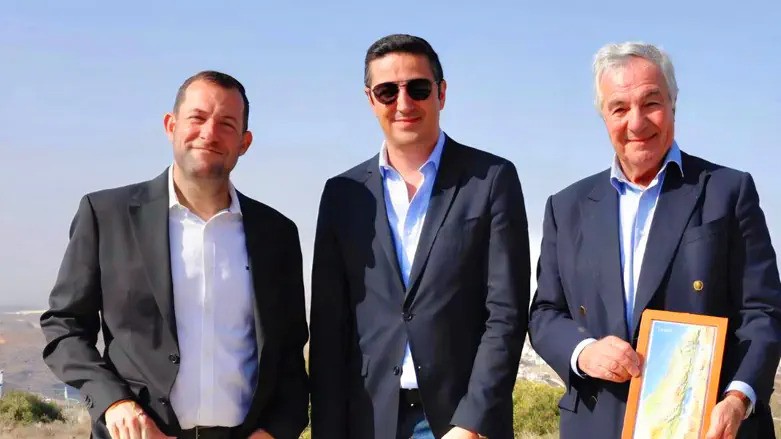
In a landmark moment that merges symbolism, diplomacy, and an unexpected convergence of European nobility with Israeli regional leadership, a royal delegation from the House of Ligne—one of Belgium’s most storied and influential noble families—has completed an unprecedented visit to Samaria. As Israel National News reported on Monday, this is the first time in history that members of this ancient dynasty have set foot in the region, marking a dramatic and deeply symbolic gesture of solidarity at a time of shifting geopolitical currents between Europe and the Middle East.
The delegation, comprised of Prince Édouard de Ligne-La Trémoïlle and his father, Prince Charles-Antoine de Ligne, arrived in Israel several weeks after hosting Yossi Dagan, head of the Samaria Regional Council, at their family estate in Belgium. According to the report at Israel National News, that visit laid the personal and ideological groundwork for a burgeoning alliance—one that both sides describe as rooted in shared values, mutual admiration, and a steadfast commitment to preserving Western civilization.
The House of Ligne, whose lineage reaches back to the 11th century, is among Europe’s oldest noble families, associated for nearly a millennium with military leadership, political influence, religious patronage, cultural stewardship, and diplomatic engagement. The family’s historical footprint spans centuries of European affairs—from medieval feudal wars to 20th-century geopolitical realignments—and its members continue to maintain a presence in public, philanthropic, and cultural life across Europe.
As the Israel National News report noted, the arrival of princes—Belgium’s highest noble rank, even above duke and marquess—was an unprecedented site in modern Samaria. The symbolism was unmistakable: European aristocracy, often seen as distant from Israel’s geopolitical realities, had come not only to witness the region firsthand but to publicly endorse the rights and aspirations of its Jewish residents.
🚨 HISTORIC: BELGIAN PRINCES VISIT SAMARIA, EXPRESS SUPPORT FOR ISRAELI SOVEREIGNTY
For the first time ever, a royal delegation from Belgium’s House of Ligne toured Samaria as guests of Yossi Dagan.
Prince Édouard de Ligne:
“Sovereignty is a major issue, we stand in solidarity… pic.twitter.com/NsETDCC3FT— Mossad Commentary (@MOSSADil) November 24, 2025
Upon their arrival, Prince Édouard and Prince Charles-Antoine were welcomed as honored guests by Dagan and other regional leaders. The princes toured key sites, engaged with local residents, examined the region’s rapid development, and received in-depth briefings on the security, agricultural, and cultural challenges confronting the communities of Judea and Samaria.
One of the most striking moments during the visit, reported by Israel National News, was Prince Édouard’s clear and unequivocal support for Israeli sovereignty over Judea and Samaria.
“Sovereignty is a major issue—we stand in solidarity with you,” he declared while visiting strategic points throughout the region.
Such an explicit endorsement—from a European aristocrat, no less—presents a stark contrast to the typical diplomatic posture of European governments, many of which criticize or oppose Israeli sovereignty measures. Prince Édouard’s remarks reflect a willingness among certain European elites to reexamine long-held assumptions about the region and to view Israeli governance as a stabilizing force rather than a source of contention.
The prince emphasized his admiration for Samaria’s communities, praising their efforts to foster coexistence, strengthen security, and build regional partnerships. “I know you work extensively with various communities to bring peace to the area,” Prince Édouard remarked. “I know your values are good and just, and I wish you great success in advancing cooperation and peace in your beautiful region.”
His words resonated deeply with Samaria’s leadership, who often struggle against portrayals that oversimplify or delegitimize the region’s complexities.
During the formal reception, Dagan delivered an impassioned address that blended gratitude, geopolitical urgency, and a bold vision for global cooperation.
“It is an honor for us to host you in Samaria,” he said. “I want to welcome you on behalf of all my residents. I know this is your first visit to Israel and to Samaria, but this is only the beginning.”
He went further, articulating a message that Israel National News described as a call for transcontinental unity: “Now I feel we are like family and that we share the same values. We have the same mission—to defend Europe, Israel, the United States, and the entire free world. Together. And we know we must stand together in order to win.”
Dagan’s remarks reflect a worldview he has championed for years: that Israel’s battles—whether against terrorism, political delegitimization, economic isolation, or ideological extremism—are intrinsically linked to broader Western struggles. The mention of Europe and the United States in the same breath as Samaria highlights Dagan’s belief that the region is not merely a distant outpost but a frontline of the free world.
The Samaria Regional Council head went even further, stressing that the visit was more than ceremonial: “This visit, this delegation—I believe we are creating a strong network, a strong army for justice, for our security, for Israel, for Samaria, for Europe, and for the whole world.”
As the Israel National News report noted, Dagan framed the princes as symbolic representatives of a broader struggle within Europe—a continent he described as undergoing “terrible decline,” facing internal cultural fragmentation, rising extremism, and geopolitical uncertainty.
“We can change this,” he insisted. “We can make Europe strong again. We can do it. And we will do it.”
The rhetoric was bold, even provocative, but it called attention to the ideological camaraderie that had taken root between the two sides.
Prince Charles-Antoine offered a deeply personal reflection that added emotional resonance to the visit. As the Israel National News report highlighted, he recounted that his own father visited Israel in 1950—just two years after its founding—and came away with profound admiration for the young nation.
“He told me that of all the countries he visited in the world, the one he liked most was Israel,” the prince said. “And so, here I am for the first time. Sadly, it is too late—I should have come long ago.”
His remarks—which blended humility, regret, and wonder—captured the spirit of the visit. Prince Charles-Antoine went on to praise Israel’s rapid development, its architectural growth, and most notably its people: “The country is beautiful. I am very impressed by all the construction happening here and by the kindness of the people, how they behave, and how good they are. Thank you very much.”
For local residents, the idea that a European prince would express such admiration for their communities—and acknowledge the moral character of Israel’s citizenry—carried enormous weight.
Israel National News reported that the princes’ itinerary extended well beyond Samaria. The delegation plans to tour the Gaza Envelope, visiting communities living under constant threat from Hamas rocket fire. They will also visit the Knesset, participate in official briefings, and return to Samaria later in their trip.
The delegation’s willingness to immerse itself in Israel’s most sensitive regions suggests a genuine desire to understand the country’s geopolitical realities—not merely to engage in ceremonial diplomacy.
At the close of the visit, Dagan reiterated his belief that Israel’s future is deeply interconnected with the West’s. “Israel, Europe, and the United States must fight together,” he declared. “And we will do it together.”
Prince Charles-Antoine responded without hesitation: “I agree with you one hundred percent, Mr. Regional Council Head. This is how it must be—and unfortunately, many people in Europe still do not understand that.”
The prince’s candor, reported by Israel National News, reflects a growing sentiment among certain European figures who view Israel not as a foreign conflict zone but as a vital ally in the fight for Western stability and democratic values.
For Samaria’s residents, this unprecedented royal visit represents a moment of validation rarely afforded by European elites. As the Israel National News report noted, it may mark the beginning of a long-term partnership—one rooted not only in diplomatic cooperation but in shared values, cultural respect, and a common ideological mission.
Whether this visit proves to be a watershed moment remains to be seen. But for now, the sight of Belgian royalty walking the hills of Samaria, expressing solidarity with Israeli sovereignty, and praising the virtues of its people stands as a striking reminder of the unexpected alliances forming in a world facing profound and rapid change.
In the words of Yossi Dagan: “This is only the beginning.”