



|
Getting your Trinity Audio player ready...
|
By: Fern Sidman
Even as the crackle of gunfire echoed through the alleyways of Nablus late Monday night, an extraordinary and unprecedented diplomatic gesture unfolded at one of Judaism’s most revered — and most frequently contested — holy sites. While IDF forces were still exchanging fire with Palestinian terrorists in the heart of the city, a delegation of 20 United States lawmakers made a bold and symbolic entrance into Joseph’s Tomb, accompanied by Samaria Regional Council head Yossi Dagan.
Tzap Magazine in Israel, which accompanied the delegation and documented the tense yet historic moments, described the scene as “a convergence of faith, geopolitics, and profound solidarity, all compressed into one precarious night.” For the settlement movement and for advocates of Israeli sovereignty in Judea and Samaria, the visit represented far more than symbolic encouragement; it was a declaration of political alignment at one of the most sensitive points in the Israeli–Palestinian conflict.
According to a report in Tzap Magazine in Israel, the delegation’s arrival took place under active security operations. IDF troops were simultaneously engaged in a firefight against armed militants in the center of Nablus, part of the military’s ongoing counterterrorism operations in the northern region of Judea and Samaria. Sirens, bursts of gunfire, and rapid IDF deployment formed the backdrop to the American lawmakers’ entry into the religious compound.
Despite the volatile situation, the lawmakers insisted on proceeding — a decision that Yossi Dagan hailed as “courageous, principled, and historically significant.” As Tzap Magazine in Israel noted, the sequence of events only heightened the emotional and political weight of the moment, reminding all present that Jewish access to Joseph’s Tomb remains both intensely meaningful and perpetually contested.
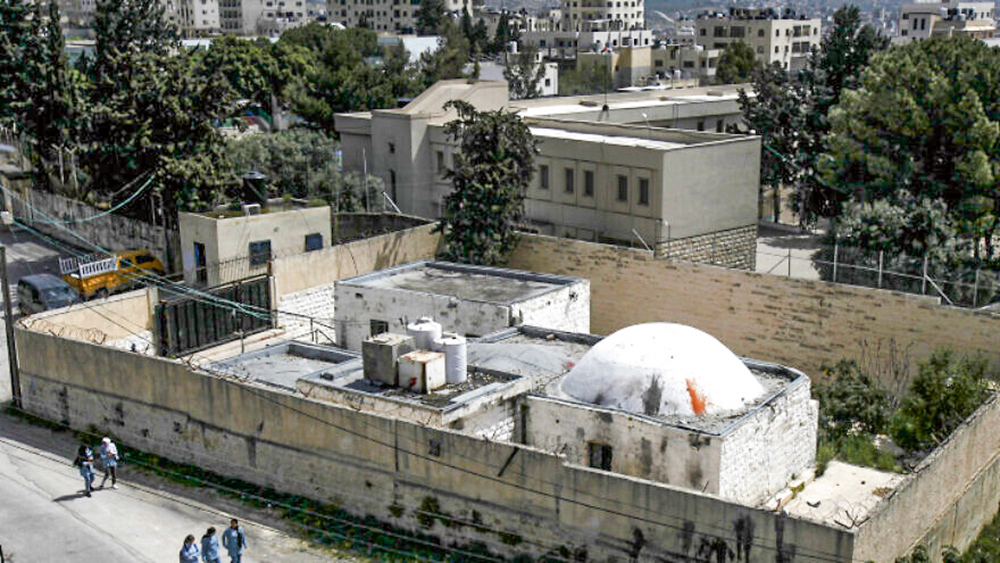
Joseph’s Tomb, believed by Jewish tradition to be the burial site of the biblical Joseph, sits in a densely populated area of Nablus — a city controlled by the Palestinian Authority where Israeli access requires military escort. In recent years, the tomb has been repeatedly attacked, burned, vandalized, and turned into a flashpoint for violence. For American lawmakers to enter under such conditions is extraordinary.
Tzap Magazine in Israel emphasized that all twenty members of the U.S. delegation have publicly and repeatedly endorsed Israel’s right to exercise full sovereignty over Judea and Samaria. Their visit to Joseph’s Tomb — a site that embodies the convergence of Jewish history, religious significance, and political struggle — was widely interpreted as a deliberate signal to the international community.
According to sources who spoke with Tzap Magazine in Israel, several lawmakers expressed that their presence served “not only as solidarity but as a statement of policy.” They underscored that Judea and Samaria are integral parts of the historic Jewish homeland, and that Israel’s ability to access and protect sacred sites must not be subject to political negotiation or threats of violence.
One congressman, whose remarks were quoted by Tzap Magazine in Israel, declared: “We are standing here tonight not despite the danger, but because of it. Israel has the right — and the obligation — to preserve its heritage and defend its people. Joseph’s Tomb is not negotiable.”
Such declarations, made on location and in the shadow of active conflict, constitute one of the strongest public demonstrations of congressional support for the settlement movement in recent memory.
Yossi Dagan, who has long acted as a diplomatic bridge between Samaria and international political leaders, described the visit as a watershed moment. As Tzap Magazine in Israel recounted, Dagan walked the lawmakers through the tomb compound, explaining its biblical importance and recounting repeated episodes of violence and desecration committed by Palestinian terrorists.
He reportedly told the delegation: “Your presence here is a moral beacon. It sends a message to the entire world that the People of Israel are not alone in Judea and Samaria.”
Dagan emphasized that Joseph’s Tomb has survived centuries of turmoil precisely because it sits at the heart of the Jewish story — and, by extension, the Zionist story. The American lawmakers’ visit, he argued, represented a recognition of this fundamental truth.
According to the information provided in the report at Tzap Magazine in Israel, Dagan personally thanked each member of the visiting group, noting that such displays of international support bolster the morale of local residents who frequently face security threats. He also expressed hope that the visit would catalyze future diplomatic and legislative efforts in Washington to reinforce Israel’s claim to sovereignty over the region.
Many of the visiting members of Congress are known for strong pro-Israel voting records. Some are evangelicals who view biblical heritage sites as central to their religious worldview. Others frame their support through strategic or national security lenses. But at Joseph’s Tomb, those perspectives intertwined.
Tzap Magazine in Israel, which interviewed several lawmakers during the visit, reported that many spoke movingly about experiencing the biblical landscape firsthand. One legislator described placing a hand on the stone structure over Joseph’s purported resting place and feeling “the weight of history and destiny.”
Another congresswoman told Tzap Magazine in Israel: “This is not simply about foreign policy. This is about truth — historical, spiritual, and moral truth.”
The emotional resonance of the site, combined with the immediate danger outside, made the visit unlike any previous congressional trip to the region.
IDF soldiers stationed nearby, tasked with securing the area during the firefight, expressed admiration for the congressional delegation’s resolve. Several spoke with Tzap Magazine in Israel, noting that they had never witnessed such a high-ranking international political group enter the compound during active combat in the city.
One soldier told the magazine: “They could have postponed. No one would have blamed them. But they chose to come. That means something.”
For the IDF, the timing of the visit demonstrated a rare alignment between military realities and political symbolism. It also underscored the challenges Israel faces in defending the right of Jews to access their sacred sites under near-constant threat.
Although the visit lasted only a few hours, its repercussions may be felt far more widely. As Tzap Magazine in Israel stressed, the presence of twenty U.S. lawmakers at Joseph’s Tomb during a live security operation sends a powerful geopolitical message: To Palestinian terrorists. Violence will not deter Israel or its allies. To the Palestinian Authority: Jewish holy sites require genuine protection, not rhetorical commitments. To the international community: Support for Israeli sovereignty in Judea and Samaria is not confined to fringe voices. To Israeli society: The settlement movement has influential friends in Washington ready to publicly stand with them.
In an era where Israel faces diplomatic tensions in Europe, challenges at the United Nations, and growing hostility on American college campuses, this visit represents an unmistakable countercurrent.
Some analysts quoted by Tzap Magazine in Israel argue that the visit is part of a wider shift in U.S. political culture. Among certain segments of Congress, especially conservatives and evangelicals, support for Israel’s territorial claims has become increasingly explicit. This is not merely about opposing terrorism — it is about affirming the Jewish people’s biblical, historical, and legal connection to the land.
Such positioning stands in stark contrast to other political voices in Washington that have embraced a more critical view of Israel’s actions in Judea and Samaria. The lawmakers’ presence at Joseph’s Tomb may represent a new phase of American engagement: one that refuses to divorce historical context from modern geopolitical realities.
At its core, the congressional delegation’s visit to Joseph’s Tomb was a dramatic convergence of danger and devotion. With IDF forces battling terrorists just minutes away, American lawmakers stood inside one of Judaism’s most sacred sites, affirming their unwavering support for Israel’s claims to the land and for its right to defend itself from ongoing threats.
As the Tzap Magazine in Israel report observed, the night will be remembered not only for its tension but for its symbolism — the moment when history, politics, and faith aligned under fire.
For the settlement movement, for advocates of sovereignty, and for Israelis who feel increasingly isolated on the world stage, the message was unmistakable:
They are not alone. And the world is watching.