



|
Getting your Trinity Audio player ready...
|
By: Fern Sidman
A growing stockpile of humanitarian aid, predominantly food, has amassed on the Gazan side of the Kerem Shalom Crossing, waiting for collection by international aid organizations, according to the Israeli defense ministry’s Coordinator of Government Activities in the Territories (COGAT). On Friday, COGAT released video footage depicting hundreds of aid trucks with supplies stacked in organized rows on pallets, providing a visual counter to international claims that Israel is obstructing the delivery of food to the Gaza Strip.
Speaking on-site, Colonel Abdullah Halabi, who heads the Coordination and Liaison Administration for Gaza, addressed the allegations directly. “Israel does not limit the number of trucks entering the Gaza Strip,” Halabi stated, standing before piles of aid containers visible on the Gazan side of the crossing. “It is the collection issue that is preventing the continuous delivery of humanitarian aid into Gaza.”
Halabi, whose remarks were documented by The Jewish News Syndicate (JNS), emphasized that Hamas is manipulating the aid narrative for political leverage. “Despite the clear facts you can see behind me, Hamas is running a deliberate and false propaganda campaign that presents a distorted picture of the humanitarian situation,” he said, accusing the terror group of weaponizing humanitarian suffering to exert pressure in hostage negotiations with Israel.
COGAT continues to urge international organizations to dispatch teams to retrieve the aid and facilitate its distribution to Gaza’s civilian population. “We operate every day to bring in aid; Hamas operates every day to create a perception of crisis,” Halabi asserted. “The international community needs to know the truth. We are working in close coordination with the U.N. and aid organizations, urging them to continue arriving to collect the aid.”
According to COGAT’s figures cited by JNS, some humanitarian assistance is reaching its intended recipients. On Friday alone, approximately 90 food trucks were unloaded at the crossing, with over 100 trucks’ worth of aid collected and disseminated by the United Nations and affiliated international agencies.
Yet the issue remains contentious. On the social media platform X, U.S. Ambassador to Israel Mike Huckabee shared images of the accumulating aid, stating, “There is enough food to feed all of Gaza but it sits rotting! U.N. is a tool of Hamas! U.S.-based [Gaza Humanitarian Foundation] is actually delivering food FOR FREE and SAFELY. U.N. food is either looted by Hamas or rots in the sun!”
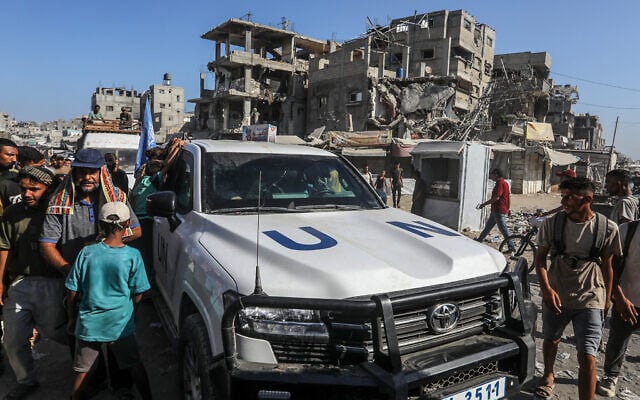
The United Nations, in response, attributed the backlog to Israeli military restrictions and widespread criminal looting within Gaza. Olga Cherevko, spokeswoman for the U.N. Office for the Coordination of Humanitarian Affairs (OCHA), said in a statement carried by the Associated Press that, “These factors have put people and humanitarian staff at grave risk and forced aid agencies on many occasions to pause the collection of cargo from crossings controlled by the Israeli authorities.”
OCHA also noted on its website that the breakdown of law and order within Gaza—partly due to the collapse of the Hamas-run police force—has created fertile conditions for criminal gangs to intercept aid convoys once inside the enclave. This degradation in governance, according to Cherevko, has further paralyzed the delivery of essential goods to civilians.
In parallel, the Foundation for Defense of Democracies (FDD), as quoted by JNS, criticized the U.N.’s continued reliance on aid distribution channels that Hamas has allegedly exploited. FDD has documented cases where Hamas seized truckloads of aid for resale on the black market, generating hundreds of millions of dollars while the average Gazan endured chronic shortages.
Enia Krivine, senior director of FDD’s Israel Program and National Security Network, stated in a Thursday report that the Gaza Humanitarian Foundation (GHF)—a relatively new player in the aid landscape—has successfully bypassed these channels, thereby depriving Hamas of its economic stronghold over aid distribution. “Hamas understands that if it doesn’t regain control of the aid economy in Gaza, its days of ruling the enclave will be over,” Krivine said. “By refusing to work with GHF, the United Nations is shamefully throwing a lifeline to Hamas.”
The JNS report noted that the GHF’s approach has received tacit support from segments of the U.S. administration, especially those skeptical of the U.N.’s effectiveness and impartiality in conflict zones where designated terrorist organizations exert control.
On Saturday night, the IDF Spokesperson’s Unit published footage of an airdrop of humanitarian aid as part of the ongoing efforts to allow and facilitate the entry of aid into the Gaza Strip, as was reported by Israel National News.
“The airdrop, which was carried out in coordination with international organizations and led by COGAT, included seven packages of aid containing flour, sugar, and canned food,” said the IDF Spokesperson’s Unit.
INN also reported that earlier on Saturday, the IDF announced that, in accordance with directives from the political echelon and following a situational assessment, it has begun a series of actions aimed at improving the humanitarian response in the Gaza Strip, and to refute the false claim of deliberate starvation in the Gaza Strip.
In addition, it was decided that designated humanitarian corridors would be established to enable the safe movement of UN convoys delivering food and medicine to the population.
Meanwhile, diplomatic efforts to reach a ceasefire in exchange for the remaining hostages appear to be faltering. President Trump voiced his exasperation on Friday, blaming Hamas for the collapse of negotiations. “It was too bad—Hamas didn’t really want to make a deal,” Trump told reporters. “I think they want to die. And it’s very, very bad. It got to a point where you’re going to have to finish the job.”
Trump also highlighted the hostage issue as a core reason for Hamas’s refusal to cooperate. “Don’t forget, we got a lot of hostages out,” he said. “So now we’re down to the final hostages, and they know what happens after you get the final hostages. And basically because of that, they really didn’t want to make a deal. I saw that.”
His remarks follow mounting criticism from both domestic and international observers over the perceived stalemate in mediation efforts. Yet as JNS has documented, the impasse lies less in logistics than in political will—both on the part of Hamas, which continues to leverage civilian hardship as a negotiating chip, and segments of the international community that have yet to adopt a unified and resolute approach to humanitarian aid distribution.
The aid accumulation at the Kerem Shalom Crossing thus becomes emblematic of a larger crisis—one in which geopolitical calculations and organizational inertia have left truckloads of food stranded under the sun, while millions remain dependent on a broken system. The clarity of video footage and firsthand testimonies from COGAT may serve to reframe a conversation too often mired in ambiguity and accusation.
