



|
Getting your Trinity Audio player ready...
|
By: Fern Sidman
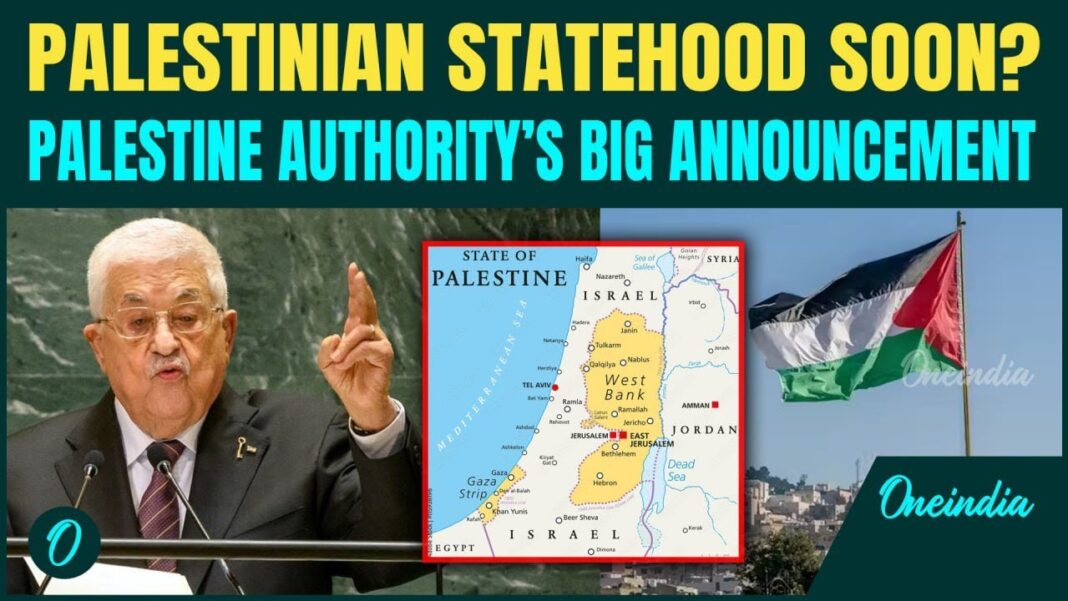
Palestinian Authority (PA) President Mahmoud Abbas is seriously weighing the prospect of unilaterally declaring the establishment of a Palestinian state during the upcoming United Nations General Assembly (UNGA) session in New York this September, i24 News reported on Sunday, citing Senior Middle East Correspondent Ariel Oseran.
According to the information provided in the i24 News report, the plan — first detailed by the Qatari outlet Al-Araby Al-Jadeed — would center on a formal constitutional declaration outlining the envisioned state’s borders and political foundations. The document is also expected to set a date for Palestinian National Council elections, though no parallel plans have been made for holding other elections, including those for the Palestinian Legislative Council, a senior Palestinian source told the network.
As the i24 News report noted, such a move would come nearly 32 years after the signing of the Oslo Accords, the landmark 1993 agreement between the Palestine Liberation Organization (PLO) and Israel intended to pave the way for a negotiated two-state solution. Abbas’s potential declaration would bypass ongoing — and currently stalled — peace negotiations, instead placing the Palestinian statehood question directly on the global stage.
The constitutional declaration envisioned by Abbas’s team would serve both as a political statement and as a symbolic act of sovereignty, according to the report at i24 News. While it would not result in the immediate creation of a recognized independent state, it would aim to galvanize international recognition and rally support among nations sympathetic to Palestinian aspirations for self-determination.
The initiative, however, risks deepening longstanding internal Palestinian divisions. As Oseran explained on i24 News, the move would be undertaken without broad-based national consensus, given the fractured political landscape between the PA, dominated by Abbas’s Fatah faction, and Hamas, the Islamist group that governs the Gaza Strip.
A senior Palestinian official quoted by i24 News acknowledged that no elections have been held in over a decade for the Palestinian Legislative Council, underscoring the gap between formal governance structures and current political realities. The official suggested that setting a date for Palestinian National Council elections — the legislative body of the PLO — could serve as a gesture toward political renewal, even in the absence of comprehensive electoral reform.
The prospect of a unilateral declaration drew swift and sharp reactions from Israeli officials. Security Minister Itamar Ben-Gvir, one of the most vocal critics of the PA, responded on X (formerly Twitter) by calling for the immediate dismantling of the Palestinian Authority.
“I will appeal to the Prime Minister with a request to bring immediate operative measures to the next cabinet meeting to dismantle the Palestinian Authority,” Ben-Gvir wrote. Referring to Abbas by his nom de guerre, Abu Mazen, he added: “This must be the response to the terrorist Abu Mazen’s fantasies of a ‘Palestinian state’ — crushing the terror authority he heads.”
The report at i24 News noted that Ben-Gvir’s comments reflect the hardline stance within parts of Israel’s governing coalition, where the PA is often viewed not as a legitimate peace partner but as a hostile entity fostering incitement and terror.
If Abbas proceeds, the move could spark significant diplomatic ripples. i24 News reported that some analysts believe a unilateral declaration might garner symbolic backing from certain UN member states, particularly within the Arab League, the Non-Aligned Movement, and countries already recognizing Palestine as a state. However, such a declaration is unlikely to shift the positions of major Western powers, many of which have tied recognition to the outcome of direct negotiations with Israel.
The United States and European Union, in particular, have historically opposed unilateral steps that they view as undermining the negotiated framework laid out in past agreements. At the same time, the i24 News report observed that growing frustration with the stagnation of the peace process has led to increased calls, particularly in Europe, for recognizing Palestinian statehood as a way to reinvigorate diplomacy.
The timing of the potential declaration — nearly a third of a century after Oslo — is laden with symbolism, but the practical effects remain uncertain. As Oseran reported on i24 News, without national consensus or operational sovereignty over all claimed territories, the declaration would be largely political in nature.
It would also come at a time of heightened regional volatility, with ongoing hostilities between Israel and Hamas, deepening West Bank tensions, and international attention increasingly focused on post-conflict arrangements in Gaza. Under these conditions, analysts told i24 News that Abbas’s gambit may be intended as much to bolster his political standing at home and abroad as to achieve immediate tangible results.
The UNGA, where every member state has equal voting rights, has long been a forum where the Palestinian leadership seeks diplomatic victories. In 2012, the body voted to upgrade Palestine’s status to that of a “non-member observer state.” While such resolutions are non-binding, they carry considerable symbolic weight and can be used to advance the Palestinian narrative in international forums.
Abbas’s team sees the September gathering as an opportunity to frame the Palestinian cause as a matter of unfinished international business, using the anniversary of Oslo as a rhetorical anchor to argue that decades of diplomatic efforts have failed to deliver statehood, as was reported by i24News.
Israeli officials are already discussing possible countermeasures should Abbas move forward. These could range from withholding tax revenues collected on behalf of the PA, to expanding settlement activity in key areas in Judea and Samaria, to tightening security restrictions on PA-administered zones.
Some members of Israel’s cabinet, including Ben-Gvir, have argued for far more drastic measures — including dismantling the PA altogether — though such steps would carry significant political and security risks, including the potential collapse of day-to-day governance in large parts of Judea and Samaria.
While Abbas has yet to make a formal announcement, Palestinian officials told i24 News that internal consultations are ongoing. Much will depend on how the proposal is received by key Arab states and by major international powers ahead of the UNGA session.
The coming weeks are expected to bring further clarity on whether the constitutional declaration will proceed as planned, and if so, what form it will take. The move would not be unprecedented — similar declarations have been made in the past — but it would represent the most high-profile unilateral step toward Palestinian statehood in years.
Whether this maneuver shifts the political calculus in the region, or simply hardens existing positions, will depend on the interplay between diplomatic outreach, domestic Palestinian politics, and Israeli government response in the months leading up to September.
