



|
Getting your Trinity Audio player ready...
|
By: Fern Sidman – Jewish Voice News
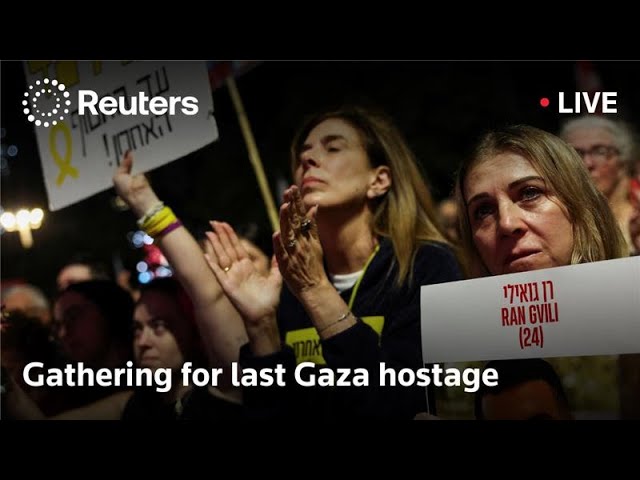
In a development that Israeli officials cautiously describe as “a moment of guarded optimism,” Hamas has resumed active efforts in the Gaza Strip to locate the remains of the last Israeli hostage still unaccounted for in the territory—police officer Ran Gvili, the 24-year-old murdered during the October 7, 2023 atrocities. According to a report on Sunday at World Israel News, Hamas has reactivated search operations in Gaza City’s battered Zeitoun neighborhood, an area that has endured some of the most intense combat of the war.
The renewed search is being conducted jointly with the International Committee of the Red Cross (ICRC), marking the first time since early autumn that Hamas has cooperated with a neutral international body on the recovery of Gvili’s remains. Both Israeli and international mediators hope this signals a genuine shift in the terrorist group’s posture as negotiations enter a decisive phase.
Gvili’s fate has held extraordinary emotional resonance in Israel. With the release or recovery of all other captives, his remains now represent the final unresolved human tragedy of the October 7 massacre—an open wound in Israeli society and an issue that has become inseparable from discussions of any long-term ceasefire or political framework for Gaza.
The World Israel News report noted that Israeli intelligence has long believed Hamas possesses reliable information about Gvili’s location, though the fog of war—and the degradation of Hamas’s command structures after months of IDF operations—may have complicated access to those who hold the relevant knowledge.
Yet Kan Reshet Bet, Israel’s national broadcaster, reported over the weekend that Hamas is now conveying “promising leads,” raising hopes that the deadlock may finally be breaking.
On Saturday, senior Hamas official Khalil al-Hayya, a key figure in brokering the October ceasefire and one of the movement’s political negotiators based in Qatar, told Al Jazeera that the new joint search effort is targeting areas that have never before been included in recovery operations. This assertion—if true—could suggest that Hamas is accessing subterranean or previously contested zones that were unreachable during earlier phases of the conflict.
Al-Hayya’s remarks were immediately analyzed by Israeli officials, who told Channel 12 News that they are “optimistic that the matter will be resolved soon,” though they emphasized that previous Hamas assurances have often dissolved under scrutiny. Still, World Israel News reported that there is real momentum behind the scenes and growing confidence among mediators that this time may be different.
The timing of Hamas’s renewed cooperation is no accident. Late Friday, Prime Minister Benjamin Netanyahu dispatched a high-level Israeli delegation to Cairo, led by hostage envoy Gal Hirsch, to participate in accelerated negotiations with Egyptian and Qatari mediators. The agenda was twofold: Intensify the search for Gvili’s remains, and finalize the transition to the second phase of the U.S.-brokered 20-point Gaza peace plan.
The second phase of that plan is centered on the disarmament and demilitarization of Hamas, the rehabilitation of civilian infrastructure in Gaza, and the creation of a transitional security environment overseen by an American-led multinational mechanism.
For Israel, the recovery of Gvili’s remains has become a precondition for moving forward. For Hamas, cooperation on the matter appears to be an attempt to demonstrate goodwill—or at least political pragmatism—as it faces the greatest strategic crisis in its history.
According to sources cited by World Israel News, Hamas has “signaled its willingness” to advance to the next stage of the peace plan. These signals are emerging at a moment of unprecedented military pressure: the organization’s battalions have been decimated, its tunnel network severely compromised, and its leadership increasingly isolated both regionally and globally.
One senior Israeli official involved in the Cairo discussions told World Israel News that the mediators believe Hamas now recognizes that the “era of armed rule in Gaza is ending.” For Hamas’s exiled leadership in Doha, the calculus may be shifting from ideological maximalism to organizational survival.
“The mediators are signaling that Hamas is showing interest in adhering to the agreement and wants to move to the next stage, which includes disarmament and the demilitarization of the Strip,” said the official. “It’s either they agree, or we will dismantle them of their weapons. We will not leave in Gaza any threat to the State of Israel.”
This blunt message reflects Israel’s overarching strategic doctrine: the war will not end until Hamas is either disarmed or destroyed. If Hamas believes it cannot win militarily, cooperation on humanitarian or symbolic matters—such as recovering Gvili’s remains—may be the price of retaining even minimal influence in any post-conflict political arrangement.
As reported by World Israel News, the current search operations are concentrated in the Zeitoun district, an area repeatedly contested since October 2023. The district’s dense layout, labyrinthine alleyways, and multilayered tunnels made it an ideal Hamas stronghold; it is also believed to contain some of the group’s remaining intelligence and operational archives.
Israeli military analysts speculate that Gvili’s remains—or the information needed to locate them—may lie in one of Zeitoun’s collapsed tunnel shafts or beneath a structure destroyed in the early days of the war. If so, the recovery effort could be both technically complex and politically sensitive.
That Hamas has agreed to conduct searches in regions that would expose its remaining holdings, infrastructure, or surviving commanders is a noteworthy development. It could imply that the group views this gesture as a diplomatic necessity.
For Israel, retrieving Gvili’s remains is not only a moral duty but a political imperative. The families of hostages wield immense influence in Israeli society; their voices have shaped public expectations throughout the conflict. A final resolution to the hostage question would remove one of the last emotional barriers to advancing the Gaza peace plan.
For Hamas, cooperation may be intended to rebrand its stance ahead of negotiations over the future governance of Gaza. As the World Israel News report noted, some Western and Arab mediators believe that limited cooperation now could help the group preserve a role—however diminished—in Gaza’s political future.
Despite the emerging optimism, Israeli officials emphasize that Hamas often uses humanitarian gestures as bargaining chips or public relations tools.
Several strategic obstacles remain as Hamas may be divided internally, with field commanders resisting political concessions. The location of the remains may be unknown even to current Hamas leadership, particularly if lower-tier operatives involved in Gvili’s killing have been eliminated. The search may be complicated by ongoing fighting, unexploded ordnance, or structurally unstable ruins.
Some Israeli military officials remain skeptical, warning that Hamas may be exaggerating its intelligence for leverage.
The recovery of Ran Gvili’s remains would not end the conflict, but it could open the door to the war’s next chapter—a chapter in which the diplomatic, military, and humanitarian dimensions of Gaza’s future are confronted simultaneously.
As the World Israel News report stressed, the stakes of the moment extend far beyond a single hostage case. The decisions made in the coming weeks will shape not only the fate of Gaza but the broader regional balance of power.
For now, the Zeitoun search represents something rare in this conflict: a small measure of cooperation between sworn enemies. Whether it becomes the prelude to a broader transformation—or merely a fleeting tactical maneuver—remains to be seen.
But for the family of Ran Gvili, and for a nation still haunted by the horrors of October 7, even the possibility of closure is enough to shift the emotional landscape of a long and painful war.