



|
Getting your Trinity Audio player ready...
|
By: Fern Sidman
Jerusalem, a city where every stone and shard whispers fragments of ancient history, has once again yielded an extraordinary treasure from beneath its soil. In an announcement that reverberated across the archaeological world, the Israel Antiquities Authority confirmed the discovery of an exceedingly rare gold coin bearing the likeness of Queen Berenice II of Egypt, unearthed in the City of David’s Givati Parking Lot excavation.
The small quarter-drachma coin, made of nearly pure gold (99.3%), dates from between 246 and 221 BCE, corresponding to the reign of Ptolemy III, husband of Queen Berenice II. What renders this discovery so singular is not merely the coin’s rarity — with only about twenty known examples worldwide — but the context: it is the first specimen ever found in a controlled archaeological excavation, offering invaluable evidence about Jerusalem’s status under Ptolemaic rule in the Hellenistic period.
As VIN News emphasized in its report on Wednesday, the find is “a once-in-a-generation discovery,” a moment when archaeology, numismatics, and history converge to rewrite longstanding assumptions about the city’s trajectory in the centuries following the destruction of the First Temple.
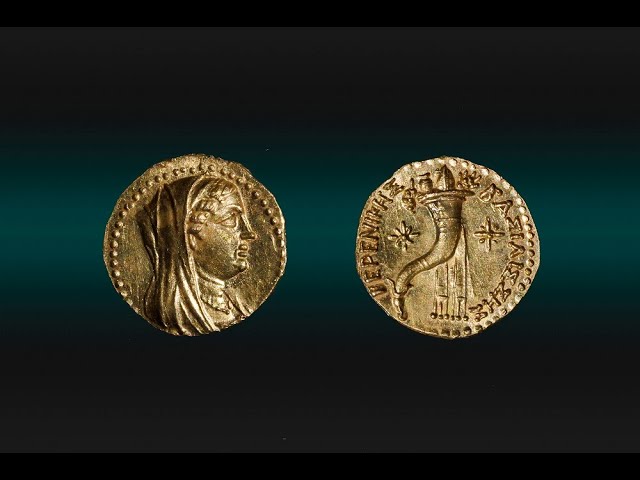
The obverse of the coin features the portrait of Queen Berenice II, her visage rendered with the regal elegance typical of Hellenistic art. Adorned with a crown and veil, a necklace resting around her neck, the queen is depicted not simply as consort to a king, but as a sovereign figure in her own right.
On the reverse, a cornucopia — symbol of prosperity and fertility — flanked by two stars, is accompanied by the rare Greek inscription “ΒΑΣΙΛΙΣΣΗΣ” (“Of Queen Berenice”). Scholars note that such inscriptions are uncommon for this period, particularly when applied to women. As VIN News reported, this coin represents “one of the earliest known instances of a Ptolemaic queen portrayed with titular authority during her lifetime.”
Dr. Robert Kool, Head of the Coin Department at the Israel Antiquities Authority, and Dr. Haim Gitler, Chief Curator of Archaeology at the Israel Museum, stressed the exceptional nature of this detail. “This is not simply a portrait of a royal spouse,” they explained. “The inscription and imagery position Berenice as a ruler in her own right, underscoring her unusual degree of independence and political clout in the Ptolemaic dynasty.”
This nuance is critical. While later queens such as Cleopatra VII would dominate historical memory, Berenice’s appearance on coinage centuries earlier indicates a precedent for female prominence within the dynastic iconography of Egypt.
The coin was discovered not in the act of excavation but during the sifting of soil removed from the site. Rebecca Langeler, an archaeologist working at the Givati dig, recounted her moment of astonishment.
“I was sifting through the soil when I suddenly saw something shiny,” Langeler recalled. “I picked it up and saw it was a gold coin. At first, I couldn’t believe what I was seeing, but within seconds I started running excitedly through the excavation. I’ve been digging in the City of David for two years, and this is the first time I’ve found gold!”
Her discovery, highlighted in the VIN News report as a “career-defining moment,” illustrates the serendipity that often underpins archaeological breakthroughs. One second of recognition turned an ordinary day of fieldwork into a contribution that may reshape scholarly understanding of Hellenistic Jerusalem.
Until now, much of the scholarly consensus held that Jerusalem in the centuries after the destruction of the First Temple in 586 BCE remained a marginal, impoverished city. Conventional narratives emphasized its decline under Persian rule and its slow, hesitant recovery.
Yet the discovery of the Berenice coin, in conjunction with other mid-3rd century BCE artifacts found at the same site, complicates this view. Excavation directors Dr. Yiftah Shalev of the Israel Antiquities Authority and Efrat Bocher of the Jerusalem Research Center argue that the evidence points to a Jerusalem not only surviving but actively reintegrating into broader Mediterranean political and economic networks.
“The discovery of such a rare gold coin in Jerusalem, dating to the time of Ptolemaic rule in the region, offers a fascinating glimpse into the city’s status during that period,” they explained. “This coin, together with a collection of other finds, suggests that Jerusalem was not desolate and disconnected, but rather a city in the process of recovery, once again tied to the centers of political, economic, and cultural power of the era.”
As the VIN News report put it succinctly: “Far from being an isolated outpost, Jerusalem was reemerging as a vital link in the chain of Hellenistic geopolitics.”
The context of the coin’s production further illuminates its significance. Scholars believe it was minted in Alexandria, the Ptolemaic capital, possibly as part of rewards distributed to soldiers following the Third Syrian War, one of the recurrent conflicts between the Ptolemaic and Seleucid empires.
If this hypothesis is correct, its appearance in Jerusalem could signal more than economic exchange — it may reflect the city’s integration into the logistical and political circuits of Ptolemaic rule. As the VIN News report noted, such artifacts are “not merely financial tokens but instruments of ideology, designed to project power, prosperity, and dynastic legitimacy into the provinces.”
By circulating coins with Berenice’s portrait and inscription, the Ptolemaic state was, in effect, extending her authority into territories under its sway. That one of these coins found its way into Jerusalem — and endured there until modern excavation — testifies to the city’s active participation in the networks of exchange that defined the Eastern Mediterranean.
For Jewish history, the discovery carries profound implications. The period of Ptolemaic rule in Judea has often been overshadowed in popular imagination by the subsequent Hasmonean revolt against Seleucid oppression. Yet the coin underscores that long before the Maccabees, Jerusalem was already enmeshed in the great dynastic rivalries of the Hellenistic age.
The find also sheds light on cultural interactions. The presence of a Greek-inscribed coin bearing the likeness of an Egyptian queen in Jerusalem speaks to the multicultural layers of influence operating in the city. As the VIN News report observed, “This is not simply an Egyptian artifact or a Greek artifact — it is a Jerusalem artifact, one that illustrates how the city absorbed, reflected, and recontextualized the forces shaping the wider Mediterranean.”
Israel’s Minister of Heritage, Amichai Eliyahu, highlighted the symbolic significance of the discovery in his remarks. “Jerusalem never ceases to surprise,” Eliyahu said. “The rare coin uncovered in the City of David, the first of its kind in the world ever found in a formal excavation, may be a small object, but it has a significant contribution to our understanding of the city. The excavations in the City of David continue to reveal entire chapters of Jerusalem’s history, both from the glorious days of the Kingdom of Judah and from the period after the First Temple’s destruction and the exile.”
As the VIN News report pointed out, Eliyahu framed the find not merely as academic but as national, reinforcing the link between modern Israel and its ancient capital. “After 2,000 years,” he declared, “we have returned to our capital, and we are privileged to uncover its rich past.”
The discovery also highlights the ongoing role of archaeology in shaping collective memory and identity. In a region where history and politics are deeply intertwined, each new find becomes more than an academic curiosity; it becomes a building block in the narrative of continuity and connection.
For Jewish communities in Israel and the diaspora alike, the Berenice coin demonstrates that Jerusalem has been continuously significant, not only during biblical periods but throughout the often-overlooked centuries between antiquity’s empires.
As the VIN News report emphasized, such discoveries “reaffirm Jerusalem’s enduring role as a crossroads of civilizations and as a city whose fate was bound to the great powers of every age.”
The coin will soon be displayed publicly for the first time, as part of the 26th Annual City of David Research Conference in early September. Archaeologists and numismatists worldwide are expected to converge on Jerusalem to study the artifact firsthand.
For the public, the exhibition will provide a rare opportunity to view an object that is both visually stunning and historically transformative. As Dr. Gitler remarked, “Only about 20 such coins are known worldwide, and this is the first of its kind ever discovered in a formal excavation — making it of exceptional research value.”
In the annals of Jerusalem’s archaeology, the gold quarter-drachma of Queen Berenice II will surely occupy a distinguished place. It is a fragment of gold that illuminates centuries, bridging the destruction of the First Temple, the struggles of recovery, and the entanglements of Hellenistic politics.
For scholars, it will provoke new questions about Jerusalem’s role in the Ptolemaic world. For the public, it offers a tangible connection to a queen whose name has been all but forgotten, and to a city whose resilience continues to astonish.
As VIN News concluded in its report: “Jerusalem’s soil keeps its secrets tightly — but when revealed, they remind us that this city was never marginal, never forgotten, but always at the heart of the ancient world.”
