



|
Getting your Trinity Audio player ready...
|
By: Fern Sidman
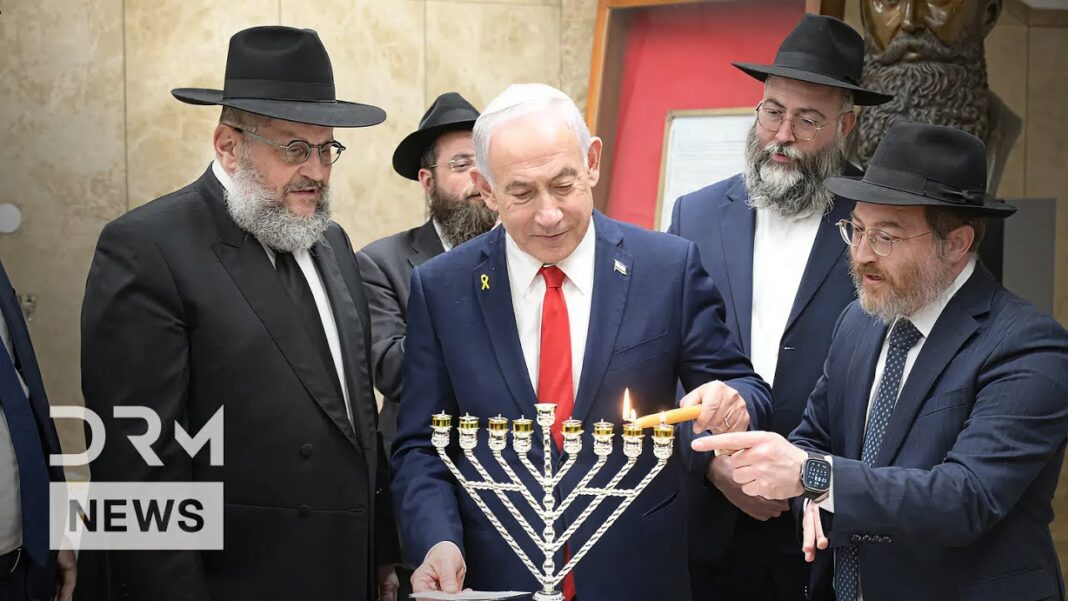
On a quiet Sunday evening in Jerusalem, as the final light of Hanukkah was kindled, Israeli Prime Minister Benjamin Netanyahu stood alongside Chabad-Lubavitch emissaries in the Prime Minister’s Office and delivered a message that resonated far beyond the walls of his official residence. The lighting of the eighth and final candle, traditionally a moment of culmination and quiet triumph, was transformed into a solemn yet defiant declaration of Jewish endurance in the face of violence, grief, and rising global antisemitism.
According to a report on Sunday at VIN News, the ceremony was deliberately imbued with added gravity. It took place exactly one week after one of the deadliest antisemitic attacks in recent history: the terrorist massacre at a Chabad-organized Hanukkah celebration at Bondi Beach in Sydney, Australia. On December 14, gunmen opened fire on the event known as “Chanukah by the Sea,” killing 15 people and wounding dozens more. Australian authorities swiftly classified the atrocity as an antisemitic terrorist attack, a determination that sent shockwaves through Jewish communities worldwide.
As reported by VIN News, Netanyahu used the intimate Hanukkah ceremony not only to mourn the victims but also to articulate a broader narrative—one that framed Jewish history as a continuum of light confronting darkness, and resilience triumphing over terror.
Hanukkah, the Festival of Lights, commemorates a small band of Jews who, against overwhelming odds, preserved their faith and reclaimed their spiritual sovereignty. Netanyahu explicitly invoked this historical parallel, underscoring that the tragedy in Sydney was not an isolated incident but part of a long and painful chronicle of antisemitic violence.
“The Chabad community and the entire people of Israel have endured a great tragedy in Sydney, where despicable murderers have murdered [the victims] for being Jews, and solely because they were Jews,” Netanyahu said, his voice measured yet resolute, according to the VIN News coverage of the event.
The prime minister’s words cut through diplomatic abstractions, naming the crime for what it was: an act of murder driven by hatred of Jews as Jews. In doing so, Netanyahu echoed a growing frustration within Jewish communities that antisemitic violence is too often contextualized, minimized, or euphemized.
Yet the ceremony was not one of despair. Standing beside Chabad rabbis—whose emissaries operate in thousands of cities across the globe—Netanyahu emphasized that Jewish spirit, once again, had not been extinguished.
“But we have not lost our spirit, nor will we lose it,” he continued. “We will continue being victorious.”
This language of victory was not martial bravado but rather an assertion of moral and spiritual survival—a theme Netanyahu has increasingly emphasized amid escalating threats to Jewish life worldwide.
A central element of Netanyahu’s remarks was his focus on the Chabad-Lubavitch movement itself. Over decades, Chabad has become synonymous with Jewish continuity, operating in environments that range from cosmopolitan capitals to remote outposts where Jewish life might otherwise fade.
Netanyahu recalled previous attacks on Chabad institutions around the world—tragic reminders that the movement’s visibility has often made it a target. Yet, he observed, such assaults have never succeeded in diminishing Chabad’s mission.
“It didn’t make us lose our spirit,” Netanyahu said. “On the contrary: I saw the empowerment and springing into action in order to bring the people of Israel closer together everywhere on Earth.”
In a brief moment of levity, reported by VIN News with characteristic attention to nuance, Netanyahu added: “I didn’t check if there are any in Antarctica, but I know they are working on that.”
The remark drew smiles, but its underlying message was serious. Chabad’s global network, Netanyahu suggested, represents not only religious outreach but a living rebuttal to those who seek to terrorize Jews into invisibility.
The Sydney massacre reverberated profoundly in Israel, a nation that sees itself as both a refuge and a responsibility for Jews everywhere. VIN News reported that Netanyahu’s decision to mark the anniversary so explicitly reflected a deliberate act of solidarity with the Australian Jewish community and with Diaspora Jewry more broadly.
In Israel’s political lexicon, expressions of shared grief often carry strategic significance. Netanyahu’s remarks linked the pain of Bondi Beach with Israel’s broader struggle against antisemitism, terrorism, and delegitimization. The message was clear: attacks on Jews abroad are not distant tragedies but part of a shared Jewish fate.
“From the bottom of our hearts,” Netanyahu said, “we also share in the grief, but also see the greatness and are more determined than ever to ensure the eternity of Israel.”
VIN News analysts noted that this framing situates Israel not merely as a nation-state but as a moral anchor for Jewish perseverance—a theme that resonates strongly with Chabad’s own philosophy.
The Bondi Beach attack has intensified scrutiny of rising antisemitism in Western democracies, a trend that VIN News has documented extensively over the past year. From violent assaults and vandalism to increasingly brazen rhetoric online and on university campuses, Jewish communities worldwide have reported an atmosphere of heightened fear and vulnerability.
Netanyahu’s Hanukkah remarks implicitly addressed this reality. By lighting the final candle alongside Chabad emissaries, he underscored that Jewish visibility—public menorahs, communal celebrations, open expressions of faith—will not be surrendered to intimidation.
“We are doing it here,” he said, referring to Israel, “Chabad emissaries are doing it around the world, and we will be victorious.”
According to the information provided in the VIN News report, this insistence on public Jewish life is itself an act of defiance. In the aftermath of the Sydney massacre, many Jewish leaders have grappled with the tension between security concerns and the imperative not to retreat from public spaces. Netanyahu’s message leaned decisively toward the latter.
Critics and supporters alike often note Netanyahu’s keen understanding of political symbolism. The Hanukkah candle-lighting, while modest in scale, carried a resonance that extended far beyond Jerusalem. VIN News reported that images and footage of the ceremony circulated widely on social media, particularly among Jewish communities still reeling from the Sydney attack.
By choosing Hanukkah—a holiday defined by perseverance against religious persecution—Netanyahu placed the present moment within a broader historical arc. The implication was unmistakable: Jews have endured far worse than gunmen on a beach, and they have emerged not only intact but renewed.
At the same time, Netanyahu’s words reflected a somber realism. The prime minister did not suggest that antisemitism is a relic of the past or that Jewish security can be taken for granted. Instead, his remarks acknowledged the cost of Jewish visibility while affirming its necessity.
VIN News emphasized that the presence of Chabad emissaries at the Prime Minister’s Office was not merely ceremonial. These rabbis and their families often serve on the front lines of Jewish communal life, especially in regions where antisemitism has surged. Their experiences lend credibility—and urgency—to Netanyahu’s message.
In cities such as Sydney, Paris, London, and New York, Chabad centers frequently become both sanctuaries and symbols. Attacks against them are therefore attacks against the idea that Jewish life can flourish openly anywhere in the world.
Netanyahu’s tribute to Chabad’s resilience thus functioned as a broader statement about Jewish responsibility: to mourn the dead, protect the living, and persist in the face of hatred.
As the eighth candle flickered, its light joining the cumulative glow of the menorah, Netanyahu concluded with words that VIN News described as both elegiac and resolute.
“We are victorious,” he said. “And we will continue being victorious.”
In the context of Hanukkah, victory is not measured in territorial conquest or political dominance, but in continuity—the refusal to allow terror to dictate identity or destiny. One week after the bloodshed at Bondi Beach, Netanyahu’s message sought to reclaim that definition.
For Jewish communities around the world, still grappling with grief and fear, the ceremony in Jerusalem offered more than condolences. It offered a reaffirmation that, even in the shadow of violence, the flame endures—and that its light, once kindled, cannot easily be extinguished.