



|
Getting your Trinity Audio player ready...
|
505 Days Underground, One Unbroken Prayer: Former Hamas Hostage’s Faith-Filled Testimony Stuns AmericaFest
By: Andrew Carlson
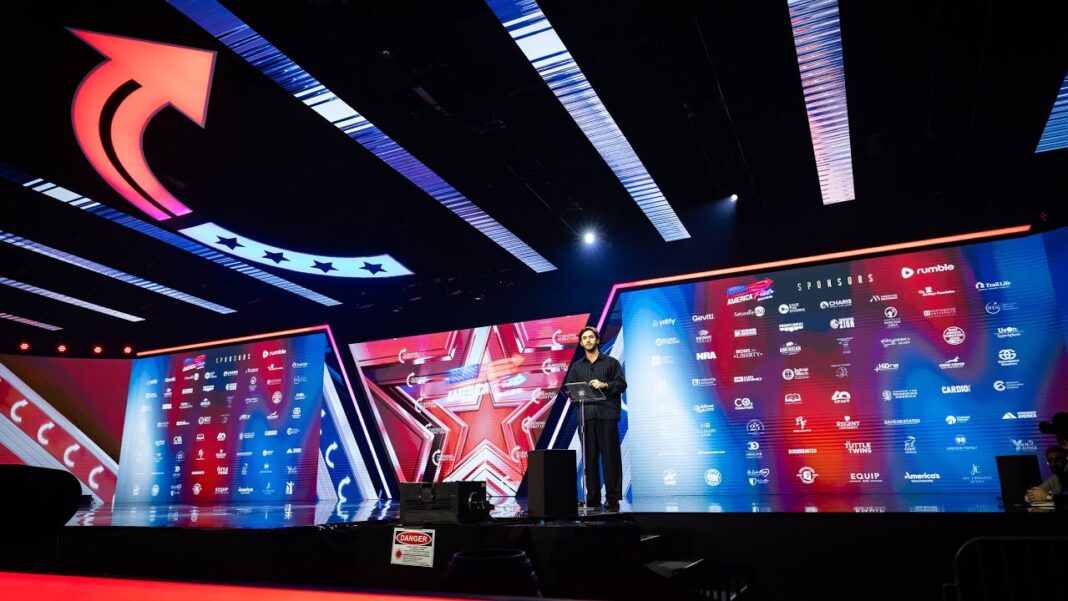
In a cavernous hall filled with thousands of activists, commentators, and political leaders, one voice on Friday night cut through the noise with a gravity that demanded silence. At Turning Point USA’s annual AmericaFest, Omer Shem Tov—an Israeli civilian who endured 505 days as a hostage in the underground dungeons of Gaza—delivered a speech that was at once harrowing and transcendent. As reported on Sunday by VIN News, Shem Tov’s testimony became one of the most emotionally arresting moments in the conference’s history, reframing a highly charged political gathering into a profound meditation on faith, endurance, and the human cost of terrorism.
Shem Tov was abducted during Hamas’ October 7 terrorist onslaught, an attack that shattered families, communities, and the fragile sense of security across Israel. What followed for Shem Tov was more than sixteen months of captivity beneath Gaza—months defined by darkness, deprivation, and the ever-present specter of death. Yet in his address to the AmericaFest audience, Shem Tov resisted the language of vengeance or political polemic. Instead, he spoke of prayer, spiritual intimacy, and an unbroken dialogue with God that sustained him when every other form of support was stripped away.
“I spoke to God every day,” Shem Tov told the hushed crowd, his voice steady but heavy with memory. VIN News reported that he described these daily prayers not as formal rituals, but as raw, continuous conversations—pleas, reflections, confessions, and moments of gratitude woven together in the suffocating stillness of captivity. In a place where time dissolved and hope often felt abstract, prayer became his lifeline, the one domain over which his captors had no control.
Shem Tov’s remarks offered a rare and deeply personal glimpse into the psychological terrain of hostage captivity. As the VIN News report detailed, he spoke candidly about the physical torment—scarcity of food, the oppressive confines of tunnels, the constant movement meant to evade detection. Yet it was the mental anguish, the isolation and uncertainty, that he described as most corrosive. Days blended into weeks, weeks into months, with no assurance that survival was anything more than a fleeting possibility.
In those moments, Shem Tov explained, faith was not an abstract concept but an active force. “When everything was taken from me, I still had my connection to God,” he said. That connection, he explained, gave structure to chaos. It imposed meaning on suffering and provided a sense of companionship in the loneliest imaginable conditions.
What struck many observers was Shem Tov’s refusal to frame his experience solely through the lens of hatred. While acknowledging the brutality of Hamas and the terror of captivity, he consciously avoided calls for revenge. Instead, he spoke about resilience—the capacity to preserve one’s inner world even when the external world collapses. Prayer, he said, allowed him not only to ask for survival, but to affirm his humanity when his captors sought to erase it.
This emphasis on meaning resonated powerfully within the AmericaFest audience, a gathering more accustomed to fiery rhetoric than spiritual reflection. VIN News reported that as Shem Tov spoke, the vast hall fell into an almost reverential silence. Attendees stood motionless, many visibly emotional, as he recounted moments when despair threatened to overwhelm him—and how faith intervened at those precise junctures.
Shem Tov’s appearance marked one of his most significant public engagements since his release, and VIN News emphasized the weight of that fact. For many former hostages, the transition back into public life is fraught with psychological challenges. That Shem Tov chose to address such a large audience, and to do so with such vulnerability, underscored his determination to bear witness—not only to his own suffering, but to the broader human toll of terrorism.
As he spoke, Shem Tov situated his personal story within a universal framework. Captivity, he suggested, strips individuals down to their essence. In those stripped-down moments, values either collapse or crystallize. For him, faith crystallized. “That’s what kept me alive,” he told the audience.
The response was immediate and overwhelming. According to the VIN News report, Shem Tov concluded his remarks to a prolonged standing ovation, the crowd chanting his name in a rare display of collective unity at a conference often marked by ideological divisions. For several minutes, applause drowned out the hall’s sound system, as attendees seemed to recognize that they had just witnessed something extraordinary—not a political speech, but a testimony of survival.
Beyond the emotional impact, Shem Tov’s address carried broader implications. The VIN News report noted that his story serves as a stark counterpoint to abstract discussions about terrorism, geopolitics, and conflict. In policy debates, the human dimension is often reduced to statistics and strategic assessments. Shem Tov restored that dimension, reminding listeners that behind every headline are individuals whose lives are irrevocably altered by violence.
His speech also placed a strong emphasis on the role of faith in contexts of extreme adversity. In an era when religious belief is often portrayed as peripheral or divisive, Shem Tov presented faith as a stabilizing force—a source of moral clarity and psychological endurance. The VIN News report emphasized that this aspect of his testimony resonated across ideological lines, touching believers and secular listeners alike.
For Turning Point USA, Shem Tov’s appearance represented a departure from the conference’s usual programming, and it may well be remembered as the defining moment of AmericaFest. In a gathering dominated by debates over policy, culture, and elections, his words shifted the focus to something more elemental: the capacity of the human spirit to endure unspeakable hardship without surrendering its core values.
As the conference continued into the weekend, the reverberations of Shem Tov’s speech lingered. Attendees referenced his testimony in conversations and social media posts, many echoing the themes of faith, resilience, and the moral imperative to remember the victims of terrorism not as symbols, but as human beings.
In the final analysis, Omer Shem Tov’s address was more than a recounting of suffering. It was an affirmation of life in the face of death, of meaning in the face of chaos. As the VIN News report aptly noted, his words served as a reminder that even in the deepest tunnels of Gaza, where light is absent and hope seems impossible, the human capacity for faith can illuminate the darkness.
Lovely writing here by Carlson. Much appreciated.