



|
Getting your Trinity Audio player ready...
|
WSJ Reporter Evan Gershkovich’s Final Act of Defiance Before Release in Historic Prisoner Swap
Edited by: Fern Sidman
In a remarkable display of courage and defiance, Wall Street Journal reporter Evan Gershkovich made a bold request for an interview with Russian President Vladimir Putin just days before his release from imprisonment in Russia. As was reported by The New York Post, this cheeky gesture came as part of a larger, covert deal that saw the release of three Americans, including Gershkovich, in a significant multi-country prisoner swap reminiscent of Cold War-era exchanges.
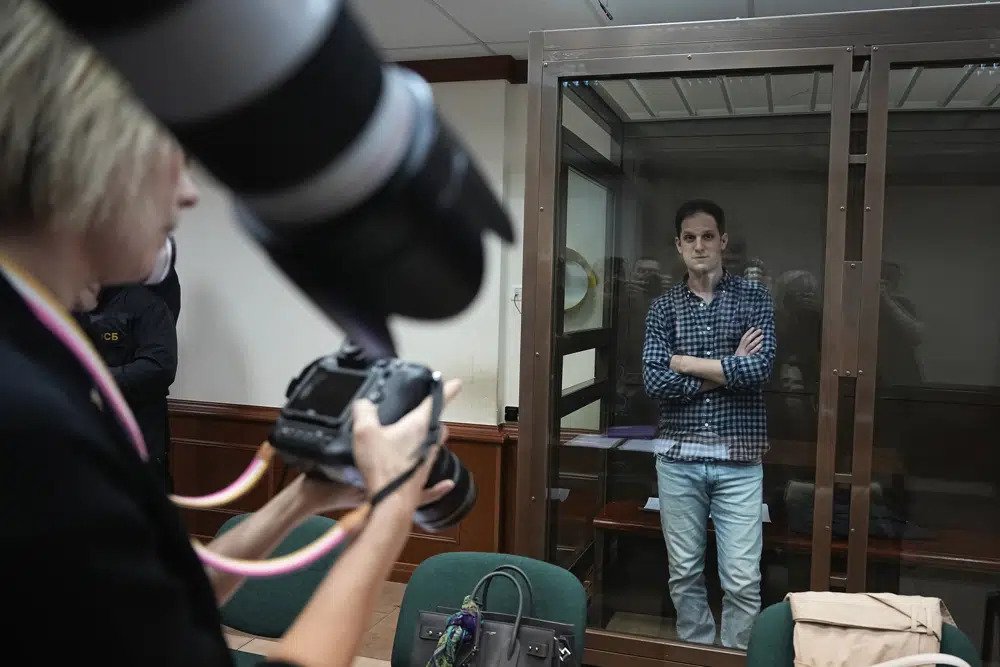
Evan Gershkovich, 32, was arrested last year on charges of espionage, a claim he and the U.S. government vehemently denied. The Post report noted that as a journalist for the Wall Street Journal, Gershkovich was known for his fearless reporting, and his arrest was widely condemned as a politically motivated act by the Kremlin to suppress Western media.
In the days leading up to his release, Gershkovich was provided with a form to request presidential clemency from Putin. Demonstrating his characteristic bravery and wit, Gershkovich used the final line of the form to request an interview with the Russian leader, a figure who notoriously avoids Western media scrutiny. Indicated in The Post report was that his daring move allowed Gershkovich to have the last laugh, subtly mocking the Kremlin’s tactics as he prepared to leave Russian custody.
Gershkovich’s release on Thursday was part of a high-stakes, top-secret negotiation that culminated in the largest prisoner exchange since the Cold War. The Post reported that the swap involved the release of 24 prisoners, including former U.S. Marine Paul Whelan and Russian-American journalist Alsu Kurmasheva.
Paul Whelan, 54, a former US Marine, had been detained in Russia since 2018 on espionage charges. He was in the country for a friend’s wedding when he was arrested and later sentenced to 16 years in prison in 2020. According to the information provided in The Post report, Whelan’s family revealed to the BBC that he had visited Russia multiple times and claimed to have had connections with a Federal Security Service (FSS) agent, the successor agency to the Soviet Union’s KGB.
Whelan asserted that he had visited the agent’s house the winter before his arrest, lending him over $1,140 for the upcoming wedding. However, The Post reported that the FSS alleged that the payment was intended for intelligence purposes, an accusation Whelan consistently denied.
Alongside Gershkovich and Whelan, Alsu Kurmasheva, a Russian-American journalist, was also freed. Kurmasheva’s detention had similarly raised international concerns about the Kremlin’s crackdown on journalists and its broader implications for press freedom.
The release of Gershkovich, Whelan, and Kurmasheva marks a significant diplomatic achievement and highlights the complex dynamics of international relations and human rights issues. The covert nature of the negotiations underscores the sensitivity and high stakes involved in securing the freedom of individuals accused of espionage and other serious charges.
The release of Gershkovich, Paul Whelan, and Alsu Kurmasheva in this historic prisoner swap was the culmination of a series of covert and high-stakes negotiations between global leaders. As per the information in The Post report, this intricate and delicate operation, which began in February, involved unprecedented levels of secrecy and diplomatic maneuvering, highlighting the complex nature of international diplomacy in the modern era.
The initial framework for the prisoner swap was set during discussions between President Biden and German Chancellor Olaf Scholz, the Post report said. Initially, the deal was to include Alexei Navalny, a prominent critic of Russian President Vladimir Putin. However, Navalny’s unexpected death shortly after these discussions commenced derailed the original plan, forcing the leaders to regroup and re-strategize.
The sensitive nature of the negotiations necessitated an extraordinary level of secrecy. To prevent any leaks that could jeopardize the fragile deal, insiders resorted to keeping the talks entirely analog. Drafts and critical documents were hand-delivered to U.S. and German officials, avoiding digital communications that could be intercepted, as was revealed in The Post report. The Wall Street Journal noted that a single leak could have blown the entire operation apart, underscoring the precariousness of the situation.
Despite being quarantined due to a COVID-19 infection and preparing to drop out of the 2024 elections, President Biden personally handled a critical call with Slovenian Prime Minister Robert Golob on July 21. The call focused on Slovenia’s contribution to the deal, specifically the inclusion of two convicted Russian spies. The Post report indicated that a Slovenian official described the intense pressure of the conversation, highlighting the urgency and importance of the matter. This call was pivotal in securing the necessary pardons and moving the deal forward.
Even in the final days leading up to the exchange, significant details remained unresolved. CIA Director William Burns flew to Ankara, Turkey, to meet with the country’s spy chief and finalize the logistics of the prisoner swap, The Post report said. This last-minute diplomatic effort was crucial in ensuring that all elements of the deal were in place.
The secrecy extended to the families of the prisoners. Gershkovich’s mother, Ella, was asked to remain silent when she first suspected her son’s potential release. This request came after the Kremlin expedited Gershkovich’s trial, resulting in a 16-year prison sentence in July, as was explained in The Post report. The tight-lipped approach ensured that the plans remained undisclosed until the final moments.
On the day of the exchange, 24 prisoners were freed in a coordinated effort involving multiple countries. The swap marked the largest of its kind since the Cold War and represented a significant diplomatic achievement, according to many published reports.
Gershkovich’s ordeal began when Kremlin agents arrested him at the Bukowski Grill steakhouse in Yekaterinburg. During his time in detention, he was held under harsh conditions, including 23-hour solitary confinement in a 9-foot-by-12-foot cell at Moscow’s notorious Lefortovo Prison, known for housing serial killers and political prisoners, according to the information contained in The Post report. Despite these conditions, Gershkovich remained resilient, using his confinement to read and write.
Determined to leave prison as a better writer, Gershkovich immersed himself in Russian literary classics such as Vasily Grossman’s “Life and Fate” and Leo Tolstoy’s “War and Peace.” His mother, concerned about the potential psychological impact of these heavy tomes, encouraged him to read lighter novels, as was noted in The Post report. Nonetheless, Gershkovich’s dedication to his craft saw him through the darkest days of his imprisonment.
While incarcerated, Gershkovich faced Chief Investigator Alexei Khizhnyak, notorious for his brutal interrogation tactics, including threats against fellow detainee Paul Whelan. Gershkovich, however, found a unique way to navigate these encounters. The report in The Post said that he discovered that Khizhnyak was a fan of Liverpool, a rival to his beloved Arsenal, and used this shared interest in football, along with his knowledge of Russian literature, to engage with his interrogator.
Upon his release, Gershkovich was allowed to bring with him personal letters from family and colleagues, as well as a book he had begun writing in prison. These items served as a testament to his enduring spirit and the support network that sustained him during his captivity. Indicated in The Post report was that the ability to write and receive letters provided a crucial lifeline, keeping him connected to the outside world.
Gershkovich, along with other freed prisoners, was transferred to U.S. custody in Ankara, Turkey. The final transfer marked the end of a harrowing chapter and the beginning of a new one. The Post reported that The Wall Street Journal’s CEO, Robert Thomson, expressed immense relief and gratitude, stating, “We are grateful to share the sublime news that our colleague Evan Gershkovich has finally been released after almost 500 days in a Russian prison.”
Gershkovich’s release also saw the liberation of Alsu Kurmasheva, a Radio Free Europe/Radio Liberty journalist and dual U.S.-Russian citizen, who had been convicted of spreading false information about the Russian military, according to The Post report. Her employer and family have consistently denied the allegations. The release of these journalists highlights the ongoing global struggle for press freedom and the risks faced by those who endeavor to report the truth.
Evan Gershkovich’s story is one of resilience, defiance, and the enduring power of journalism. His ability to maintain his integrity and spirit under the harshest conditions is a testament to his character. The intricate negotiations that led to his release underscore the complexities of international diplomacy and the unwavering commitment of those who fight for the freedom of the press. As Gershkovich returns home, his journey serves as a powerful reminder of the sacrifices made in the pursuit of truth and the collective effort required to uphold human rights and freedom of expression.
