



|
Getting your Trinity Audio player ready...
|
By: Fern Sidman
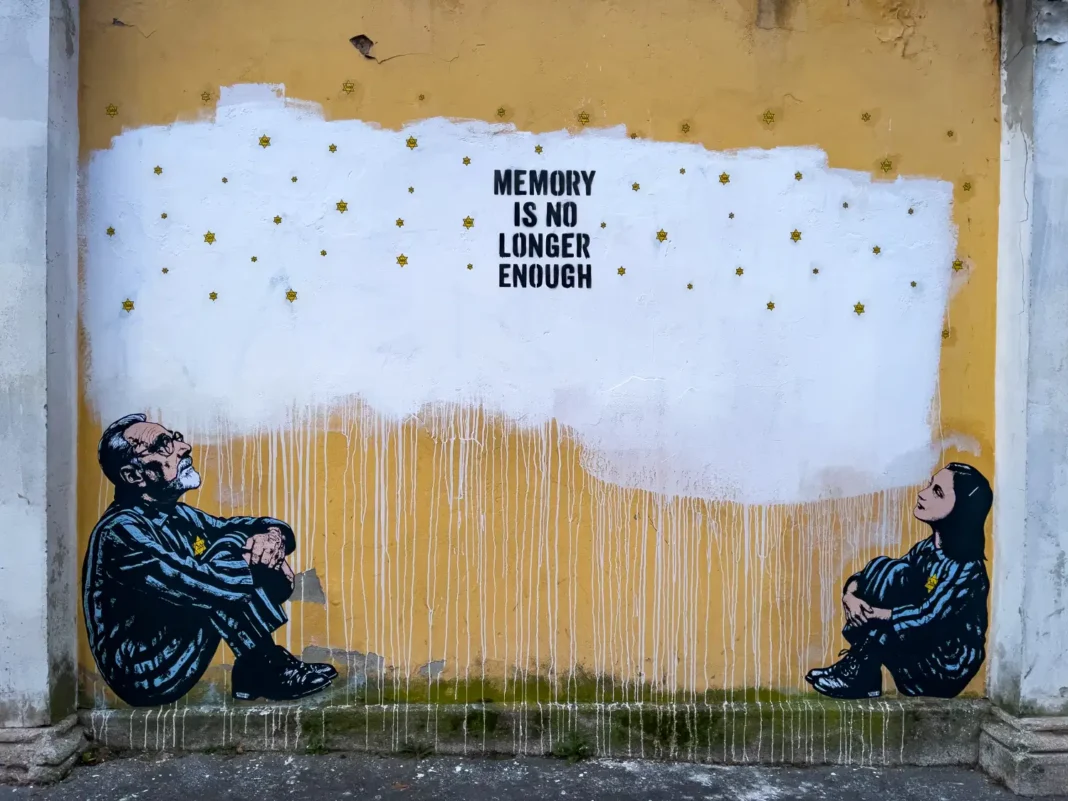
Only days after its unveiling on a wall heavy with historical resonance, a mural in Milan intended as a solemn meditation on Holocaust memory was violated in an act that reverberates far beyond chipped paint and scarred plaster. The artwork, titled Memory Is No Longer Enough, was created by contemporary artist aleXsandro Palombo to mark Holocaust Remembrance Day. Its vandalism, swift and targeted, has reopened an old and unsettling question: how secure is memory in an era where hatred not only survives but actively seeks to erase testimony itself?
The mural stands on the outer wall of the Montello Barracks in Milan, a site already inscribed with layers of meaning. In Palombo’s composition, Primo Levi and Anne Frank sit side by side on the ground, depicted in the striped uniforms of Auschwitz deportees. Their postures are quiet, almost resigned, yet not without dignity. Their gazes are lifted upward, fixed on a sky rendered not in blue but in yellow stars—an unsettling transfiguration of the badges Jews were forced to sew onto their clothing under Nazi rule. In the artist’s vision, those stars no longer function as instruments of humiliation. Instead, they form a firmament of memory, a silent constellation evoking the six million Jewish victims of the Nazi genocide.
It was Levi’s face that was defaced.
The damage was not random. The vandalism struck directly at the visage of one of the most lucid and morally uncompromising witnesses of the Shoah. Primo Levi, chemist, writer, survivor of Auschwitz, devoted his postwar life to articulating the mechanisms of dehumanization and the ethical collapse that made genocide possible. To attack his image is not merely to vandalize a work of art; it is to symbolically assault the authority of testimony itself and the civic responsibility it imposes on those who inherit it.
The act gains even darker resonance when placed in its immediate context. The wall on which Memory Is No Longer Enough was painted is not a neutral surface. In 2025, it had already been the site of a disturbing episode: portraits of Holocaust survivors Liliana Segre, Sami Modiano, and Edith Bruck were defaced. Swastikas were scrawled across the images. Stars of David were erased. A large inscription reading “Israelis Nazis” was sprayed across the wall, collapsing historical reality into a grotesque inversion. That earlier vandalism was not an isolated provocation but part of a broader pattern of contemporary antisemitic expression that weaponizes memory itself, twisting it into accusation and denial.
Palombo’s response at the time was neither silence nor retreat. Instead, he returned to the site. He cleaned the wall, removed the anti-Jewish insults, and transformed the scarred surface into a new act of public denunciation. The portrait of Primo Levi was not placed there by accident. It was a deliberate gesture, a confrontation with the logic of erasure. Where others sought to obscure, Palombo chose to illuminate. Where hate attempted to desecrate, he responded by reaffirming the primacy of testimony.
That gesture, however, has now itself been violated.
The title of the mural—Memory Is No Longer Enough—reads today with grim prescience. The work suggests that remembrance, when reduced to ritual alone, may be insufficient to withstand active hostility. Memory must be defended, renewed, and protected, not only in museums and ceremonies but in the contested terrain of public space. The defacement of Levi’s face dramatizes this fragility with unsettling clarity.
Palombo’s work occupies a distinctive place in contemporary memorial art. Elusive and reserved in his personal life, he is internationally recognized for a body of work that blends pop aesthetics with moral urgency. His interventions draw from the visual language of mass culture while engaging subjects of profound ethical gravity: inequality, exclusion, human rights, and historical responsibility. His approach is often reflective, sometimes irreverent, but never detached. Public space, in his practice, is not a backdrop but a battleground of meaning.
In recent years, Palombo’s Holocaust-related works have been formally incorporated into Italy’s institutional memory. In 2025, the Shoah Museum of Rome acquired several of his pieces dedicated to survivors Liliana Segre, Sami Modiano, and Edith Bruck for its permanent art collection. These works are displayed in front of the Portico d’Ottavia, a location laden with historical significance, and are integrated into the museum’s public memory itinerary. Their presence there affirms that contemporary art can serve not only as commemoration but as moral intervention, insisting on the relevance of witness in the present tense.
Yet the vandalism in Milan demonstrates that institutional recognition does not shield memory from attack. On the contrary, it may provoke it. The public nature of Palombo’s work—its refusal to retreat into protected cultural enclosures—makes it both powerful and vulnerable. By placing Holocaust witnesses in the open cityscape, he forces passersby into an encounter with history that cannot be curated away. The defacement, in this sense, is an acknowledgment of that power, however perverse its motivation.
The choice to vandalize Levi’s face carries particular symbolic weight. Levi’s writings are marked by clarity, restraint, and an almost surgical precision in dismantling the myths that surround evil. He rejected simplifications and resisted the temptation of moral grandstanding. For Levi, memory was inseparable from understanding, and understanding demanded rigor. To deface his image is to reject that rigor in favor of obliteration.
What, then, does this act reveal about the current moment?
First, it underscores that antisemitism has not receded into the past but has adapted, often disguising itself in the language of political provocation or historical inversion. The earlier graffiti accusing “Israelis” of Nazism was not merely offensive rhetoric; it was an attempt to collapse victim and perpetrator, thereby emptying history of moral clarity. The defacement of Levi’s portrait continues that trajectory, aiming not to argue but to erase.
Second, it highlights the precarious position of Holocaust memory as lived experience recedes. As survivors age and their voices fall silent, testimony increasingly relies on texts, images, and artistic mediation. These forms are powerful, but they are also vulnerable to attack. The mural’s vandalism is a reminder that remembrance is not self-sustaining. It requires active guardianship—by institutions, artists, educators, and citizens alike.
Finally, the episode raises urgent questions about public responsibility. Palombo’s work transforms urban walls into sites of collective awareness, insisting that memory belongs not only to the past but to the civic present. When such sites are attacked, the response cannot be limited to restoration alone. Cleaning a wall, repainting a face, while necessary, does not address the underlying hostility that motivates the act. That hostility thrives in silence, ambiguity, and indifference.
The defaced mural in Milan stands as a stark metaphor. Memory, even when inscribed in concrete and pigment, can be violated. Testimony, even when rendered iconic, can be attacked. And yet, the very act of vandalism inadvertently confirms the enduring power of what it seeks to destroy. Levi’s words, Anne Frank’s diary, the stories of Segre, Modiano, and Bruck—all persist precisely because they speak to truths that cannot be fully erased.
Palombo’s art confronts society with a choice: to look away, or to engage; to allow memory to fade into abstraction, or to defend it as a living moral obligation. The mural’s title does not suggest resignation. It is a warning. Memory alone is no longer enough—but memory, defended and acted upon, may still be.
In the coming days, the wall at Montello Barracks will likely be restored again. Levi’s face will be repainted. The stars will once more gaze down from the yellow sky. But the deeper work—the work of ensuring that remembrance is not merely symbolic but resilient—remains unfinished. The vandalism is not the final word. It is a challenge, posed in the ugliest of forms, demanding an answer not only from artists and institutions, but from society itself.
