



|
Getting your Trinity Audio player ready...
|
By: Fern Sidman
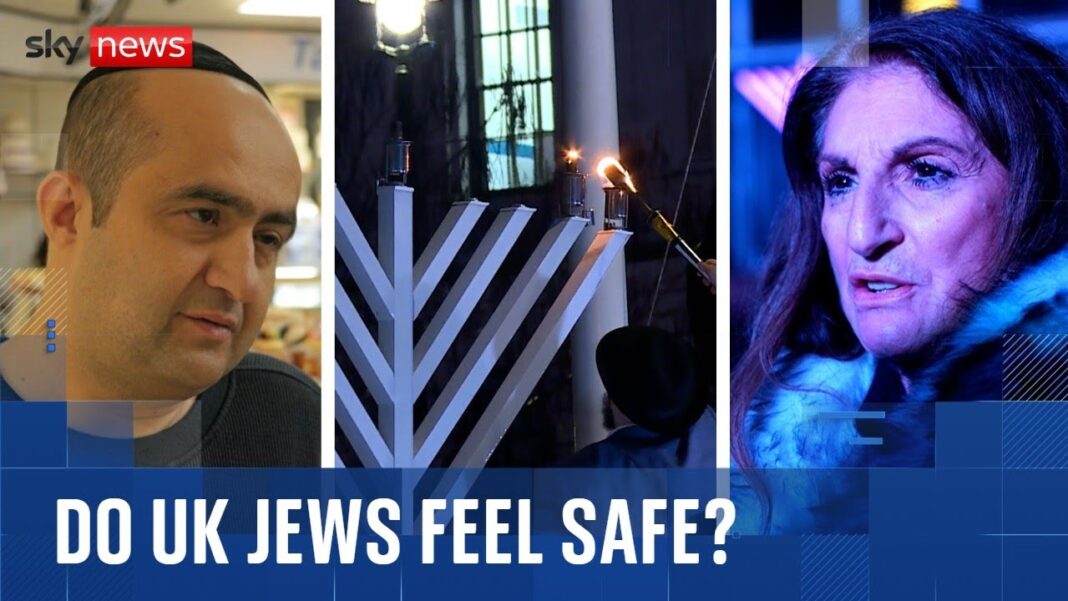
British law enforcement officials are confronting a grim and unprecedented reality: Jewish children, some barely old enough to grasp the full meaning of fear, are now calling police stations to ask whether armed officers can protect them while they attend Hanukkah celebrations. The disturbing revelation, first reported on Friday in The Algemeiner, shines a spotlight on the depth of anxiety permeating the United Kingdom’s Jewish community amid a relentless surge in antisemitic incidents and terror-linked violence.
Speaking at a forum hosted by the influential Policy Exchange think tank in London, Sir Stephen Watson, Chief Constable of Greater Manchester Police, delivered remarks that stunned both policymakers and security experts. According to Watson, calls have been coming in “day in and day out” from Jewish families—and, most heartbreakingly, from children themselves—seeking reassurance that they can safely participate in religious and cultural life. Watson described a scenario in which groups of 10-year-old girls asked whether armed police could be present at a Hanukkah party, a request that he said should shock the conscience of any civilized society.
“These are children who should be worrying about balloons and bicycles,” Watson said, in comments highlighted in The Algemeiner report. “Instead, they are asking whether armed officers will be there to keep them alive.” His words crystallized a chilling truth: for many Jewish families in Britain, the ordinary rhythms of communal life now unfold under the shadow of fear.
Watson’s remarks went beyond isolated anecdotes. He painted a broader portrait of what he described as a deeply abnormal reality that has become tragically routine. Jewish children, he noted, are the only children in Britain who routinely attend schools surrounded by high fences, guarded by armed personnel, and subject to constant police patrols. Watson characterized this state of affairs as an unacceptable normalization of intolerance.
“The intolerable has become normalized and is now almost accepted as the way things are,” he said. For Britain’s Jewish communities, security measures that were once extraordinary responses to specific threats have become permanent fixtures of daily life.
This sense of vulnerability has been exacerbated by a series of traumatic events abroad and at home. The deadly attack on a Hanukkah celebration at Bondi Beach in Sydney—where 15 people were murdered and dozens more wounded—reverberated powerfully across Jewish communities worldwide. According to the information provided in The Algemeiner report, British police have been investigating reports that some individuals in the UK openly celebrated the massacre, a reaction Watson described as “sickeningly distasteful” and emblematic of a broader moral decay.
The intensification of fear did not emerge in a vacuum. As Watson explained, the Hamas-led invasion of southern Israel on October 7, 2023, marked a profound inflection point. In the weeks and months that followed, antisemitic incidents surged across Europe, including the UK, transforming what had once been perceived as abstract or distant threats into immediate and visceral dangers.
“October 7 marked a dramatic increase in the threat facing our Jewish communities,” Watson said, according to The Algemeiner report. “The level of fear escalated, and it suddenly became clear that this was no longer an abstract issue.”
That realization was brutally reinforced earlier this year when a terrorist attack on Yom Kippur in Manchester claimed the lives of two Jewish men. Despite extensive security arrangements, the attackers succeeded, prompting serious questions about whether even heightened protective measures are sufficient in the face of evolving threats. Watson acknowledged that security, while necessary, has proven tragically imperfect.
“Security went from being a necessary measure to something that, despite its presence, was unable to protect people on Yom Kippur from being attacked and murdered,” he said.
According to Watson, the trajectory since then has been deeply troubling. The number of threats has increased, their nature has grown more sophisticated, and the effectiveness of attacks has risen. Fear within Jewish communities has become both more widespread and more concrete, driven by tangible incidents rather than hypothetical risks.
“We are now in a situation where the dynamics have continued to shift, but not for the better,” Watson warned, as reported by The Algemeiner. “Everything has worsened.”
These developments have compelled British authorities to recalibrate their approach to antisemitic incitement and public order. In a significant policy shift, police in London and Manchester announced this week that chanting slogans such as “globalize the intifada” would now result in arrest. The slogan, popular among some anti-Israel demonstrators, has been widely condemned by Jewish organizations as a call to violence against Jews and Israelis.
The joint statement from the Metropolitan Police and Greater Manchester Police marked a notable hardening of stance. “Violent acts have taken place, the context has changed, words have meaning and consequence,” the statement read. “We will act decisively and make arrests.”
The announcement was not merely rhetorical. Shortly after the policy was unveiled, police arrested two individuals in central London for racially aggravated public order offenses after they allegedly shouted slogans calling for intifada during an anti-Israel demonstration. A third person was detained for obstructing the arrests. These swift actions, reported by The Algemeiner, signaled a new willingness by authorities to confront rhetoric that crosses the line from political expression into incitement.
At the same time, Watson was careful to delineate the legal boundaries governing protest speech. He noted that slogans such as “From the river to the sea, Palestine will be free” are not categorically illegal, though their permissibility depends heavily on context. Shouting the phrase outside a synagogue, for example, would likely constitute a criminal offense. Similarly, while waving a Palestinian flag is lawful in most circumstances, doing so in a manner perceived as intimidating—such as outside a place of Jewish worship—could result in arrest.
These distinctions reflect the complex balancing act facing law enforcement: protecting freedom of expression while safeguarding vulnerable communities from targeted harassment and threats.
For many Jewish leaders, the fact that such measures are now necessary represents a profound failure of social cohesion. The image of children requesting armed protection to celebrate a religious holiday has become a potent symbol of that failure. As The Algemeiner has reported, Jewish organizations across the UK are calling not only for enhanced security, but for a broader societal reckoning with the roots of antisemitism.
The Bondi Beach massacre, the Manchester Yom Kippur attack, and the global reverberations of October 7 have together created a climate in which Jewish life is increasingly perceived as precarious. That perception, Watson suggested, is not unfounded. The threat is real, the fear is justified, and the consequences of inaction are severe.
Yet amid the bleakness, there are signs of resolve. British authorities have pledged to intensify efforts to combat antisemitic incitement, prosecute offenders, and adapt security strategies to a rapidly changing threat environment. As The Algemeiner report noted, these steps represent an acknowledgment—long overdue, critics argue—that antisemitism is not merely a problem of offensive speech, but a precursor to violence.
Ultimately, the most haunting aspect of Watson’s testimony is not the statistics or the policy shifts, but the moral indictment implicit in his words. A society in which children must ask for armed protection to celebrate Hanukkah, he suggested, is a society that has failed to uphold its most basic promises of safety and equality.
As Britain braces for further challenges, the experiences of its Jewish communities have become a litmus test for the nation’s commitment to pluralism and the rule of law. Whether the current surge in enforcement and rhetoric will translate into lasting security remains uncertain. What is clear is that the stakes could scarcely be higher.
For now, Jewish families across the UK light their Hanukkah candles under police guard, hoping that the glow of tradition will outshine the darkness of fear—and that the calls from children asking for armed protection will one day become unthinkable relics of a troubled era.