



|
Getting your Trinity Audio player ready...
|
By: Fern Sidman
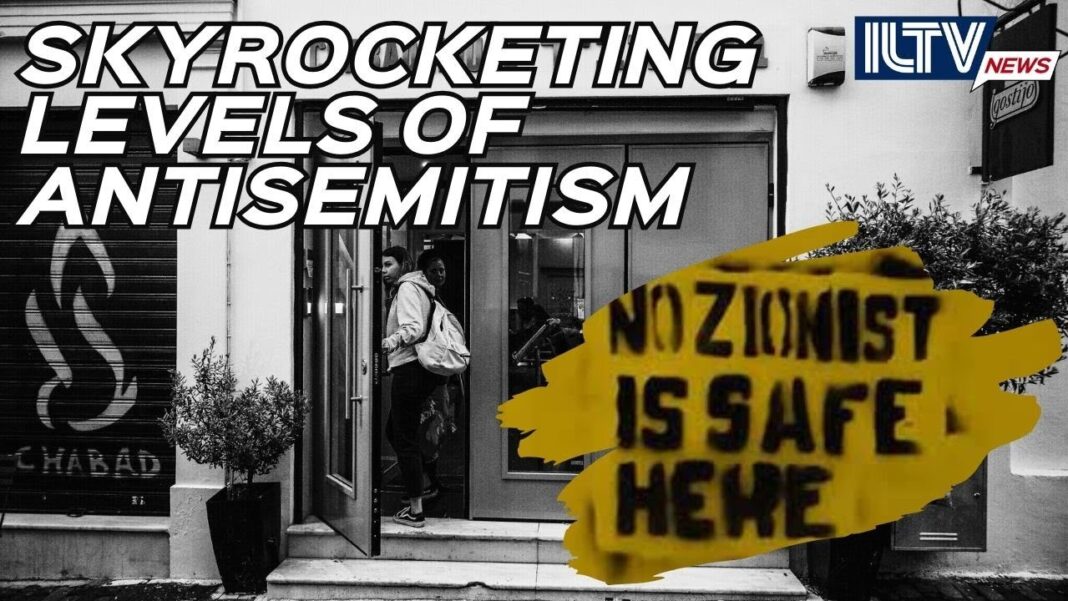
Jewish communities across the world were left shaken this week following a disturbing series of antisemitic incidents that underscored what experts describe as a dangerous and accelerating trend. The Combat Antisemitism Movement (CAM), through its Antisemitism Research Center (ARC), issued stark warnings as it tracked a dramatic surge in violence, vandalism, and intimidation directed at Jews and Jewish institutions on multiple continents.
In France, police in the affluent Paris suburb of Neuilly-sur-Seine arrested a knife-wielding man after he harassed and pursued worshippers near a synagogue. According to CAM’s ARC, the incident was one of several in Europe this week that highlighted the growing vulnerability of synagogues, once considered sanctuaries of safety and community.\
In the United States, Jewish leaders were similarly rattled when police in Houston detained a man who attempted to enter a synagogue after sending the institution some 30 threatening emails. The Combat Antisemitism Movement noted that this incident fit a troubling pattern seen across North America in recent months, where digital harassment often escalates into physical attempts to intimidate or attack Jewish spaces.
South America was not spared either. In Colombia, vandals defaced the Sociedad Hebrea de Socorros synagogue, equating the Star of David with a swastika in grotesque graffiti. CAM described the act as “a brazen effort to invert history and equate Jewish identity itself with Nazism — a tactic as dangerous as it is hateful.”
The Combat Antisemitism Movement’s ARC also catalogued a string of additional assaults and desecrations. In Ottawa, an elderly Jewish woman was stabbed while shopping at a grocery store, sending shockwaves through Canada’s Jewish community. In Los Angeles, an Israeli man was attacked at Santa Monica Pier in what witnesses described as a targeted assault.
In Europe, antisemitic violence took another chilling turn when Israeli singer David D’Or was splashed with red paint during a concert in Warsaw, with assailants shouting “Free Palestine.” In Lyon, France, a Holocaust memorial was defaced with “Free Gaza” graffiti, once again conflating legitimate political grievances with direct attacks on Jewish memory and identity.
According to CAM’s ARC, 22.9% of antisemitic incidents recorded this week were violent assaults or acts of vandalism — up significantly from 18.7% the previous week. The organization stressed that the rising trajectory indicates not isolated episodes but an escalating trend demanding urgent international attention.
As these attacks reverberated globally, CAM marked a milestone in Australia, where antisemitism has surged to unprecedented levels in recent years. In response, more than 250 local leaders, representing nearly 100 municipal councils, convened on the Gold Coast for the first-ever Australian Mayors Summit Against Antisemitism, organized by the Combat Antisemitism Movement and chaired by Gold Coast Mayor Tom Tate.
The summit, described by CAM as “historic,” sought to galvanize local government officials to confront antisemitism not only as a Jewish problem but as a threat to the democratic and multicultural fabric of Australian society.
“Mayors are on the frontlines of community life,” a CAM spokesperson explained. “By mobilizing them, we can ensure that antisemitism is addressed in schools, in workplaces, and in public spaces where its normalization is most dangerous.”
The summit emphasized practical measures, from strengthening hate-crime reporting mechanisms to increasing Holocaust education. Local leaders also committed to adopting the International Holocaust Remembrance Alliance (IHRA) working definition of antisemitism, a move CAM has championed globally.
In addition to monitoring violence and convening policymakers, the Combat Antisemitism Movement has invested in cultural advocacy to reshape narratives. This week, U.S. social media influencer Montana Tucker joined a CAM-organized delegation to Israel.
Tucker, known for her viral videos addressing antisemitism and Holocaust education, visited a Gaza Humanitarian Foundation (GHF) aid distribution center in Rafah. According to CAM, the visit was designed to spotlight Hamas’s role in manipulating aid and perpetuating suffering, countering the narrative that places sole blame on Israel.
A video documenting Tucker’s experience is expected to be released soon, with CAM confident it will reach millions of viewers and expose how Hamas’s exploitation of civilians fuels humanitarian crises.
The sheer diversity of this week’s antisemitic incidents — from knife attacks in France to synagogue harassment in Texas, graffiti in Colombia, and violent assaults in Canada and Poland — underscores the global scope of the challenge. As the Combat Antisemitism Movement consistently warns, antisemitism today knows no borders, adapting itself to local political contexts but retaining its core animus against Jewish life and identity.
CAM officials emphasized that governments, civic leaders, and cultural influencers must adopt a coordinated response. “The increase in violent incidents tracked by our Antisemitism Research Center this week is not just a statistical blip,” CAM stated. “It is a flashing red signal that requires immediate action from law enforcement, educators, political leaders, and civil society.”
The Combat Antisemitism Movement has pledged to continue expanding its monitoring efforts, providing real-time data to policymakers and media outlets. It is also intensifying its partnerships with local governments, as seen in Australia, and leveraging digital platforms through figures like Montana Tucker to reach younger audiences.
Yet, as CAM leaders stress, awareness must translate into action. Synagogues worldwide remain on high alert, Jewish communities are increasingly anxious, and the sense of safety that should accompany religious and cultural life feels fragile.
The organization’s message this week was unambiguous: “From Paris to Houston, Bogotá to Warsaw, Lyon to Ottawa, Jews are being targeted not for what they do, but for who they are. Antisemitism is the oldest hatred, but it demands our newest and strongest responses. Silence and complacency are not options.”
