



|
Getting your Trinity Audio player ready...
|
By: Fern Sidman
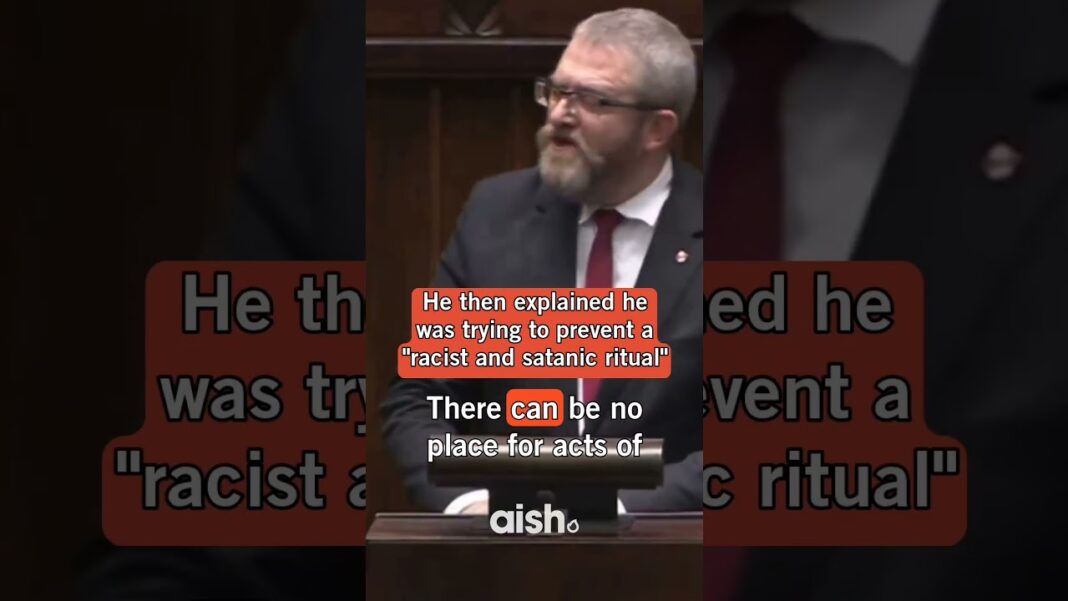
Two Jewish heritage sites in Dukla, Poland, were vandalized over the weekend in what Jewish leaders have described as a deeply troubling escalation of antisemitic acts. The attacks came just days after controversial Polish Member of the European Parliament (MEP) Grzegorz Braun publicly denied the existence of gas chambers at the former Auschwitz-Birkenau concentration camp and repeated an age-old antisemitic blood libel during a live radio interview.
As The Algemeiner reported on Tuesday, the defacement targeted both the ruins of a historic synagogue destroyed by the Nazis during the Holocaust and a memorial dedicated to local Holocaust victims. Vandals spray-painted the obscene phrase “F–k” alongside a Star of David on the synagogue ruins, while a swastika and the word “Palestine” were scrawled across the entrance memorial of the Jewish cemetery. Both sites are maintained by the Foundation for the Preservation of Jewish Heritage in Poland (FODZ), an organization founded in 2002 by the Union of Jewish Communities in Poland and the World Jewish Restitution Organization (WJRO) with a mission to safeguard Poland’s Jewish heritage.
In a statement highlighted in The Algemeiner report, WJRO President Gideon Taylor condemned the attacks as more than mere vandalism. “These hateful acts are not only antisemitic, but they are also attempts to erase Jewish history and desecrate memory,” Taylor said, calling on Polish authorities to swiftly identify and prosecute those responsible.
The attacks in Dukla call attention to a broader concern over rising antisemitism in Poland, particularly in light of inflammatory statements from political figures such as MEP Braun. Speaking to The Algemeiner, Jack Simony, director general of the Auschwitz Jewish Center Foundation (AJCF), stressed that the vandalism must be understood in context. “While we cannot say definitively that it [the vandalism] was sparked by Grzegorz Braun’s Holocaust denial, his rhetoric contributes to an atmosphere where hatred is emboldened and truth is under assault,” Simony stated. He warned that Holocaust denial is not a harmless provocation but a dangerous incitement that often leads to acts of violence and bigotry.
On July 10, an official ceremony marked the 84th anniversary of the Jedwabne massacre—a 1941 atrocity in which hundreds of Polish Jews were brutally murdered, largely by their non-Jewish neighbors, during the Nazi occupation. According to the information provided in The Algemeiner report, the event was attended by Polish dignitaries, Chief Rabbi Michael Schudrich, and Israeli Deputy Ambassador Bosmat Baruch. However, the commemoration was marred by attempts from far-right and anti-Israel activists—including Braun and his supporters—to disrupt proceedings with antisemitic banners and blockades aimed at participants.
That same day, Braun escalated tensions further during a live radio broadcast. Braun denied the historical reality of the gas chambers at Auschwitz, labeled the Auschwitz-Birkenau Memorial and Museum a promoter of “pseudo-history,” and shockingly claimed that Jewish ritual murder was a factual occurrence—recycling a libelous trope that has fueled centuries of persecution, The Algemeiner report said.
Polish prosecutors announced an investigation into Braun’s statements, citing Article 55 of the Act on the Institute of National Remembrance (IPN), which makes Holocaust denial a criminal offense in Poland. The Auschwitz-Birkenau Memorial and Museum promptly condemned Braun’s comments and vowed to pursue legal action. Other prominent voices—including the Institute of National Remembrance, the Embassy of Israel in Poland, Polish Foreign Minister Radosław Sikorski, and the U.S. Embassy in Warsaw—joined in denouncing the remarks. The U.S. Embassy stated that Braun’s rhetoric “distorts history, desecrates memory, or spreads antisemitism.”
The Auschwitz Jewish Center Foundation, also cited in The Algemeiner report, called on the European Parliament to consider disciplinary action against Braun, including possible censure or expulsion. AJCF Director Tomek Kuncewicz characterized Braun’s comments as “an act of violence against truth, against survivors, and against the legacy of our shared humanity.” Simon Bergson, AJCF Chairman, called Braun’s remarks “blatant and baseless lies,” while Jack Simony labeled them “a calculated act of antisemitic incitement that must be met with legal consequences and universal moral condemnation.”
The desecration of Jewish sites in Dukla is viewed by many Jewish organizations as part of a broader pattern of hostility fueled by extremist rhetoric. The connection between Holocaust denial, antisemitic incitement, and acts of vandalism has raised alarm among advocates who warn that failing to confront these issues emboldens perpetrators.
Jewish leaders across Europe and beyond have called for a robust response from both Polish authorities and international institutions to ensure that such acts do not go unpunished, as was noted in The Algemeiner report. WJRO’s Gideon Taylor reiterated that memory and history must be safeguarded, not only as a tribute to the victims of the Holocaust but as a necessary defense against the resurgence of hate and historical revisionism.
The gravity of the situation was perhaps best summarized by AJCF’s Jack Simony, who told The Algemeiner that Holocaust education is critical in preventing the spread of denial and hatred. “When we fail to confront lies, we invite their consequences,” Simony said. “Memory must be defended—not only for the sake of the past, but for the safety of our future.”
As of this writing, Polish authorities have not announced any arrests related to the Dukla vandalism, but the incident continues to draw widespread condemnation and renewed calls for vigilance in protecting Jewish heritage and confronting antisemitism in all its forms.
