



|
Getting your Trinity Audio player ready...
|
By: Tzirel Rosenblatt
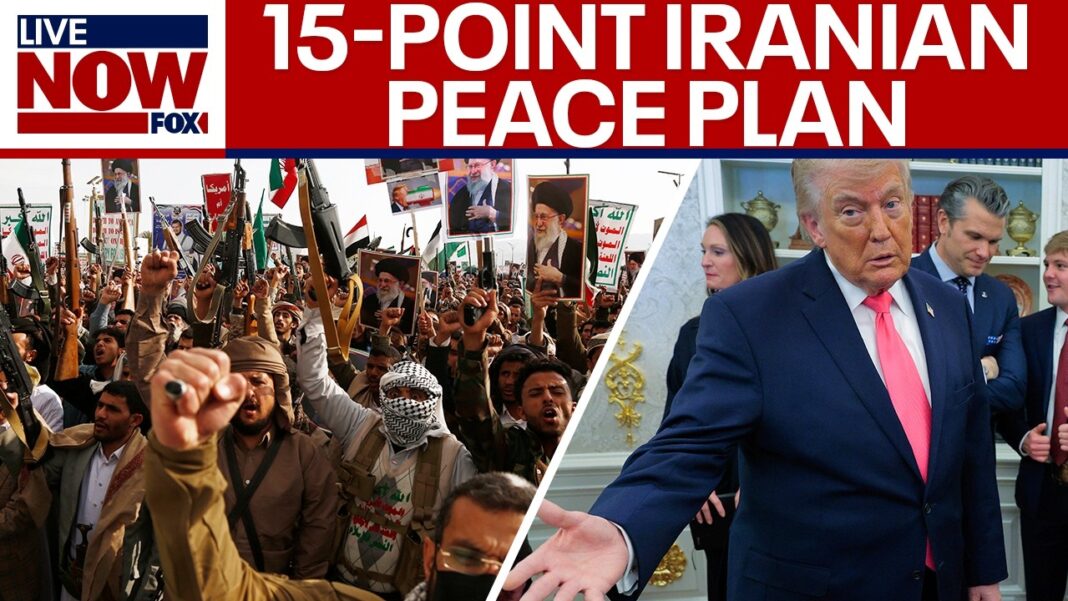
As the war in the Middle East enters its fourth volatile week, a quiet yet consequential diplomatic initiative has emerged from Washington—one that may determine whether the conflict escalates further or begins a tenuous path toward resolution. According to a report on Tuesday by The New York Times, the United States has transmitted a comprehensive 15-point proposal to Iran, outlining potential terms to end hostilities that have already reshaped regional dynamics and rattled global markets.
The plan, conveyed through Pakistani intermediaries, represents the most concrete indication to date that the administration of President Donald Trump is actively seeking an offramp from a war that has proven both militarily complex and economically destabilizing. Yet, as The New York Times repeatedly emphasizes, the proposal’s prospects remain uncertain, clouded by questions of internal Iranian cohesion, Israeli alignment, and the broader strategic calculus of all parties involved.
Since its inception on February 28, the conflict has evolved into a multifaceted confrontation involving not only the United States and Israel but also a constellation of regional actors. Airstrikes targeting Iran’s ballistic missile infrastructure and nuclear facilities have been met with sustained retaliatory missile launches by Tehran, extending the battlefield into neighboring states and key maritime corridors.
Despite these developments, there is little indication that the military campaign is nearing conclusion. Israeli officials, cited by The New York Times, have suggested that operations may continue for weeks, underscoring the entrenched nature of the conflict. At the same time, the White House has maintained that military objectives remain paramount, even as diplomatic avenues are explored.
Karoline Leavitt, the White House press secretary, encapsulated this dual-track approach in remarks highlighted by The New York Times: diplomacy is being pursued, but “Operation Epic Fury continues unabated.” This juxtaposition reflects a broader strategy in which negotiation and force are not mutually exclusive but rather complementary instruments of policy.
While The New York Times did not obtain a copy of the proposal, officials familiar with its contents have provided insight into its broad contours. The plan reportedly addresses three core areas: Iran’s nuclear program, its ballistic missile capabilities, and the security of maritime routes—particularly the Strait of Hormuz.
Each of these elements is central to the conflict’s underlying causes. The United States and Israel have long maintained that Iran must be prevented from acquiring nuclear weapons, a position that has guided both diplomatic efforts and military actions. The inclusion of ballistic missiles in the proposal reflects concerns about Iran’s ability to project power across the region, while the focus on maritime routes underscores the global economic stakes.
The Strait of Hormuz, through which a significant portion of the world’s oil and natural gas flows, has become a critical flashpoint. As The New York Times reported, Iran has effectively restricted Western shipping in the waterway, contributing to disruptions in global energy supply and driving prices upward. Any agreement that addresses this issue would have immediate and far-reaching economic implications.
The choice of Pakistan as a conduit for the proposal is both strategic and pragmatic. Field Marshal Syed Asim Munir has emerged as a central figure in the mediation effort, leveraging his relationships with both Washington and Tehran to facilitate communication.
According to The New York Times report, Munir maintains close ties with Iran’s Islamic Revolutionary Guard Corps, positioning him as a credible intermediary capable of navigating the sensitivities of both sides. His involvement reflects a broader pattern of indirect diplomacy, in which third-party actors play a crucial role in bridging gaps between adversaries.
Pakistan’s Prime Minister, Shehbaz Sharif, has publicly expressed support for the initiative, offering to host negotiations should both parties agree. In a statement cited by The New York Times, Sharif emphasized his country’s readiness to facilitate “meaningful and conclusive talks,” highlighting Pakistan’s ambition to serve as a diplomatic hub in the region.
This approach is further reinforced by the involvement of other regional actors, including Egypt and Turkey, which have encouraged Iran to engage constructively. The multilateral nature of these efforts reflects a recognition that the conflict’s resolution will require coordination across a diverse set of stakeholders.
For Iran, the reception and evaluation of the American proposal are complicated by internal dynamics that remain in flux. The assassination of Ali Khamenei at the outset of the conflict has left a vacuum at the highest levels of leadership, raising questions about decision-making authority and institutional coherence.
As The New York Times report noted, senior Iranian officials have struggled to maintain effective communication, in part due to security concerns. The risk of targeted strikes has limited their ability to convene in person, further complicating efforts to formulate a unified response.
This uncertainty extends to the question of who ultimately holds the authority to negotiate. While figures such as Mohammad Bagher Ghalibaf have been engaged in discussions with intermediaries, the absence of a clearly defined leadership structure introduces an additional layer of unpredictability.
The New York Times report underscores that this internal fragmentation may delay Iran’s response to the proposal, even as external pressures mount. The country’s continued missile launches and its retention of approximately 440 kilograms of highly enriched uranium suggest that it remains committed to maintaining its strategic capabilities, at least in the short term.
Another critical variable is Israel’s stance on the proposal. While the United States has taken the lead in crafting the plan, it remains unclear whether Israeli leadership is fully aligned with its provisions. The New York Times report highlighted this uncertainty, noting that the proposal’s acceptance would likely require coordination between Washington and Jerusalem.
Prime Minister Benjamin Netanyahu has consistently emphasized the necessity of preventing Iran from acquiring nuclear weapons, a goal that aligns with American policy. However, the broader question of whether to pursue regime change or to accept a weakened Iranian government remains unresolved.
The New York Times report observes that both Trump and Netanyahu have vacillated on this issue, reflecting the complexity of balancing military objectives with diplomatic opportunities. The current proposal appears to signal a willingness on Washington’s part to leave the existing regime in place, albeit in a diminished and more constrained form.
The urgency of the American initiative is driven in part by the war’s economic consequences. The disruption of energy flows through the Strait of Hormuz has had a pronounced impact on global markets, contributing to rising prices and increased volatility.
The New York Times has documented these effects extensively, noting that the conflict’s economic fallout extends beyond the immediate region. For the United States, which must contend with domestic economic considerations as well as international commitments, the pressure to stabilize the situation is considerable.
This economic dimension adds a layer of complexity to the strategic calculus. While military objectives remain central, the costs of prolonged conflict—both financial and political—create incentives for negotiation. The 15-point proposal can thus be seen as an attempt to reconcile these competing priorities, offering a framework that addresses core concerns while opening the door to de-escalation.
Despite the significance of the proposal, its ultimate impact remains uncertain. The New York Times repeatedly emphasizes the lack of clarity surrounding Iran’s response, the extent of Israeli support, and the broader feasibility of the plan.
What is clear, however, is that the initiative represents a pivotal moment in the conflict. It reflects a recognition that military action alone may not achieve the desired outcomes and that diplomacy, however challenging, remains an essential component of any lasting solution.
The coming days and weeks will be critical in determining whether this recognition translates into tangible progress. The involvement of intermediaries, the dynamics within Iran, and the alignment of key allies will all play decisive roles in shaping the outcome.
In the final analysis, the 15-point proposal embodies the delicate balance between force and diplomacy that defines modern conflict. It is an acknowledgment of both the limitations of military power and the complexities of negotiation in a fragmented and volatile environment.
The central question remains whether the various actors involved can navigate this balance effectively. The stakes are high, not only for the region but for the global community, which has already felt the reverberations of the conflict.
In this moment of uncertainty, the proposal stands as both an opportunity and a test—a chance to chart a course away from escalation and toward a more stable future, and a measure of the willingness of all parties to engage in the difficult work of compromise.
