



|
Getting your Trinity Audio player ready...
|
By: Fern Sidman
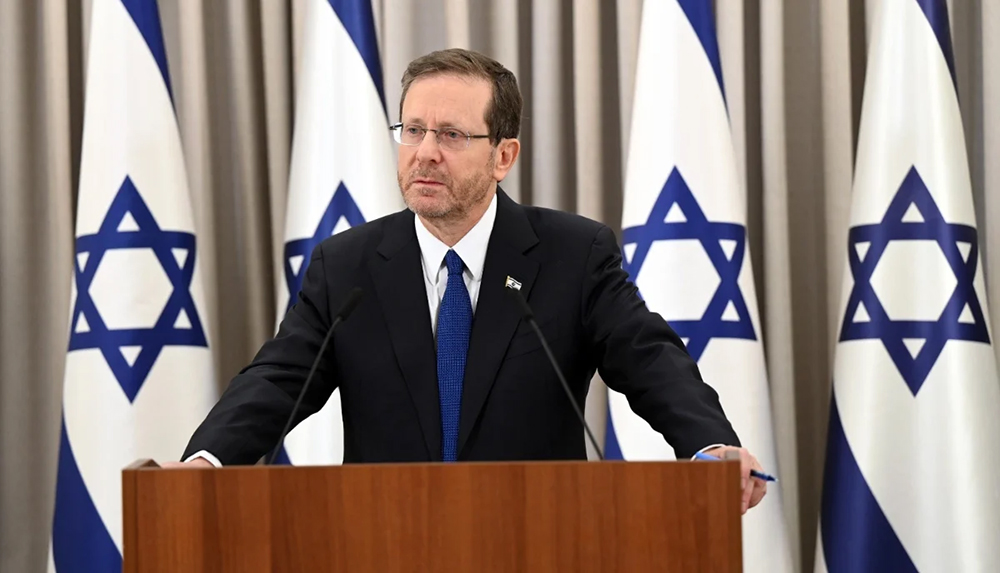
By any reasonable standard, the invitation extended to Israeli President Isaac Herzog to visit Sydney next month should have been an uncontroversial act of decency. The Australian head of state was to come not to celebrate policy or to negotiate arms deals, but to stand shoulder to shoulder with a traumatized nation and commemorate the victims of the Bondi Beach Hanukkah massacre — fifteen innocent people murdered at a Jewish celebration in one of the most iconic public spaces in the country. Instead, the visit has become a lightning rod for one of the most divisive debates in contemporary Australian life.
As The Algemeiner has reported on Wednesday, the Australian National Imams Council (ANIC) has publicly called on Prime Minister Anthony Albanese to rescind Herzog’s invitation, accusing the Israeli president of being “implicated in widespread war crimes and breaches of international law.” In its press release and subsequent social media posts, the organization demanded that Herzog not be “welcomed or afforded legitimacy” on Australian soil, even as it professed solidarity with the Jewish community over the Bondi attack.
To many Jewish leaders and community figures, the message was not one of solidarity but of rupture.
David Ossip, president of the New South Wales Jewish Board of Deputies, did not mince words. Quoted by The Algemeiner, Ossip lamented that at the very moment Australians are desperate for unity, “calls for division” are being amplified from some of the most influential religious bodies in the country.
“Australia has been attacked, and its citizens have been slaughtered on the beach,” he said. “Many countries, quite rightly, want to show their solidarity with us at this time. Let them.”
That appeal to common decency — let those who wish to mourn with us do so — sits uneasily alongside ANIC’s insistence that the Israeli head of state is beyond the pale, even in the context of memorializing Australian victims of terror. As The Algemeiner report observed, this clash of perspectives has exposed a deeper question: is there any space left in Australian public life where grief can be shared without being filtered through the prism of the Middle East conflict?
ANIC’s statement is notable not only for its content but for its framing. On the one hand, the council declared that it “stands in solidarity with the Jewish community and mourns the victims of the horrific Bondi terrorist attack.” On the other, it accused Herzog of complicity in “grave war crimes and acts of genocide against the Palestinian people,” asserting that accountability must not be “compromised.”
The Algemeiner report noted that the body did not attempt to reconcile these two positions. Instead, it effectively collapsed the mourning of Australian Jews into a referendum on Israeli military policy, thereby transforming what was intended as a moment of shared national grief into yet another battleground of the Israel-Palestinian conflict.
The result has been predictable: outrage among Jewish organizations, discomfort within government circles, and an emboldening of activists who view the Bondi massacre not as a domestic terror attack but as a data point in a global ideological struggle.
Prime Minister Albanese now finds himself caught between competing imperatives. Herzog has already accepted the invitation, and rescinding it would almost certainly be interpreted by Jewish Australians as a betrayal at a time of extraordinary vulnerability. Yet ANIC’s intervention has given political cover to those who would prefer that the Israeli president not appear in Sydney at all.
The Australian government, already reeling from the attack, is pursuing sweeping firearm reforms, including a national gun buyback program and tighter caps on individual gun ownership. In New South Wales, additional legislation has passed granting police expanded powers to restrict protests for up to three months and criminalizing the public display of symbols associated with designated terrorist organizations such as Hamas.
These measures, intended to restore public safety and civic order, have themselves become flashpoints. ANIC denounced the NSW laws as conflating “lawful, peaceful protest with terrorism and acts of violence,” warning that they “increase social division rather than strengthening cohesion.” Once again, the tragedy at Bondi has been reframed as an excuse — in the council’s view — to curtail political expression, particularly in solidarity with Palestinians.
Meanwhile, Jewish leaders are speaking in increasingly urgent tones about what they see as a national emergency. As The Algemeiner report recounted, Australia’s rabbis have called on Albanese to establish a federal Royal Commission into antisemitism — the most powerful form of public inquiry available under Australian law.
In a letter of searing clarity, the Rabbinical Association of Australia wrote: “We have sat with grieving families. We have visited the injured. We have stood with children who no longer feel safe walking to school. We have watched members of our communities withdraw from public spaces, universities, and civic life out of fear.”
Their demands go beyond symbolism. The rabbis have called for the banning of certain chants and slogans that have become staples of anti-Israel demonstrations — “death to the IDF,” “globalize the intifada,” and “from the river to the sea, Palestine will be free.” These phrases, they argue, are not mere political rhetoric but incitements that normalize violence against Jews and Israelis.
This is not an abstract concern. It is a lived reality.
In its coverage, The Algemeiner has consistently framed the ANIC episode not as a one-off controversy but as part of a larger pattern in which Jewish trauma is repeatedly subordinated to ideological campaigns against Israel.
The paper has noted that, in the weeks since the Bondi massacre, Jewish institutions across Australia have reported a surge in threats, vandalism, and harassment. Schools have tightened security. Synagogues have curtailed public events. Parents have begun to reconsider whether it is safe for their children to wear visible Jewish symbols in public.
Against that backdrop the attempt to block Herzog’s visit appears less like a principled stand on international law and more like an erasure of Jewish suffering from the national narrative.
ANIC’s critique of the NSW protest laws raises legitimate questions about civil liberties, but The Algemeiner report pointed out that the council has been conspicuously silent about the environment of intimidation that prompted those laws in the first place.
In the wake of the massacre, Australian police faced demonstrations in which Hamas insignia were displayed and incendiary slogans shouted within days of a terror attack that specifically targeted Jews. For many in the Jewish community, the new restrictions are not an assault on democracy but a belated recognition that words and symbols can become weapons.
At its core, the dispute over Herzog’s visit is a dispute about the meaning of solidarity.
For Jewish Australians, solidarity means being allowed to grieve without having their pain immediately politicized, and being reassured that the highest levels of government recognize the attack on Bondi Beach as an attack on the nation itself.
For ANIC, solidarity seems to mean expressing sorrow while simultaneously placing preconditions on who is allowed to mourn alongside them — a formulation that risks turning empathy into a transactional commodity.
The coming weeks will test Albanese’s leadership. If he caves to pressure and rescinds Herzog’s invitation, he may appease a vocal segment of the population, but he will almost certainly fracture trust with a Jewish community that already feels besieged. If he stands firm, he will face accusations of ignoring “accountability” in Gaza — even though Herzog’s visit is explicitly about honoring Australian victims of terror.
The Algemeiner report warned that whatever decision is made will reverberate far beyond this single visit. It will signal whether Australia is capable of separating domestic grief from foreign policy disputes, or whether every tragedy involving Jews must now be litigated through the lens of the Middle East.
The Bondi Beach massacre was a wound inflicted on the Australian soul. The invitation to Isaac Herzog was, in essence, an attempt to suture that wound with the presence of a fellow head of state who represents a people that knows too well the cost of terror.
That this gesture has become the subject of such ferocious opposition says less about Herzog than it does about the fragility of Australia’s social fabric in an age of globalized grievance.
As The Algemeiner report made clear, the real question is not whether one agrees with every policy of the Israeli government. It is whether, in the aftermath of a massacre, a nation can still muster the grace to say: we mourn with you, without conditions.
If it cannot, then the divisions exposed by ANIC’s call are not merely political. They are existential.

What are the imams doing to prevent these incidents, or are they inciting them? What are they doing in Australia? Gaza calls.
Don’t expect better behavior from the Australian National Imams Council (ANIC). That is who they are.
ANIC is, unsurprisingly demanding their “right” to globalize the intifada. They MUST NOT be allowed to get away with it. World, WAKE UP. Muslims intend to Islamize the World. Albanese needs to JUST SAY NO!!!!!!!!!!