



|
Getting your Trinity Audio player ready...
|
By: Fern Sidman
The United Nations Security Council convened on Wednesday for a high-stakes vote on a resolution calling for an immediate ceasefire in Gaza — a measure that notably made no mention of the release of Israeli hostages still held by Hamas. The resolution received overwhelming support from 14 of the Council’s 15 members, but was ultimately blocked by a U.S. veto, a move hailed by Israel and sharply criticized by several international observers.
As reported by Israel National News on Wednesday, the U.S. action was a direct response to what Washington described as a fundamentally flawed and one-sided resolution that failed to address the root cause of the ongoing conflict — Hamas terrorism — and ignored the plight of over 120 hostages still believed to be held in Gaza since the October 7 massacre.
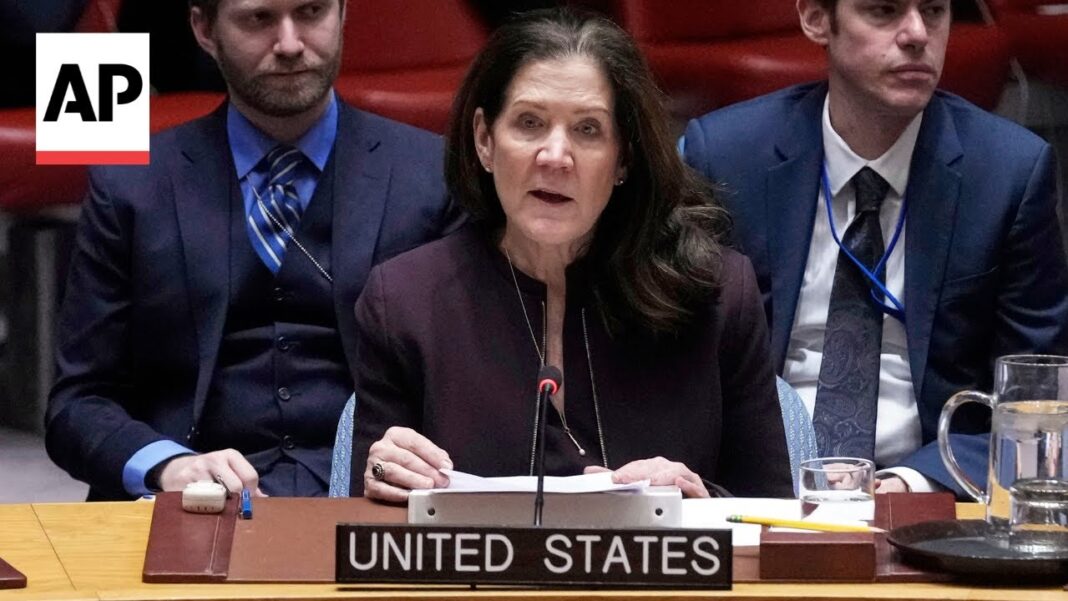
Acting U.S. Ambassador to the U.N. Dorothy Shea delivered a firm statement prior to casting the veto. “The United States has been clear we would not support any measure that fails to condemn Hamas and does not call for Hamas to disarm and leave Gaza,” she told the Council. Shea further warned that the resolution, if passed, would “undermine diplomatic efforts to reach a ceasefire that reflects the realities on the ground, and embolden Hamas.”
The resolution’s failure marks a significant juncture in international efforts to broker peace in Gaza. According to the information provided in the Israel National News report, the text, while calling for an immediate cessation of hostilities, did not include any reference to the hostages or to Hamas’s responsibility for triggering the conflict through its October 7 invasion of southern Israel, during which terrorists slaughtered over 1,200 civilians and kidnapped scores more, including women, children, and the elderly.
Israel’s Ambassador to the United Nations, Danny Danon, offered a scathing rebuke of the resolution and expressed gratitude toward the United States for upholding moral clarity in a moment he characterized as a test of international resolve.
“I thank the United States for demonstrating moral clarity and leadership at the UN Security Council by vetoing the one-sided resolution against Israel,” Danon said, as quoted by Israel National News. “The resolution that was brought to a vote called for a ceasefire in Gaza without conditioning such a ceasefire on the immediate and unconditional release of the hostages — a gift to Hamas.”
Danon emphasized that such a proposal sends a “dangerous message to Hamas terrorists: reject every proposal and the international community will reward you; hold innocent civilians hostage and the UN will grant you legitimacy.” He concluded by stating, “This is not diplomacy — it is surrender to terror. As long as the hostages remain in Gaza, there will be no ceasefire. Israel will continue to apply military pressure and use all necessary means until every hostage is brought home.”
The position articulated by both the U.S. and Israel reflects a growing insistence that any viable ceasefire must be predicated on the dismantling of Hamas’s military capabilities and the return of the hostages — objectives that Israel National News has reported are viewed by Israeli officials as non-negotiable.
The U.S. veto, while applauded in Jerusalem, drew ire from other member states who argued that the humanitarian toll of the conflict necessitated an immediate cessation of hostilities. Several delegations expressed frustration that the Council remained paralyzed in the face of mounting civilian casualties and deteriorating humanitarian conditions in Gaza. However, the report on Israel National News noted that Israeli officials maintain the blame for the ongoing crisis lies squarely with Hamas, whose continued use of civilian infrastructure, hospitals, and schools for terrorist operations has prolonged the conflict and worsened conditions on the ground.
Wednesday’s veto is not the first time the United States has shielded Israel from what it sees as unjust or unbalanced resolutions at the United Nations. But the stakes are notably higher in the current geopolitical climate, with international pressure on Israel intensifying and divisions among Security Council members growing more pronounced.
While the failed resolution may not lead to immediate change in the conflict’s trajectory, it underscores the widening rift between Western nations — led by the U.S. — and other members of the international community over how best to achieve peace and security in Gaza. The Israel National News report has emphasized that for Israel, true peace can only be achieved by eradicating Hamas’s ability to threaten civilians and ensuring that all hostages are released without precondition.
As the Security Council regroups and diplomatic channels remain strained, the Israeli government has made clear — both at the U.N. and through its ongoing military operations — that any ceasefire not tethered to the unconditional return of its citizens will be rejected outright.
In the words of Ambassador Danon, “This is a war against barbarism, not just for Israel, but for the values of the free world. The message must be clear — no legitimacy for terror.”
