



|
Getting your Trinity Audio player ready...
|
Edited by: TJVNews.com
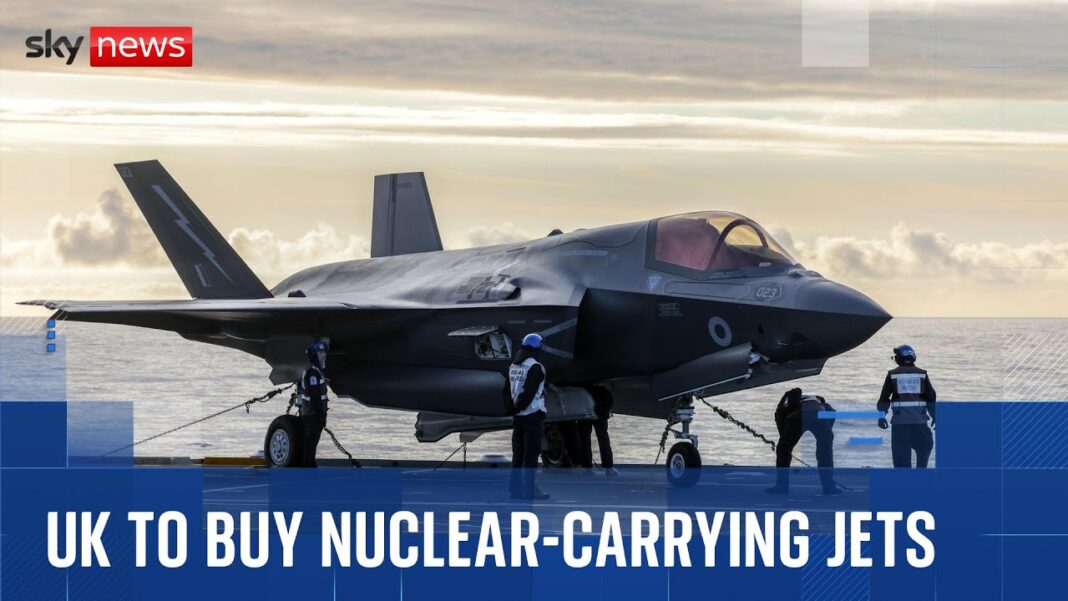
In a historic announcement that signals the most significant reorientation of Britain’s nuclear deterrent in a generation, Prime Minister Sir Keir Starmer confirmed on Tuesday that the United Kingdom will acquire at least a dozen U.S.-made F-35A fighter jets capable of carrying nuclear bombs. Speaking from The Hague at a pivotal NATO summit, Starmer described the purchase as a “measured and necessary response” to what he called a “growing nuclear threat.”
According to a report on the BBC, the jets will be integrated into NATO’s airborne nuclear mission, marking a decisive shift in the UK’s nuclear posture and aligning Britain more directly with U.S. and allied nuclear forces on the European continent. “We will procure at least 12 and we will make these aircraft able to bear nuclear weapons if necessary,” said Starmer. The decision is a clear signal of Britain’s intention to deepen its commitment to NATO’s nuclear umbrella at a time of heightened geopolitical volatility.
The new F-35A jets, unlike the vertical-landing F-35B variant currently operated by the Royal Air Force and Royal Navy, are designed to carry the U.S.-manufactured B61 thermonuclear bomb—a modernized, precision-guided weapon already pre-positioned at several European airbases by the United States.
As BBC News reported, the UK’s move is part of a coordinated NATO effort to reinforce the alliance’s nuclear deterrence posture amid concerns over Russian aggression and nuclear sabre-rattling from other actors, including North Korea and Iran. “Downing Street says the move is the biggest strengthening of the UK’s nuclear posture in a generation,” the BBC noted in its coverage.
Defense Secretary John Healey echoed that sentiment in an interview with BBC Breakfast on Wednesday morning. “This investment strengthens the NATO-collective deterrent that comes from having this nuclear capability,” Healey said, underscoring the dual imperative of deterrence and alliance solidarity.
Despite the clear strategic intent behind the procurement, questions about the UK’s operational sovereignty over the new nuclear-capable aircraft remain. As BBC Politics Live highlighted during a parliamentary debate on Wednesday, Conservative MP Lincoln Jopp pressed the government on whether the UK would be beholden to Washington in the event of conflict.
“Will a dual-key arrangement be in place regarding the deployment of these weapons—namely that the Brits can’t use them without the American say-so?” Jopp asked.
Border Security Minister Dame Angela Eagle sought to reassure Parliament that the UK would retain its decision-making autonomy within NATO’s governance framework. “The current decision is about joining the NATO nuclear mission, which would require the agreement of all 31 allies,” she said. “The UK will always retain the right to participate, or not, on the basis of that governance arrangement.”
As BBC Defense Correspondent Jonathan Beale noted, the actual control of the B61 bombs remains in American hands, even when deployed on allied aircraft—a policy designed to ensure tight political and operational control of nuclear weapons. However, that reliance may prove contentious in the future, especially in a fast-moving conflict scenario.
Beyond its strategic and diplomatic implications, the jet procurement program is also being framed as an economic boon. According to the information provided in the BBC Newsnight report, the defense contract is expected to support more than 20,000 jobs across the UK and involve over 100 British firms within the supply chain. Much of the airframe, including components for the F-35, has long been produced at BAE Systems’ facility in Lancashire, making the program both a national security and industrial policy priority.
“The program will inject vitality into the British aerospace sector and further entrench the UK’s role as a key manufacturing partner in the global F-35 project,” said Healey in his remarks from The Hague.
The announcement closely follows the release of the UK’s updated Strategic Defense Review, which reorients the country’s security doctrine toward preparing for high-intensity conflict scenarios, including the direct threat of attack on the British homeland.
As BBC Analysis Editor Ros Atkins explained, the government’s latest National Security Strategy outlines a sobering assessment: that the UK must “actively prepare for the possibility of the UK homeland coming under direct threat, potentially in a wartime scenario.”
In line with this recalibrated doctrine, Sir Keir Starmer has committed his government to a bold new spending benchmark—pledging to raise the UK’s national security investment to 5% of GDP by 2035. Of that, 3.5% will be earmarked for core defense expenditures, with the remainder allocated to defense-adjacent domains such as cyber defense, homeland security, and critical infrastructure resilience.
The commitment is expected to be endorsed by all 32 NATO member states at this week’s summit, a decision the BBC describes as “a watershed moment in the alliance’s post-Cold War evolution.”
While government officials have been careful to couch the decision in terms of collective defense and alliance cohesion, the strategic subtext is unambiguous. As BBC World Service reported, the F-35A deployment sends a pointed message to adversaries, particularly Russia: that the UK remains a nuclear power not just in name, but in operational capacity and forward readiness.
“The UK’s Trident submarines remain the cornerstone of our independent nuclear deterrent,” said Starmer, “but in an era of radical uncertainty, we must be prepared to act across every domain—land, sea, air, cyber, and space.”
Indeed, the choice to field dual-capable aircraft represents not a departure from the Trident doctrine, but rather a diversification of Britain’s strategic nuclear options—a move that may reshape the European security landscape for years to come.
As NATO faces its most complex security environment since the Cold War, Britain’s decision to purchase nuclear-capable F-35A jets represents a defining shift. It speaks volumes about the government’s willingness to project nuclear resolve, shoulder greater responsibility within NATO, and prepare for scenarios once considered unthinkable.
As BBC diplomatic correspondent James Landale observed, the move “recasts the UK’s defense strategy not just as reactive, but preemptively resilient.”
Whether this ambitious realignment proves prescient or provocative will depend on how the UK navigates the dual challenges of strategic dependence and deterrence in an increasingly unstable world. What is certain, however, is that Britain’s nuclear shadow has just grown longer—and more complex.
