




|
Getting your Trinity Audio player ready...
|
By: Fern Sidman
The long-simmering debate over Palestinian statehood erupted into a full-blown diplomatic firestorm on Sunday as the United Kingdom, Canada, and Australia officially recognized Palestine as a United Nations member state. The move, announced in coordinated statements from London, Ottawa, and Canberra, represents the first time major Western powers have formally embraced Palestinian sovereignty, and it has triggered immediate fury in Jerusalem and Washington.
According to a report that appeared on Sunday in The New York Post, the decision is being read not only as a sharp rebuke of Israel’s ongoing military campaign in Gaza but also as a symbolic tilt toward Palestinian aspirations that could reshape the balance of power at the upcoming United Nations General Assembly session in Manhattan.
Until now, recognition of Palestinian statehood had largely been the domain of non-Western or developing nations. More than 145 UN member states already recognize Palestine, granting it “observer” status at the global body but leaving it short of full voting rights. What makes Sunday’s announcement seismic, as The New York Post report noted, is that three of America’s closest allies—two Commonwealth powers and one member of the G7—have broken ranks with Washington’s decades-long policy of withholding recognition absent a negotiated peace settlement with Israel.
British Prime Minister Keir Starmer set the tone with a message broadcast on X, declaring:
“Today, to revive the hope of peace and a two-state solution, I state clearly as the prime minister of this great country that the United Kingdom formally recognises the State of Palestine.”
Starmer emphasized that recognition was not an endorsement of Hamas, which he denounced as “a brutal terror organization.” Instead, he cast the decision as an effort to revive a moribund peace process and to counter the Iranian-backed terrorist group’s influence: “Our call for a genuine two-state solution is the exact opposite of their hateful vision.”
Australian Prime Minister Anthony Albanese echoed the sentiment, framing the move as part of a coordinated diplomatic strategy to break the cycle of war. “Australia’s recognition of Palestine today, alongside Canada and the United Kingdom, is part of a coordinated international effort to build new momentum for a two-state solution, starting with a ceasefire in Gaza and the release of the hostages taken in the atrocities of October 7, 2023,” he said.
Canadian Prime Minister Mark Carney was equally emphatic. “Today, Canada recognizes the State of Palestine,” he wrote on X. In an official statement, Carney pointed out that Canada had long supported the principle of two states. “Since 1947, it has been the policy of every Canadian government to support a two-state solution for lasting peace in the Middle East,” he said, framing recognition as the logical continuation of decades of Canadian foreign policy.
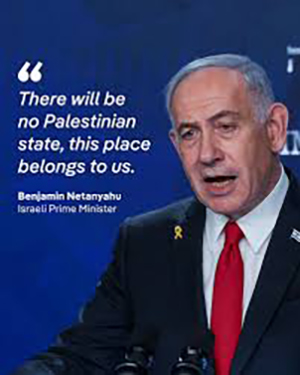
The backlash from Israel was swift and scathing. Prime Minister Benjamin Netanyahu, in a televised address following a cabinet meeting, blasted the decision as a betrayal of Israel and a dangerous capitulation to Hamas.
“I have a clear message to those leaders who recognize a Palestinian state after the terrible massacre of October 7: You are giving a huge reward to terrorism,” Netanyahu declared, as reported by The New York Post.
“It will not happen. There will not be a Palestinian state west of the Jordan,” he vowed, reiterating his government’s longstanding opposition to Palestinian sovereignty in the absence of ironclad security guarantees.
Israeli National Security Minister Itamar Ben Gvir amplified this sentiment, denouncing the Western powers’ decision as “capitulation to Hamas” and demanding Israel immediately annex Judea and Samaria in response.
The White House, too, rejected the coordinated recognition in unusually forceful terms. An unnamed official told The New York Post that President Trump was unwilling to consider recognition under any circumstances so long as Hamas remained in control of Gaza and Israeli hostages were still in captivity.
“As the president stated, he would be rewarding Hamas and would be hindering efforts to bring home the hostages if he recognizes a Palestinian state, and he doesn’t think they should be rewarded,” the official said. “So he is not going to do that.”
House Foreign Affairs Committee Chairman Brian Mast (R-Fla.) struck a similarly caustic tone, describing the recognition of Palestinian statehood by America’s allies as “empty virtue signaling that only rewards the Hamas butchers and rapists.”
The Hostages and Missing Families Forum, representing relatives of the 48 Israelis still believed to be held captive in Gaza, reacted with anguish. The group condemned the decision by the UK, Canada, and Australia as a devastating blow to ongoing efforts to secure their loved ones’ release.
“Offering such significant political rewards without securing the return of all 48 of our loved ones represents a catastrophic failure of political, moral, and diplomatic leadership that will severely damage efforts to bring them all home,” the forum said in a statement cited in The New York Post report.
Their words reflected a widespread fear in Israel that recognition would not only embolden Hamas but also reduce international pressure on the group to negotiate in good faith.
Hamas, meanwhile, has cynically claimed that such recognition is “the fruit of Oct. 7,” portraying the massacre of 1,200 Israelis and the abduction of 251 hostages as the catalyst for Western concessions.
The latest wave of recognitions does not end with the Anglosphere trio. Several European nations, including France, Belgium, Portugal, Luxembourg, Malta, and San Marino, have signaled plans to follow suit, many timing their announcements to coincide with the United Nations General Assembly later this week.
France, in particular, has become a focal point of debate. President Emmanuel Macron is expected to push forward despite strong domestic opposition and warnings from Israel and the United States.
9 Out of 10 Britons Oppose Recognition
The United Kingdom’s decision to formally recognize a Palestinian state — an initiative touted by Prime Minister Keir Starmer as a potential centerpiece of his foreign policy — has run into overwhelming public opposition, according to new polling reported by The Telegraph of the UK.
The survey, conducted by JL Partners and published in The Telegraph, revealed that nine in ten Britons do not support Starmer’s decision to recognize Palestinian statehood under present conditions. The findings illustrate a widening gulf between the Prime Minister’s diplomatic agenda and the sentiments of the electorate, particularly at a time when the Middle East remains convulsed by violence and unresolved hostage crises.
One of the most striking conclusions from the JL Partners poll, as highlighted in The Telegraph report, is that 51 percent of Britons oppose any move toward recognition of Palestinian statehood so long as Hamas retains control over the Gaza Strip and continues to hold Israeli hostages abducted during the terror group’s October 7, 2023 barbaric massacre.
That sentiment reflects not only humanitarian concerns but also a broader skepticism about rewarding a governing authority that is widely regarded as a terrorist organization. According to the information provided in The Telegraph report, the survey indicates that for many Britons, the question of recognition is not merely symbolic but tied to concrete issues of security, legitimacy, and accountability.
Perhaps the most politically explosive figure in the poll is that 52 percent of respondents believe granting recognition at this juncture would constitute nothing less than a “reward for terrorists.” As The Telegraph report observed, this perception resonates strongly with Israel’s longstanding argument that premature recognition of Palestinian statehood risks legitimizing Hamas’s October 7 atrocities and emboldening other terrorist actors across the region.
Such a view poses a direct challenge to Starmer’s position. The Prime Minister has argued that recognition is an essential step toward achieving a durable two-state solution, one that would strengthen moderate Palestinian voices against Hamas. Yet the survey suggests that the British public is deeply unconvinced, seeing recognition under current conditions as incentivizing violence rather than creating space for peace.
While a majority ties opposition to Hamas’s control of Gaza, the survey also revealed a more entrenched skepticism. According to the report in The Telegraph, 17 percent of Britons reject the idea of a Palestinian state under any circumstances. For this cohort, recognition is not simply premature — it is fundamentally incompatible with Britain’s national interest and moral obligations, given Hamas’s ideology, the persistence of antisemitism in Palestinian political culture, and the threat posed to Israel’s existence.
This uncompromising minority shines a proverbial spotlight on the depth of polarization in British public opinion. Whereas Starmer’s government has attempted to present recognition as a pragmatic and widely supported policy, the data shows that the idea remains divisive and fraught.
For Prime Minister Starmer, the findings reported by The Telegraph pose a serious political risk. His government had hoped to present recognition as a bold moral initiative that would place Britain at the forefront of international diplomacy, alongside other Western countries that have already moved in that direction. Yet if nine in ten Britons oppose the policy in its current form, the Prime Minister may find himself accused of ignoring domestic opinion in pursuit of international prestige.
The Telegraph report stressed that the survey reflects a stark warning: while Starmer might win plaudits in certain diplomatic circles, he risks alienating the majority of British voters, who fear that such recognition could destabilize the region and compromise the UK’s credibility as a counterterrorism partner.
Britain’s role in the Israeli-Palestinian conflict is uniquely charged. From the 1917 Balfour Declaration to the British Mandate in Palestine, London has long carried a historic burden in the region. As The Telegraph reminded its readers, each British government since the creation of Israel in 1948 has grappled with how to balance support for the Jewish state with sympathy for Palestinian aspirations.
But the stakes today are higher. With Hamas still entrenched in Gaza, with hostages languishing in captivity, and with Israel engaged in a prolonged military campaign, recognition risks being interpreted as a political green light for extremism. The JL Partners survey, as published by The Telegraph, makes clear that the British public is acutely aware of these dangers.
