



|
Getting your Trinity Audio player ready...
|
UK, Canada, and Australia Recognize Palestinian Statehood, Defying US and Israel Amid Global Backlash
By: Fern Sidman
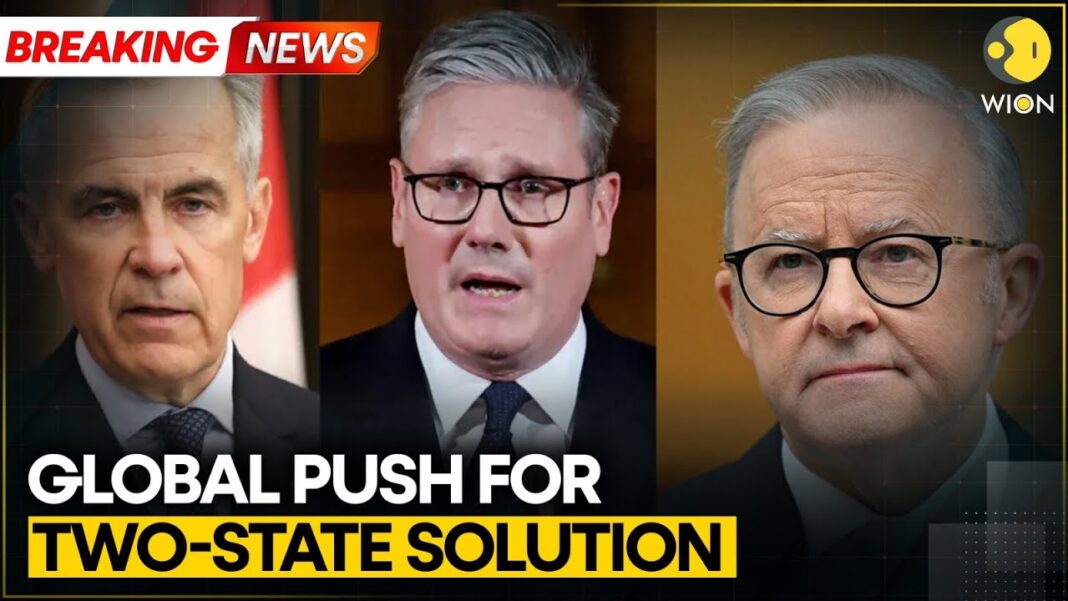
The long-simmering debate over Palestinian statehood erupted into a full-blown diplomatic firestorm on Sunday as the United Kingdom, Canada, and Australia officially recognized Palestine as a United Nations member state. The move, announced in coordinated statements from London, Ottawa, and Canberra, represents the first time major Western powers have formally embraced Palestinian sovereignty, and it has triggered immediate fury in Jerusalem and Washington.
According to a report that appeared on Sunday in The New York Post, the decision is being read not only as a sharp rebuke of Israel’s ongoing military campaign in Gaza but also as a symbolic tilt toward Palestinian aspirations that could reshape the balance of power at the upcoming United Nations General Assembly session in Manhattan.
Until now, recognition of Palestinian statehood had largely been the domain of non-Western or developing nations. More than 145 UN member states already recognize Palestine, granting it “observer” status at the global body but leaving it short of full voting rights. What makes Sunday’s announcement seismic, as The New York Post report noted, is that three of America’s closest allies—two Commonwealth powers and one member of the G7—have broken ranks with Washington’s decades-long policy of withholding recognition absent a negotiated peace settlement with Israel.
British Prime Minister Keir Starmer set the tone with a message broadcast on X, declaring:
“Today, to revive the hope of peace and a two-state solution, I state clearly as the prime minister of this great country that the United Kingdom formally recognises the State of Palestine.”
Starmer emphasized that recognition was not an endorsement of Hamas, which he denounced as “a brutal terror organization.” Instead, he cast the decision as an effort to revive a moribund peace process and to counter the militant group’s influence: “Our call for a genuine two-state solution is the exact opposite of their hateful vision.”
Australian Prime Minister Anthony Albanese echoed the sentiment, framing the move as part of a coordinated diplomatic strategy to break the cycle of war. “Australia’s recognition of Palestine today, alongside Canada and the United Kingdom, is part of a coordinated international effort to build new momentum for a two-state solution, starting with a ceasefire in Gaza and the release of the hostages taken in the atrocities of October 7, 2023,” he said.
Canadian Prime Minister Mark Carney was equally emphatic. “Today, Canada recognizes the State of Palestine,” he wrote on X. In an official statement, Carney pointed out that Canada had long supported the principle of two states. “Since 1947, it has been the policy of every Canadian government to support a two-state solution for lasting peace in the Middle East,” he said, framing recognition as the logical continuation of decades of Canadian foreign policy.
The backlash from Israel was swift and scathing. Prime Minister Benjamin Netanyahu, in a televised address following a cabinet meeting, blasted the decision as a betrayal of Israel and a dangerous capitulation to Hamas.
“I have a clear message to those leaders who recognize a Palestinian state after the terrible massacre of October 7: You are giving a huge reward to terrorism,” Netanyahu declared, as reported by The New York Post.
“It will not happen. There will not be a Palestinian state west of the Jordan,” he vowed, reiterating his government’s longstanding opposition to Palestinian sovereignty in the absence of ironclad security guarantees.
The rhetoric was matched by threats of retaliatory measures. Israeli officials, according to The New York Post report, are considering a range of responses, from accelerating annexation of parts of Judea and Samaria to shuttering the French consulate in Jerusalem and even seizing French-owned properties in Israel such as the Sanctuary of the Eleona, a Christian pilgrimage site.
Israeli National Security Minister Itamar Ben Gvir amplified the threats, denouncing the Western powers’ decision as “capitulation to Hamas” and demanding Israel immediately annex Judea and Samaria in response.
The White House, too, rejected the coordinated recognition in unusually forceful terms. An unnamed official told The New York Post that President Trump was unwilling to consider recognition under any circumstances so long as Hamas remained in control of Gaza and Israeli hostages were still in captivity.
“As the president stated, he would be rewarding Hamas and would be hindering efforts to bring home the hostages if he recognizes a Palestinian state, and he doesn’t think they should be rewarded,” the official said. “So he is not going to do that.”
House Foreign Affairs Committee Chairman Brian Mast (R-Fla.) struck a similarly caustic tone, describing the recognition of Palestinian statehood by America’s allies as “empty virtue signaling that only rewards the Hamas butchers and rapists.”
The Hostages and Missing Families Forum, representing relatives of the 48 Israelis still believed to be held captive in Gaza, reacted with anguish. The group condemned the decision by the UK, Canada, and Australia as a devastating blow to ongoing efforts to secure their loved ones’ release.
“Offering such significant political rewards without securing the return of all 48 of our loved ones represents a catastrophic failure of political, moral, and diplomatic leadership that will severely damage efforts to bring them all home,” the forum said in a statement cited in The New York Post report.
Their words reflected a widespread fear in Israel that recognition would not only embolden Hamas but also reduce international pressure on the group to negotiate in good faith.
In stark contrast, Palestinian Authority President Mahmoud Abbas welcomed the announcements as a long-overdue step toward justice. He described the recognition as vital for regional stability and as a signal that the global tide was shifting.
“The recognition of Palestine is not only a political act but a moral necessity,” Abbas said in a statement. He insisted that sovereignty would allow Palestinians to pursue peace from a position of dignity rather than desperation.
Hamas, meanwhile, has cynically claimed that such recognition is “the fruit of Oct. 7,” portraying the massacre of 1,200 Israelis and the abduction of 251 hostages as the catalyst for Western concessions.
The latest wave of recognitions does not end with the Anglosphere trio. Several European nations, including France, Belgium, Portugal, Luxembourg, Malta, and San Marino, have signaled plans to follow suit, many timing their announcements to coincide with the United Nations General Assembly later this week.
Belgium has said its recognition would be contingent on certain conditions, while San Marino is expected to pursue a more gradual approach. Still, as The New York Post report observed, the trend reflects growing Western impatience with both Israel’s military campaign in Gaza and the failure of peace talks to produce tangible results.
France, in particular, has become a focal point of debate. President Emmanuel Macron is expected to push forward despite strong domestic opposition and warnings from Israel and the United States.
The coordinated move by London, Ottawa, and Canberra signals not only disapproval of Israel’s military campaign but also a significant realignment in Western diplomacy. For decades, the U.S. has successfully kept its closest allies from extending recognition, arguing that only direct negotiations between Israel and the Palestinians could produce a sustainable peace.
By breaking with Washington, the UK, Canada, and Australia are gambling that symbolic recognition can revive talks rather than derail them. Starmer, Carney, and Albanese all emphasized that recognition should not be seen as rewarding Hamas but as isolating the group by strengthening moderate Palestinian leadership.
Yet critics remain unconvinced. As The New York Post report pointed out, Israeli and U.S. officials argue that premature recognition undermines incentives for the Palestinians to negotiate, while simultaneously emboldening extremists who view Western concessions as validation of violent tactics.
Analysts also suggest that domestic political pressures played a role. In the UK, Starmer has faced growing demands from his party’s left flank to adopt a stronger pro-Palestinian stance, particularly as anti-Israel protests have surged in British cities. In Canada, Carney’s move aligns with a long-standing public opinion split that favors Palestinian aspirations, even if it risks further straining trade ties with Washington. And in Australia, Albanese’s recognition fulfills a campaign promise to recalibrate foreign policy toward greater independence from U.S. dictates.
According to the information provided in The New York Post report, the Trump administration has already warned Canada that its recognition of Palestine will complicate its ongoing trade conflict with the United States, raising the prospect of economic retaliation.
With the UN General Assembly looming, Netanyahu is preparing to rally international opposition to the recognitions, reportedly coordinating with President Trump for a unified rebuke. Israel may also escalate its military operations in Gaza and accelerate settlement activity in Judea and Samaria to demonstrate defiance.
Netanyahu has been clear: “There will not be a Palestinian state west of the Jordan.” His words, quoted prominently by The New York Post, leave little room for compromise.
The recognition of Palestinian statehood by the United Kingdom, Canada, and Australia marks one of the most significant diplomatic shifts in the Middle East conflict in years. It underscores deepening fractures among Western allies, highlights growing frustration with Israel’s military campaign, and raises urgent questions about the future of Palestinian leadership.
As The New York Post report emphasized, the decision is as much about symbolism as substance. Palestine remains far from exercising full sovereignty, and Israel retains overwhelming military and economic control over the territories. Yet recognition by major Western powers alters the narrative, lending legitimacy to Palestinian claims while cornering Israel diplomatically.
Whether this move will advance peace or inflame further violence remains uncertain. For now, what is clear is that the recognition has reopened fundamental debates over the nature of sovereignty, the legitimacy of resistance, and the path to resolving one of the world’s most intractable conflicts.
