



|
Getting your Trinity Audio player ready...
|
U.S. Pro-Israel Organization Warns: Letting Turkey Shape Gaza’s Future Would Spell Catastrophe
By: Fern Sidman
As the diplomatic machinery grinds forward to design an “International Stabilization Force” for postwar Gaza, one of America’s most venerable pro-Israel advocacy organizations has issued a stark and uncompromising warning: the inclusion of Turkish troops would not stabilize Gaza — it would sabotage it.
Americans for a Safe Israel (AFSI), founded in 1970 and long recognized as a formidable voice in the pro-Israel policy arena, has declared that any international force tasked with rebuilding Gaza must categorically exclude countries with a demonstrable record of supporting Hamas. In AFSI’s assessment, no country more clearly meets that disqualifying criterion than Turkey.
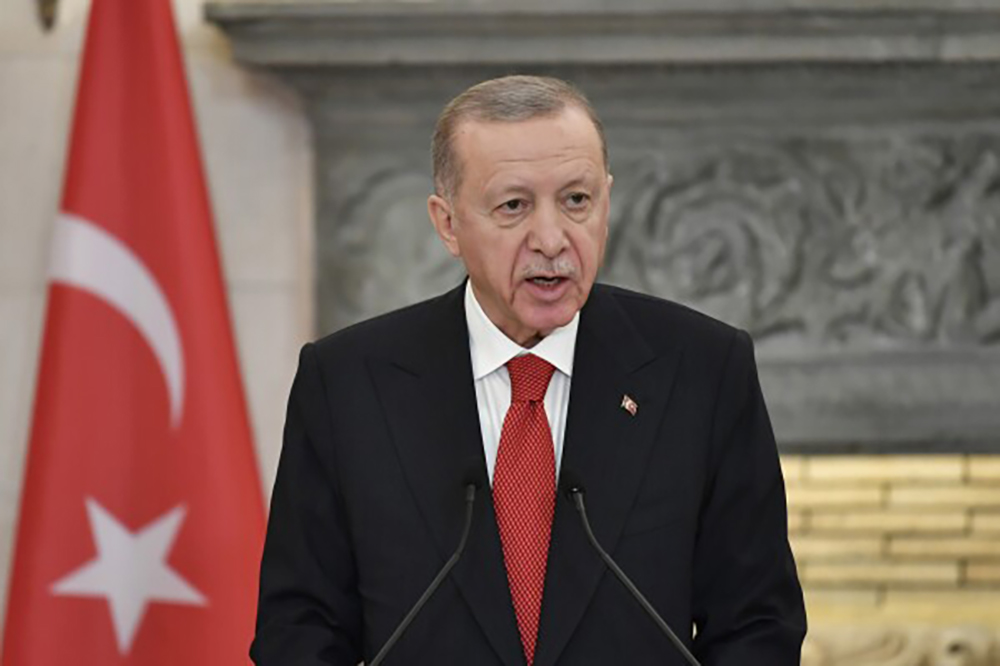
This sharp rebuke follows remarks by Turkish President Recep Tayyip Erdoğan to Bloomberg, in which he argued that the success of a Gaza stabilization mission “depends on the inclusion of actors that have legitimacy on the ground,” adding that countries party to the Sharm el-Sheikh Declaration — including Turkey — are the “most legitimate actors in this process.”
AFSI was unambiguous in its response.
“It is time for diplomats to realize that nations with a documented history of providing Hamas with safe haven, political support, financial assistance, or material aid must not be granted any role in rebuilding Gaza,” the organization said in a formal statement. The message was not couched in nuance: Turkey, AFSI contends, is not a neutral stakeholder but an enabler of the very terror apparatus the international community claims to dismantle.
At the heart of the dispute is the concept of legitimacy — the very word Erdoğan invoked to justify Turkish involvement. But legitimacy, AFSI argues, is not a rhetorical ornament; it is earned through conduct.
“Perversely, Turkey has long viewed Hamas as a ‘liberation movement’ and does not designate Hamas as the terrorist organization that it is,” said Moshe Phillips, chairman of Americans for a Safe Israel. “These facts alone should rule out Turkey from having any role in Gaza.”
Phillips’s statement cuts to the foundational problem: peacekeeping is predicated on trust. International forces are meant to function as impartial guarantors of stability, credible to all sides precisely because they are not entangled in the ideological or operational networks of combatants. A state that glorifies or shelters one belligerent forfeits that trust before its first soldier sets foot on the ground.
“Peacekeepers must be trusted by all sides if they are to function effectively,” Phillips continued. “Given Turkey’s history of support for Hamas, Israel cannot reasonably be expected to view these soldiers as neutral actors. Nor should the United States do so.”
AFSI’s objections are not speculative; they are forensic.
Over the past decade, U.S. and Israeli intelligence services have documented Turkey’s emergence as a logistical, financial, and operational hub for Hamas activity. According to AFSI, Turkish territory has been used to coordinate terrorist operations, recruit operatives, and manage extensive financial networks involving real estate holdings and commercial fronts.
These are not marginal allegations. Hamas operatives have used Turkey as a staging ground for planning attacks and recruiting new members, exploiting Ankara’s permissive political climate and the lack of meaningful enforcement against the organization.
Turkish soil has hosted complex Hamas-linked financial schemes involving real estate portfolios and shell businesses, enabling the laundering of funds destined for terrorist operations.
Since 2011, following the Gilad Shalit prisoner exchange, Turkey has openly hosted senior Hamas leaders. High-ranking figures have held meetings with President Erdoğan himself as well as with Turkish intelligence officials.
Perhaps most egregiously, Turkey granted citizenship to senior Hamas leaders — including Ismail Haniyeh before his killing in July 2024 — thereby embedding the leadership of a U.S.-designated terrorist organization within the legal and political framework of a NATO member state.
The convergence between Ankara and Hamas is not merely transactional; it is ideological.
AFSI emphasized that Erdoğan’s ruling Justice and Development Party (AKP) and Hamas share intellectual lineage in the Muslim Brotherhood. This ideological fraternity has translated into overt political alignment, particularly since the Hamas-led massacre of Israeli civilians on October 7.
Rather than distancing himself from the perpetrators of the attack, Erdoğan emerged as one of Israel’s most vocal critics, casting Hamas in the language of resistance rather than terror. In international forums, Turkey has persistently framed Hamas as a legitimate political actor, even as the group continues to proclaim its commitment to Israel’s destruction.
This ideological posture is not peripheral to the question of Turkish participation in Gaza. It defines it.
To deploy Turkish soldiers into Gaza is not to introduce a neutral stabilizing presence; it is to embed within Gaza a state apparatus whose ruling elite has repeatedly aligned itself — rhetorically, diplomatically, and materially — with the very organization that precipitated Gaza’s devastation.
AFSI’s critique transcends moral argument; it is rooted in strategic realism.
An international stabilization force that includes Turkish troops would face three immediate and intractable challenges such as loss of Israeli confidence. Israel cannot — and will not — entrust its postwar security to a force that includes soldiers from a state that has harbored its enemies and lauded its attackers.
The United States designated Hamas as a terrorist organization. Allowing a state that openly embraces Hamas to help police Gaza would shred Washington’s own counterterrorism doctrine.
It also undermines Palestinian reform. Genuine reconstruction requires dismantling Hamas’s institutional power. A Turkish presence risks entrenching Hamas’s influence by providing political cover and logistical lifelines under the guise of peacekeeping.
In short, Turkey’s inclusion would not neutralize Gaza’s militant ecosystem; it would anesthetize it.
Americans for a Safe Israel is not a newcomer to these debates. Established in 1970, AFSI has spent more than half a century challenging policies it views as endangering Israel’s security or legitimizing terror. Non-partisan in both the United States and Israel, the organization has built its reputation on educational campaigns and unapologetic advocacy that confront what it calls the “rising tide of anti-Israel propaganda.”
Its intervention in the Gaza stabilization debate is consistent with that legacy: direct, uncompromising, and grounded in a clear red line — no partner of Hamas can be entrusted with the future of Gaza.
As world powers convene to chart Gaza’s postwar future, they face a choice that is less diplomatic than existential.
Either the international community constructs a stabilization architecture anchored in genuine neutrality, accountability, and zero tolerance for terror — or it risks recreating the same dynamics that condemned Gaza to its present ruin.
AFSI’s message is therefore not merely about Turkey. It is about the integrity of the entire enterprise.
Rebuilding Gaza is not a ceremonial exercise in multilateralism. It is a test of whether the world is prepared to distinguish between peacemakers and patrons of terror — between guardians of stability and Trojan horses in uniform.
Turkey, in AFSI’s reckoning, is emphatically the latter.
Turkey is very upfront about its desire to destroy Israel. What Trojan horse? It is absurd to place Israel’s enemies, united, at her border.