



|
Getting your Trinity Audio player ready...
|
U.S. Military Buildup Intensifies in Gulf as Trump Hints Force May Not Be Necessary
By: Fern Sidman
As street protests in Iran recede from the global headlines, a far more consequential drama is unfolding beyond the public gaze — one defined not by chants in city squares, but by steel hulls, stealth aircraft, and the slow, methodical choreography of American military power. According to a report on Saturday at VIN News, the United States is executing one of the most significant strategic military reinforcements in the Middle East in decades, signaling a posture of readiness that extends far beyond routine deterrence and into the realm of potential large-scale confrontation with the Islamic Republic.
While President Trump has publicly maintained a tone of conditional restraint — insisting that “maybe we won’t need to use the forces” — the operational reality on the ground and at sea tells a far more formidable story. Under his directive, U.S. forces are not merely maintaining presence; they are consolidating, reinforcing, and positioning themselves with unmistakable strategic intent. As VIN News reported, this buildup represents a comprehensive integration of naval, aerial, and logistical capabilities designed to sustain prolonged operations across the Middle East theater.
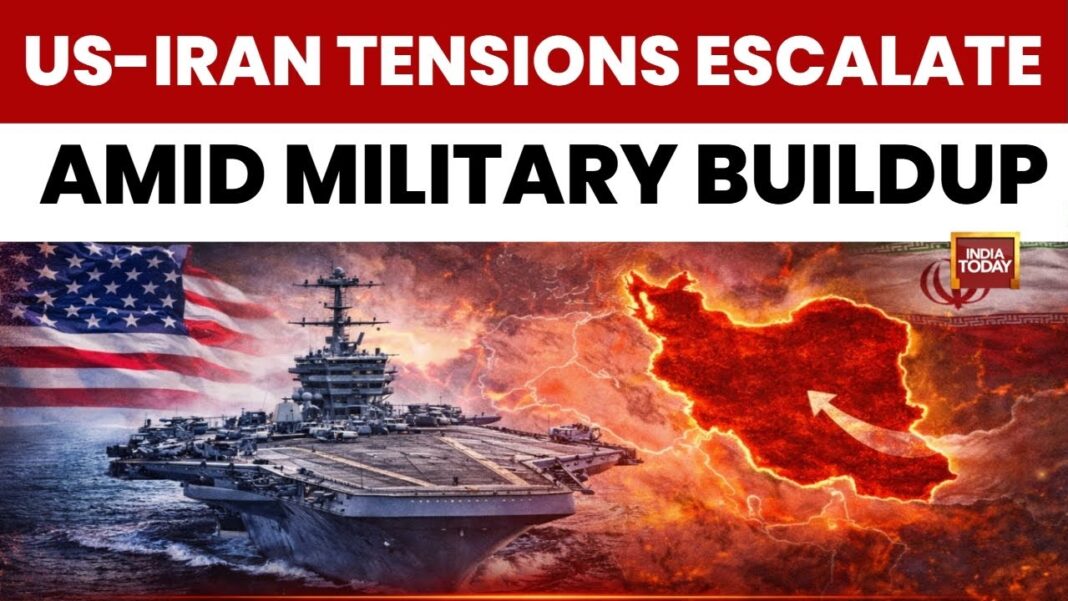
At the center of this military architecture is the USS Abraham Lincoln, a nuclear-powered aircraft carrier whose redeployment alone carries enormous symbolic and tactical weight. Originally operating in the South China Sea, the carrier changed course more than a week ago, pivoting decisively toward the Middle East. This redirection, highlighted by the VIN News report as a pivotal development, marks not just a geographic shift, but a recalibration of American strategic priorities — a message written not in diplomatic communiqués, but in tonnage, missile ranges, and air wings.
The Lincoln does not sail alone. It arrives as the flagship of a carrier strike group composed of Arleigh Burke-class destroyers — floating arsenals of modern warfare — each equipped with the Aegis combat system and Tomahawk cruise missiles capable of striking targets deep within Iranian territory. According to open-source intelligence cited by Global Defense News, the escort fleet includes the destroyers Spruance, Frank E. Petersen Jr., Michael Murphy, Bulkeley, Roosevelt, Oscar Austin, and Paul Ignatius. These vessels are not defensive ornaments; they are precision instruments of projection power, able to deliver coordinated strikes from distances measured in thousands of kilometers.
The technical architecture of these ships transforms the Persian Gulf and surrounding maritime corridors into a potential launch platform of unprecedented reach. Tomahawk cruise missiles, with operational ranges estimated between 1,500 and 2,500 kilometers, provide the United States with the capacity to strike strategic infrastructure, military installations, and command centers far inside Iranian territory without exposing aircrews to direct risk. As the VIN News report noted, this capability reflects a doctrinal shift toward standoff dominance — warfare conducted through precision, distance, and overwhelming technological superiority.
This naval power is complemented by an equally formidable aerial component. The air wing aboard the Abraham Lincoln includes nine squadrons, forming a self-contained airborne ecosystem of combat, support, and electronic warfare. F-35C stealth fighters provide fifth-generation penetration capability, designed to evade radar and neutralize advanced air defense systems. F/A-18E Super Hornets deliver multirole strike capacity, while EA-18G Growlers specialize in electronic warfare, capable of blinding enemy sensors and disrupting communications. Seahawk helicopters provide search-and-rescue and maritime security functions, while Osprey tilt-rotor aircraft enable rapid logistical support across vast operational distances.
Beyond the carrier group, the U.S. Air Force has quietly expanded its footprint across the region. Roughly a dozen F-15E strike fighters have been deployed to undisclosed bases, adding deep-strike and interdiction capacity. Existing deployments under U.S. Central Command already include F-35A stealth aircraft, F-16 multirole fighters, A-10 ground-attack aircraft, MQ-9 Reaper drones, and P-8A Poseidon maritime patrol platforms. Aerial refueling assets — including KC-135 and KC-46A tankers — ensure sustained operational endurance, allowing missions to extend far beyond traditional range limitations. The VIN News report underscored that this aerial infrastructure transforms the Middle East into a fully integrated battlespace, where air superiority, surveillance dominance, and strike precision converge into a single operational framework.
At sea, logistical sustainability has become a defining feature of the buildup. Destroyers Mitscher and McFaul are already operating in the Persian Gulf, supported by replenishment vessels Carl Brashear and Henry J. Kaiser. These ships ensure continuous resupply of fuel, munitions, and provisions, enabling long-term deployment without reliance on port infrastructure. The command ship Mount Whitney provides integrated command-and-control functions, coordinating operations across naval, air, and ground domains. The vessel Lewis B. Puller functions as a floating sea base, expanding the logistical and operational footprint of U.S. forces far from fixed installations.
Subsurface capabilities further deepen the strategic calculus. Nuclear-powered submarines South Dakota and Georgia are operating in the region, bringing stealth, intelligence-gathering, and strike capabilities beneath the surface. Armed with Tomahawk missiles and advanced surveillance systems, these submarines represent a silent deterrent — unseen, unannounced, but omnipresent. As the VIN News report emphasized, this undersea dimension transforms the military buildup from a visible show of force into a multidimensional deterrence structure that operates across every domain of modern warfare.
The strategic logic behind this deployment is as psychological as it is military. Deterrence in the 21st century is not merely about firepower; it is about perception, signaling, and the creation of inescapable strategic pressure. By surrounding Iran with overlapping layers of naval, aerial, cyber, and logistical capabilities, Washington is constructing what analysts describe as a containment architecture — a framework that leaves Tehran with diminishing strategic maneuverability.
President Trump’s public remarks reflect this dual-track strategy of rhetorical restraint and operational escalation. Speaking aboard Air Force One after returning from Davos, he acknowledged the buildup in stark terms: “We’re watching Iran. We have a lot of ships headed that way, a large fleet headed that way. We’ll see what happens. There is a big force moving toward Iran. I hope nothing happens, but we’re watching. We have a massive armada headed there, but maybe we won’t have to use it.” This language deliberately balances ambiguity and intimidation — signaling readiness without formal declaration, pressure without explicit escalation.
When asked whether he wanted Iran’s Supreme Leader, Ali Khamenei, to step down, Trump declined direct commentary but issued a pointed moral indictment: “They know what we want. There is a lot of killing.” The statement reframes the confrontation not merely as a geopolitical conflict, but as a moral struggle between authoritarian repression and international accountability — a narrative that resonates deeply within U.S. strategic culture and among its allies.
What emerges from this convergence of deployments, statements, and strategic positioning is a picture of calculated readiness rather than impulsive brinkmanship. As the VIN News report noted, the current buildup is not a reactionary mobilization, but a structured, layered, and sustainable deployment architecture — one designed to provide the United States with maximal flexibility across a spectrum of scenarios, from deterrence and containment to rapid escalation and direct engagement.
The symbolism is as powerful as the substance. Aircraft carriers, stealth fighters, nuclear submarines, and missile destroyers are not merely weapons platforms; they are instruments of geopolitical communication. They speak to allies, adversaries, and global markets simultaneously, signaling stability to some and warning to others. For Iran, the message is unmistakable: strategic isolation is no longer theoretical — it is operational, physical, and immediate.
For the broader region, the implications are profound. The Middle East is once again becoming the central theater of global power competition, not through proxy conflicts alone, but through direct great-power positioning. As the VIN News report observed, this marks a shift from indirect containment to overt strategic dominance — a reassertion of American military primacy at a moment when global order itself appears increasingly fragile.
In the final analysis, this military buildup is not simply about Iran. It is about credibility, deterrence, and the architecture of global power in a multipolar world. It reflects a doctrine in which presence equals influence, and readiness equals leverage. Whether the forces assembled will ever be used remains uncertain — and perhaps deliberately so. But their presence alone reshapes the strategic landscape, creating a new equilibrium defined by overwhelming capability and calibrated restraint.
As VIN News reported, one reality becomes increasingly clear: history may not remember this moment for the protests that faded from the streets of Iran, but for the silent armadas that moved across the seas — and the strategic message they carried with them.
