



|
Getting your Trinity Audio player ready...
|
By: Fern Sidman
A senior American diplomat has issued a stark warning that a new and potentially devastating conflict between Israel and Hezbollah could soon erupt if Lebanon fails to meet its commitments under the 2024 U.S.–French ceasefire accord, which ended Israel’s brief ground incursion into southern Lebanon late last year.
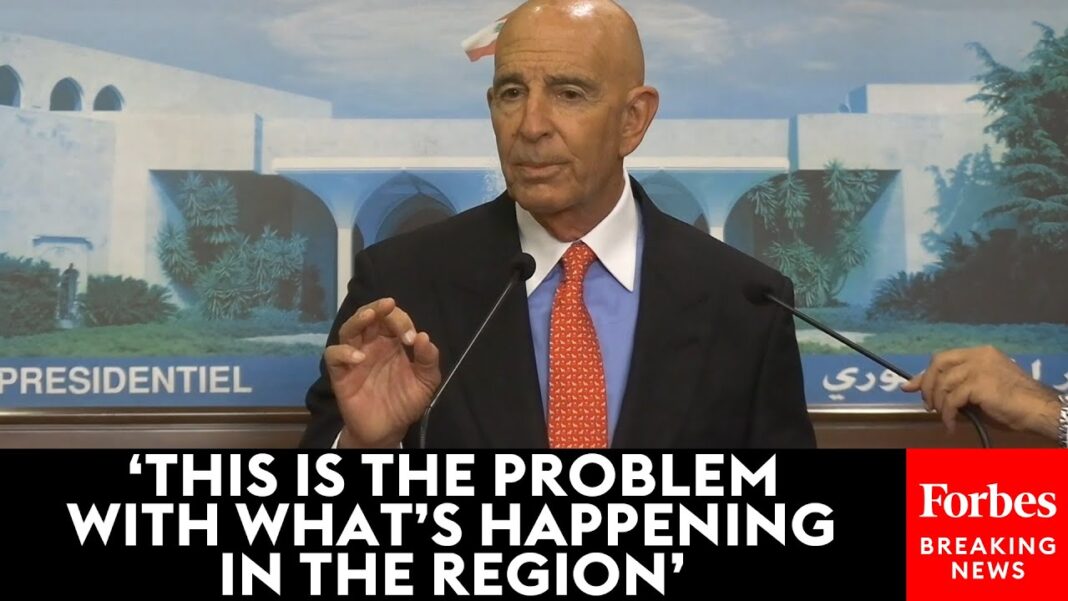
According to a report that appeared on Tuesday at World Israel News (WIN), Ambassador Tom Barrack, who represents the United States in both Turkey and Syria, cautioned that Hezbollah’s continued military entrenchment represents an existential threat not only to Israel’s security but also to Lebanon’s sovereignty. In a detailed post published Monday on his official X account, Barrack urged Beirut to act decisively to disarm the Iran-backed militia and reassert state control over its southern territories.
As World Israel News reported, Barrack’s remarks come amid growing frustration in Washington and Jerusalem over Lebanon’s slow implementation of the November 2024 ceasefire deal, which was brokered jointly by the Biden and Macron administrations. The agreement was hailed at the time as a diplomatic breakthrough: it compelled Israel to withdraw its ground forces from southern Lebanon in exchange for firm Lebanese commitments to remove Hezbollah fighters from the border area and to dismantle the group’s paramilitary infrastructure.
Under the accord, Beirut pledged to deploy its national army units south of the Litani River, filling the vacuum left by Hezbollah and preventing the return of any armed groups. Yet, nearly a year later, these commitments remain largely unfulfilled. Lebanon’s government has publicly claimed progress in seizing caches of weapons and dismantling some Hezbollah positions, but, as the World Israel News report emphasized, it has “failed to produce a concrete timetable for full disarmament”, particularly in the militant-dominated districts north of the Litani.
Analysts cited in the World Israel News report point out that Lebanon is facing a profound dilemma: acting too forcefully against Hezbollah risks domestic instability, while continued inaction invites Israeli retaliation. A recent Atlantic Council report described Beirut as being “stuck in the middle,” caught between Iranian influence on one side and Western diplomatic pressure on the other.
Barrack echoed that concern in his post, warning that Hezbollah’s foreign ties — particularly to Iran’s Islamic Revolutionary Guard Corps — had transformed the group into “a state within a state” that undermines Lebanon’s independence. “Hezbollah’s foreign control,” he wrote, “undermines Lebanon’s sovereignty, deters investment, and erodes public confidence. It is a constant red flag to Israel.”
His message to Beirut was direct and uncompromising: “Should Lebanon continue to hesitate, Israel may act unilaterally — and the consequences would be grave.”
According to the report on World Israel News, Barrack’s statement reflects growing unease within U.S. diplomatic and defense circles that Israel is preparing contingency plans for a preemptive military operation against Hezbollah’s fortified positions along the border. Over the past six months, Israeli forces have conducted multiple limited strikes on weapons depots, radar systems, and cross-border tunnels allegedly operated by Hezbollah.
Israeli intelligence officials believe that the group, emboldened by Tehran, has replenished much of its arsenal since the 2006 war and may be positioning itself for a new confrontation. The IDF Northern Command, according to the information provided in the World Israel News report, has been placed on heightened alert amid intelligence indicating that Hezbollah continues to deploy precision-guided missiles, anti-tank weapons, and drone systems near the frontier.
Barrack’s warning — that any further delay in Lebanon’s enforcement of the disarmament accord could trigger an Israeli offensive — underscores the fragility of the current ceasefire. “If Beirut fails to act,” he wrote, “Hezbollah’s military arm will inevitably face major confrontation with Israel at a moment of Israel’s strength and Iran-backed Hezbollah’s weakest point. Now is the time for Lebanon to act.”
The report at World Israel News noted that Hezbollah, originally formed in the 1980s as an Iranian proxy, has evolved into one of the most heavily armed non-state actors in the world, with an estimated arsenal of over 150,000 rockets and missiles. The group’s leadership has repeatedly declared that it would not surrender its weapons as long as Israel “occupies Palestinian lands” — a position that directly contradicts Lebanon’s obligations under both UN Security Council Resolution 1701 (2006) and the 2024 U.S.–French accord.
While Beirut insists that Hezbollah’s influence is waning, many regional experts cited in the World Israel News report argue the opposite: that the terrorist organization has further consolidated control over key sectors of Lebanon’s economy, border crossings, and intelligence networks. This entrenchment, they warn, makes it politically and practically difficult for the Lebanese Armed Forces to confront the group without plunging the country into civil conflict.
For its part, Iran has doubled down on its support for Hezbollah as part of its broader strategy to pressure Israel and the United States across multiple fronts, from Syria and Iraq to Yemen and the Red Sea. Tehran has dismissed Western calls for Hezbollah’s disarmament as “illegitimate interference,” claiming the group serves as a “defensive bulwark” against Israel.
U.S. officials speaking to World Israel News have described the situation as “increasingly untenable.” While the Trump administration remains committed to diplomacy, internal policy discussions reportedly acknowledge the growing likelihood that Israel may act independently if Lebanon fails to take decisive measures.
Israeli leaders, meanwhile, have publicly expressed dwindling patience. Senior members of the Netanyahu government told World Israel News last week that Hezbollah’s continued presence near the border constitutes “an immediate security threat” and violates the terms of the ceasefire agreement. One official was quoted as saying that “Israel will not sit idly by while Hezbollah rebuilds its war machine under the pretense of political paralysis in Beirut.”
Defense analysts argue that a renewed Israel–Hezbollah conflict could be far deadlier than the 2006 war, drawing in multiple regional players and potentially sparking a wider confrontation between Israel and Iran. Unlike in 2006, when the front was largely confined to southern Lebanon, today Hezbollah’s missile reach extends deep into Israeli territory, including Tel Aviv and Haifa.
Lebanon’s political paralysis further complicates the picture. The country has been without a fully functioning government for months, mired in economic collapse and sectarian gridlock. As the World Israel News report observed, Hezbollah’s political allies continue to hold significant influence in parliament, making any move toward disarmament a near-impossible task.
A former Lebanese defense official told World Israel News that “no Lebanese leader can confront Hezbollah without risking civil war. The state has neither the will nor the means to enforce the agreement.”
Yet Barrack’s warning leaves little room for ambiguity: inaction, too, carries catastrophic risk.
Diplomats across Europe and the Middle East are now bracing for what many see as a critical decision point. If Lebanon fails to show tangible progress in disarmament over the coming weeks, Israeli officials are expected to bring the issue before the UN Security Council — possibly demanding new enforcement mechanisms or international sanctions on Hezbollah-linked entities.
For Washington, the challenge lies in balancing its dual objectives: supporting Israel’s right to self-defense while preventing another regional war that could destabilize the entire Middle East.
In his concluding remarks, Barrack’s message was both urgent and admonitory: “Lebanon’s leaders must choose between sovereignty and subservience. The window for diplomacy is closing, and the consequences of failure will not be measured in words, but in lives.”
As tensions along the northern frontier continue to rise, Israel’s military readiness and Hezbollah’s defiance are steering the region toward a perilous crossroad. Whether Lebanon heeds the call for decisive action or allows inertia to dictate its fate may well determine whether the next Middle East war is days, weeks, or months away.