



|
Getting your Trinity Audio player ready...
|
By: Fern Sidman
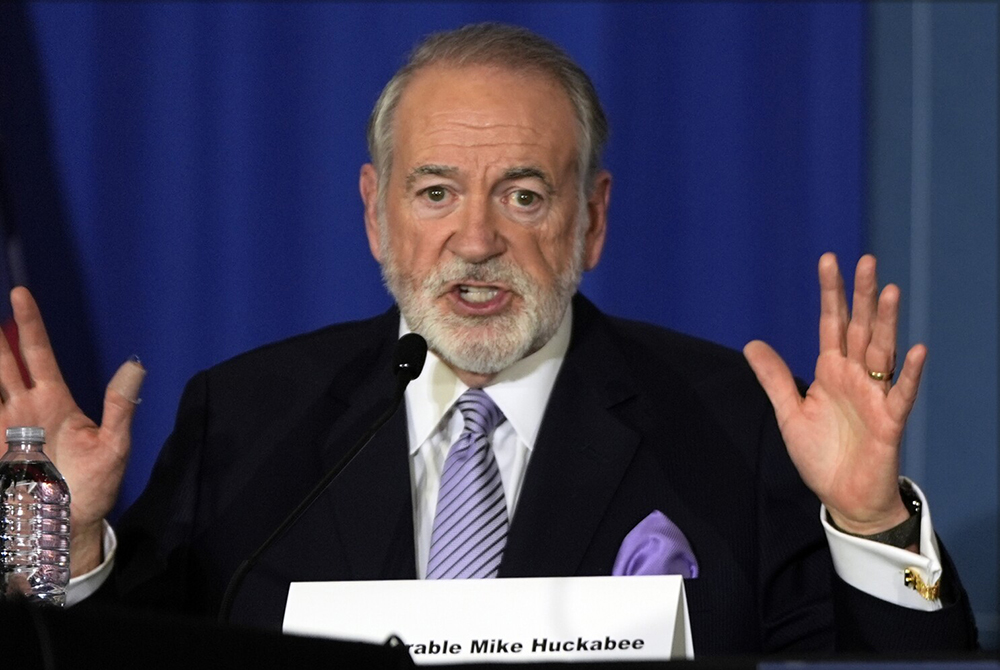
In the wake of a missile launched toward Jerusalem by the Iran-backed Houthi rebels in Yemen, U.S. Ambassador to Israel Mike Huckabee issued a striking call for military retaliation, suggesting the deployment of B-2 stealth bombers to neutralize the threat at its source. His comments, which followed a dramatic interception of the missile by Israel’s air defense systems on Tuesday evening, have intensified already volatile regional tensions and spotlighted the expanding scope of Iran’s proxy war against Israel.
“We thought we were done with missiles coming to Israel, but Houthis just lit one up over us in Israel,” Huckabee wrote on X (formerly Twitter), referring to the sudden missile launch from Yemen that triggered sirens across Jerusalem and Israel’s central region. “Fortunately, Israel’s incredible interception system means we go to the shelter and wait until all clear. Maybe those B-2 bombers need to visit Yemen!”
As reported by The Jerusalem Post, the missile was successfully intercepted by Israel’s multilayered missile defense network, believed to be the Arrow system, which is designed to neutralize long-range ballistic threats. No injuries or physical damage were reported, but the psychological impact was immediate: a direct reminder that Iranian-allied militias, even hundreds of miles away, retain the capability—and audacity—to target the Israeli heartland.
Ambassador Huckabee’s remarks swiftly drew international attention not only for their candor but for the strategic implications of involving America’s most elite aerial asset in another theater. The B-2 Spirit bomber, an icon of U.S. air superiority, was most recently deployed in Operation Midnight Hammer, the U.S.-led assault that devastated Iran’s nuclear infrastructure. According to Pentagon sources cited by The Jerusalem Post, more than 30 tons of ordnance were dropped in the strike—reportedly leveling multiple fortified nuclear facilities across Iran.
🚨After the launch, US Ambassador to Israel Mike Huckbee:” Maybe those B2 bombers need to visit Yemen!”… https://t.co/7rrxhVwjbB pic.twitter.com/5qXQ31cOE7
— Raylan Givens (@JewishWarrior13) July 1, 2025
President Donald Trump hailed the Iran operation as a “historic military success,” with The Jerusalem Post quoting U.S. officials who described the bombers’ performance as delivering a blow so severe that it would take years for Iran to reconstruct its nuclear capability. The possibility of now turning such devastating power toward the Houthis marks a significant escalation in U.S. posture—one that could redraw the contours of American engagement in the Middle East.
Only 20 B-2 bombers exist in the U.S. Air Force inventory, making them an exceptionally rare and high-value asset. Their stealth capabilities and range make them ideal for penetrating heavily defended airspace, a feature critical in both the Iran strike and any future engagement over Yemen’s rugged terrain and fortified rebel positions.
The Jerusalem Post report emphasized that Huckabee’s comments reflect the growing frustration within Israeli and American leadership circles regarding the persistent missile and drone assaults from Iranian proxies—particularly the Houthis, who have launched dozens of attacks on Israel, Saudi Arabia, and international shipping since the outbreak of the Gaza war in October.
Israeli Defense Minister Israel Katz echoed the ambassador’s combative tone, writing on social media, “The law of Yemen is the law of Tehran. After we strike the head of the serpent in Tehran, we will also strike the tail of the serpent in Yemen.” The metaphor underscores a long-held Israeli doctrine: attacks from Iranian-backed groups will not be treated as isolated incidents but as extensions of Iranian aggression.
Indeed, The Jerusalem Post has frequently noted that Israel views the Houthis’ involvement not as a localized crisis, but as part of a wider regional chessboard in which Tehran mobilizes proxies from Gaza to Lebanon to Yemen in pursuit of strategic encirclement.
While the Trump administration has thus far favored targeted naval and drone strikes against Houthi positions in coordination with allies, Ambassador Huckabee’s proposal introduces the possibility of high-impact aerial warfare as a deterrent.
Whether the Pentagon will heed such calls remains to be seen. Still, as The Jerusalem Post report observed, the ambassador’s comments are indicative of a broader strategic realignment in the wake of Operation Midnight Hammer—one that sees the U.S. and Israel increasingly willing to project power deep into enemy territory to forestall future threats.
For now, Jerusalem remains intact—but the skies above it continue to reveal the widening dimensions of a conflict that refuses to remain confined.
