



|
Getting your Trinity Audio player ready...
|
By: Fern Sidman
The United Nations Security Council convened in New York on Tuesday for its annual debate on sexual violence in conflict, a session that this year unfolded against a backdrop of extraordinary tension between Israel and the international body. The debate came days after U.N. Secretary-General António Guterres issued his annual report on conflict-related sexual violence, a report that for the first time included Hamas in its annex of offenders. Yet, even as the inclusion of the Palestinian terrorist group marked a historic acknowledgment of atrocities committed during the October 7, 2023, massacre, Guterres simultaneously warned Israel that it too risked being blacklisted in the coming year.
The juxtaposition of Hamas’s formal censure with a warning leveled against Israel encapsulated the fraught and often adversarial relationship between Jerusalem and the U.N.—a dynamic underscored in a report on Wednesday at The Jewish News Syndicate (JNS), which has documented both the horror of Hamas’s crimes and the politicized debates within international institutions that frequently shift blame toward Israel.
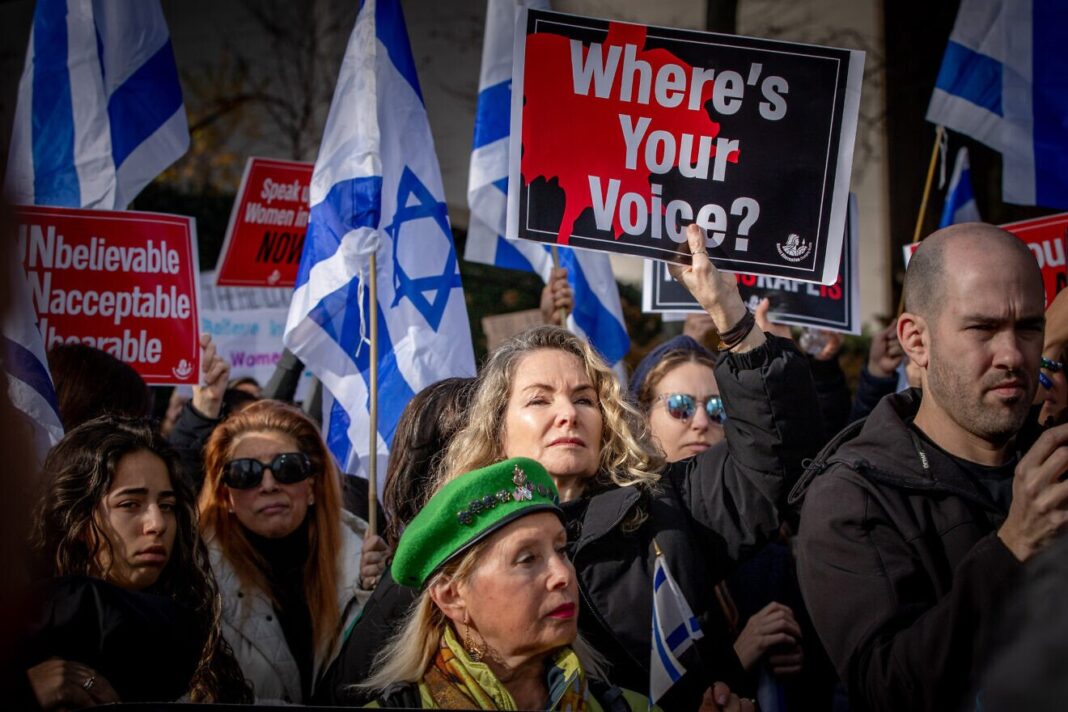
For Israel, the decision to formally include Hamas on the sexual violence blacklist represents, in the words of First Lady Michal Herzog, “a long time coming.” Addressing reporters ahead of the Security Council debate, Herzog declared unequivocally: “The world must understand: Hamas uses rape as a weapon.” She described the atrocities committed on October 7—rape, gang rape, genital mutilation, sexual abuse in captivity—not as incidental horrors of war but as “deliberate, premeditated and systematic tools of terror.”
Her remarks were supported by earlier findings from Pramila Patten, the U.N. special representative on sexual violence in conflict, whose groundbreaking report last year found “clear and convincing information” that hostages abducted to Gaza had been subjected to sexual violence. Patten concluded there were reasonable grounds to believe that conflict-related sexual violence occurred in multiple locations on the day of the Hamas assault.
As JNS has emphasized in its extensive reporting on the aftermath of October 7, survivor testimonies, forensic evidence, and accounts from released hostages have coalesced into a body of evidence too overwhelming for the international community to ignore. The inclusion of Hamas on the list of offenders thus represents an important recognition by the U.N., albeit one that Israelis and Jewish advocates say should have occurred far earlier.
During Tuesday’s session, U.N. member states weighed in with carefully measured statements. James Kariuki, the deputy U.N. ambassador for the United Kingdom, acknowledged the sexual violence perpetrated in Israel and the Palestinian territories, calling for “all reports of abuses by all parties to be fully investigated.” His comments reflected a recurring theme: the attempt to balance condemnation of Hamas with calls for investigations into Israel, an equivalence that has drawn criticism from Israeli diplomats and observers.
Denmark’s deputy U.N. ambassador, Sandra Jensen Landi, noted her country’s recognition of Hamas’s inclusion on the blacklist, stressing that “there must be accountability for all these violations.” Yet she too urged Israel to grant “unimpeded access for monitoring purposes,” echoing Guterres’s assertion that a lack of access for U.N. monitors was hampering definitive assessments.
Hedda Samson, representing the European Union, expressed “deep concern” about conflict-related sexual violence by both state and non-state actors, including Hamas. She described Guterres’s warning to Israel as “unusual,” explaining that it reflected the difficulty of establishing definitive patterns due to Israel’s “consistent denial of access for U.N. monitors.”
Israel’s ambassador to the United Nations, Danny Danon, was unequivocal in rejecting the secretary-general’s warning. In a sharply worded response, Danon denounced the accusations of sexual violence in Israeli prisons, detention centers, and military bases as “baseless.” He urged the U.N. to turn its attention to the real crisis: “the horrific war crimes committed by Hamas and the immediate release of all the hostages.”
Danon nevertheless welcomed Hamas’s blacklisting, suggesting it could serve as leverage in pushing countries that have not yet designated Hamas as a terrorist organization to finally do so. As JNS reported, Danon also emphasized that while recognition of Hamas’s crimes is an important milestone, true justice requires international action to hold the perpetrators accountable and to ensure that sexual violence is never again weaponized against civilians.
Among Israeli advocacy groups, the blacklisting of Hamas has been hailed as a landmark development. The Dinah Project, an Israel-based initiative dedicated to justice for victims of conflict-related sexual violence, described the move as “a watershed moment.”
Professor Ruth Halperin-Kaddari, director of the Ruth and Emanuel Rackman Center for the Advancement of the Status of Women at Bar-Ilan University, said in a statement that the inclusion of Hamas in the report “sends an unmistakable message: The world sees these crimes, names them and will not allow them to be erased from history.”
But Halperin-Kaddari, like many quoted in the JNS report, was quick to stress that recognition alone is insufficient. “The next step must be swift prosecution and global condemnation of those responsible, ensuring these crimes are never again deployed as a weapon of war,” she said.
Despite the welcome acknowledgment of Hamas’s atrocities, Israel found itself facing new scrutiny. In his letter to Danon, Guterres warned that Israel could be placed on the sexual violence blacklist in next year’s report due to “significant concerns of patterns of certain forms of sexual violence” in detention facilities, prisons, and one military base.
The warning, according to the report at JNS, is based not on verified patterns but on allegations that have yet to be substantiated, and on Israel’s refusal to grant U.N. monitors the access Guterres insists is necessary. The secretary-general has urged Israel to provide “unfettered access” to investigate allegations related to Palestinian detainees, adding that Israel should itself investigate and prosecute credible cases.
Israeli officials view the warning as emblematic of the U.N.’s long-standing bias. As JNS has repeatedly highlighted, Israel has often faced disproportionate scrutiny within international forums, even as terrorist groups such as Hamas operate with impunity until overwhelming evidence compels acknowledgment.
The debate in New York also called attention to a broader struggle over narrative. For Israel, the October 7 atrocities remain a moral and historical watershed, demanding clear and unambiguous international condemnation of Hamas. For many in the U.N. system, however, the imperative to maintain “balance” in discourse results in Israel itself being scrutinized in ways that are clearly politically motivated.
Michal Herzog’s remarks epitomized the Israeli frustration: “If the international community fails to condemn them, in both action and words, we risk seeing more such crimes repeated in other conflicts across the globe.” As the JNS report observed, her statement sought to reframe the discussion—not merely as an Israeli issue, but as a global one, in which Hamas’s crimes must be recognized as part of a broader threat to international norms.
The blacklisting of Hamas is likely to reverberate across diplomatic circles. As Danon noted, the move strengthens Israel’s hand in urging countries that have resisted labeling Hamas a terrorist organization to reconsider. It also sets the stage for possible legal proceedings under international frameworks, including potential prosecutions in international courts.
At the same time, Israel’s warning raises the prospect of future confrontations with the U.N., particularly if Jerusalem refuses to grant access to monitors. As JNS reported, Israeli officials are weighing how to respond without appearing to legitimize the UN’s spurious accusations.
For advocates of women’s rights and victims of conflict-related sexual violence, the developments mark both progress and peril. The inclusion of Hamas affirms the voices of survivors, yet the simultaneous warning to Israel risks muddying the moral clarity of the moment, creating an equivalence that is patently false and without merit.
Tuesday’s debate at the U.N. marked a turning point in the international community’s response to sexual violence in the Israel-Hamas conflict. The blacklisting of Hamas is a long-overdue acknowledgment of atrocities that survivors, Israeli officials, and advocacy groups have painstakingly documented since October 7. Yet the simultaneous warning to Israel ensures that the discourse will remain contentious, with Jerusalem resisting politically motivated allegations.
As JNS has reported, the stakes extend far beyond the immediate conflict. The recognition of Hamas’s crimes—and the debate over Israel’s potential inclusion on the blacklist—speak to the larger question of whether the international system can effectively confront the use of sexual violence as a weapon of war without succumbing to political pressures that distort accountability.
For now, the message to Hamas is clear: its crimes have been named, and history will not forget. Whether the world has the resolve to ensure justice for victims, however, remains an open and urgent question.
