



|
Getting your Trinity Audio player ready...
|
By: Fern Sidman – Jewish Voice News
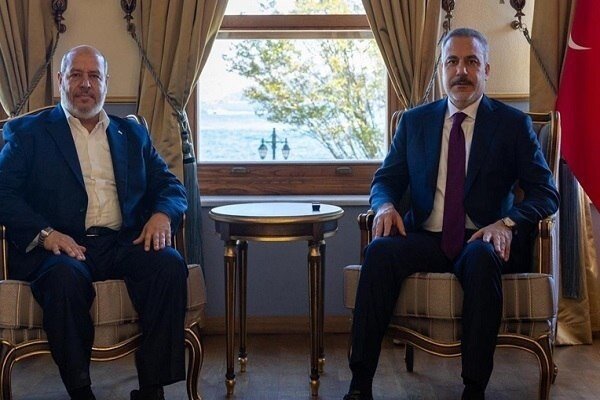
In a move drawing sharp scrutiny across the Middle East and beyond, Turkish Foreign Minister Hakan Fidan met in Istanbul on Saturday with senior Hamas officials — including Khalil al-Hayya, one of the terror organization’s top political figures and a key negotiator in ceasefire talks. As i24 News reported on Saturday, the meeting comes just days before the scheduled summit of foreign ministers from the so-called “guarantor countries” — Qatar, the United Arab Emirates, Turkey, and Saudi Arabia — convening in Istanbul to review the progress and failures of the U.S.-brokered Gaza ceasefire plan.
According to Turkey’s Foreign Ministry, the discussions centered on “the state of the ceasefire and the delivery of humanitarian aid.” Yet observers note that Ankara’s willingness to host Hamas’s leadership — only weeks after Israel’s targeted strike on the group’s Doha-based command — sends a deeper geopolitical signal. As the i24 News report highlighted, the meeting shines a spotlight on Turkey’s enduring role as a key patron of Hamas and an increasingly assertive player in post-war Gaza’s political landscape.
The Istanbul meeting, as i24 News reported, was attended by al-Hayya and several senior members of Hamas’s political bureau. Al-Hayya, who survived the Israeli airstrike in Qatar last month that killed several of his aides, remains one of the group’s most influential figures and a central player in negotiations surrounding the fragile ceasefire that began on October 10.
For Turkey, the optics of this encounter are telling. Hosting Hamas officials on the eve of a high-profile diplomatic gathering places Ankara at the nexus of both regional diplomacy and Islamist advocacy — a position that aligns with President Recep Tayyip Erdogan’s longstanding ambition to cast Turkey as the protector of the Palestinian cause.
Fidan, a former intelligence chief who has emerged as Erdogan’s chief strategist on Middle Eastern affairs, has repeatedly argued that Turkey must have a decisive say in the rebuilding and governance of Gaza. By meeting Hamas leaders directly, Fidan sought to reassert that claim — a message not lost on Israel, Washington, or the Arab capitals participating in Monday’s talks.
As the i24 News report noted, the Istanbul summit of guarantor states was originally conceived as a mechanism to ensure the ceasefire’s enforcement and to coordinate humanitarian relief. But Turkey’s parallel engagement with Hamas has raised questions about whether Ankara intends to act as a mediator — or as an advocate for Hamas’s continued influence in Gaza.
Since the U.S.-brokered truce went into effect nearly three weeks ago, the situation in Gaza has remained volatile. While active combat between Israeli forces and Hamas has largely ceased, the jihadist organization has reasserted control over key areas of the enclave, often through brutal crackdowns on Palestinians accused of collaborating with Israel or opposing Hamas rule.
i24 News reported that in several districts, Hamas fighters have carried out executions and public beatings, reestablishing their dominance through intimidation and violence. The organization’s ruthless campaign has deepened fears among Gazans that the ceasefire — intended to pave the way for reconstruction and political reform — could instead consolidate Hamas’s grip on power.
For Israel, the developments present a grim paradox. While the truce has enabled the partial return of hostages and the flow of humanitarian aid, it has also given Hamas breathing room to regroup militarily and politically. Israeli officials have warned that the group’s survival threatens to derail any post-war stabilization plan.
In a chilling reminder of the conflict’s human toll, the i24 News report confirmed that Israel determined the partial remains of three deceased individuals handed over by Hamas overnight were not among the known hostages still held in Gaza. The discovery calls attention to the murky and blatantly deceptive nature of Hamas’s dealings during the truce — tactics that have prolonged the agony of hostage families and tested Israel’s restraint.
As i24 News has extensively documented, the hostage issue remains the most emotional and politically charged element of the ongoing ceasefire. Since the October 10 truce took effect, Hamas has released 20 living hostages and transferred the remains of 17 others to Israel. Yet intelligence estimates suggest that the bodies of at least 11 hostages remain inside Gaza, alongside several others believed to be alive but in poor health.
The partial transfers of remains — some of them unidentified or incomplete — are widely viewed in Israel as psychological warfare, intended to sow confusion and despair. A senior Israeli security source told i24 News that Hamas’s pattern of withholding and selectively releasing information “is meant to maintain leverage, to play on the emotions of families, and to keep the international spotlight fixed on Gaza on its terms.”
Behind the scenes, the United States has been pressing for further releases while coordinating with Egypt and Qatar, both of which serve as intermediaries with Hamas. However, as i24 News reported, these diplomatic efforts have been undermined by Hamas’s renewed internal purges and by Turkey’s willingness to host its leaders — a move seen by Jerusalem as legitimizing a terrorist organization at a time when it should be isolated, not emboldened.
Turkey’s engagement with Hamas is neither new nor subtle. Over the past decade, Ankara has provided political refuge to Hamas figures, granted them Turkish passports, and allowed the group to raise funds and coordinate activities within its borders. While Erdogan presents this as “support for the Palestinian resistance,” Western and Israeli officials have described it as direct state sponsorship of terrorism.
i24 News has consistently noted that Turkey’s outreach to Hamas is part of Erdogan’s broader foreign policy strategy — one aimed at reviving Turkey’s Ottoman-era role as the leader of the Muslim world. By embracing Hamas, Ankara not only asserts ideological leadership but also gains leverage over rivals such as Saudi Arabia and Egypt, whose governments have taken a more pragmatic approach to Israel.
In this context, Saturday’s meeting with al-Hayya was more than a diplomatic formality. It was a calculated signal to regional and international audiences that Turkey intends to remain central to any future arrangement in Gaza, regardless of Israeli objections.
Israeli officials, speaking to i24 News, reiterated their opposition to Turkish involvement in post-war Gaza administration. Prime Minister Benjamin Netanyahu has declared that Turkey’s participation in any peacekeeping or reconstruction force is “a red line.” Israeli analysts fear that Ankara’s presence — under the guise of humanitarian support — could provide Hamas with political cover and renewed access to resources.
The ceasefire itself, though publicly hailed as a diplomatic breakthrough, is under increasing strain. The two-year war, which began with Hamas’s October 7, 2023 massacre, left 1200 Israelis brutally murdered and 251 others taken captive by the Iranian-backed terrorist group. The truce, brokered by Washington and supported by Arab allies, was intended as a prelude to disarmament and reconstruction. Yet, as i24 News reported, key provisions — notably Hamas’s disarmament — remain unresolved.
In recent days, sporadic clashes have erupted between Hamas fighters and Israeli engineering units operating along the buffer zones. At least one Israeli soldier was injured earlier this week, prompting limited retaliatory strikes by the Israel Defense Forces (IDF). These incidents have cast doubt on whether Hamas intends to honor the ceasefire in good faith or is merely regrouping for the next confrontation.
An Israeli defense analyst told i24 News that “Hamas is exploiting the truce to reorganize its forces, replenish its weapons caches, and eliminate rivals. It’s the same pattern we saw after previous ceasefires — a lull before another storm.”
Monday’s Istanbul conference of guarantor countries will test whether regional diplomacy can salvage the ceasefire’s promise. The presence of Turkey — now openly engaging Hamas — complicates efforts to present a unified front. The UAE and Saudi Arabia, while supportive of the U.S. peace framework, have reportedly grown wary of Turkey’s ambitions, fearing that Ankara’s Islamist leanings could destabilize the fragile regional consensus.
As the i24 News report observed, the meeting will focus on aid distribution, security coordination, and governance mechanisms for Gaza’s reconstruction. Yet the fundamental question remains unanswered: who will govern Gaza when the guns fall silent?
Turkey, through its outreach to Hamas, appears determined to stake a claim in that answer. But for Israel and its allies, any arrangement that leaves Hamas intact — or grants Ankara undue influence — risks turning Gaza’s fragile truce into a prelude to renewed conflict.
As the Istanbul talks approach, the uneasy calm in Gaza mirrors the broader tensions defining the Middle East today — competing powers vying for influence, fragile truces masking deeper hostilities, and diplomatic overtures shadowed by ideological agendas.
The i24 News report concluded that Turkey’s embrace of Hamas at such a critical juncture represents both a challenge and a warning: a reminder that in the Middle East’s shifting landscape, ceasefires can become opportunities for repositioning rather than reconciliation.
For now, the world watches Istanbul — a city once at the crossroads of empires, now again at the intersection of conflict and diplomacy — where the fate of Gaza’s truce, and perhaps the shape of the region’s next phase, will be quietly negotiated.
