



Trump Weighs U.S. Military Response to Iran as White House Confirms Critical Two-Week Decision Window
By: Fern Sidman
President Donald J. Trump is expected to make a final decision on whether to initiate U.S. military action against Iran within the next two weeks, White House Press Secretary Karoline Leavitt confirmed Thursday during a high-stakes press briefing that signaled a new level of strategic ambiguity amid rising tensions in the Middle East.
The president’s decision-making timeline comes at a volatile moment in the escalating standoff between Israel and the Islamic Republic of Iran, as ballistic missiles rain across Israeli cities and regional actors recalibrate their alignments in the face of deepening conflict. While Trump has remained characteristically opaque about the precise contours of American involvement, Thursday’s statement marked the clearest public indication to date that a major U.S. military decision is imminent.
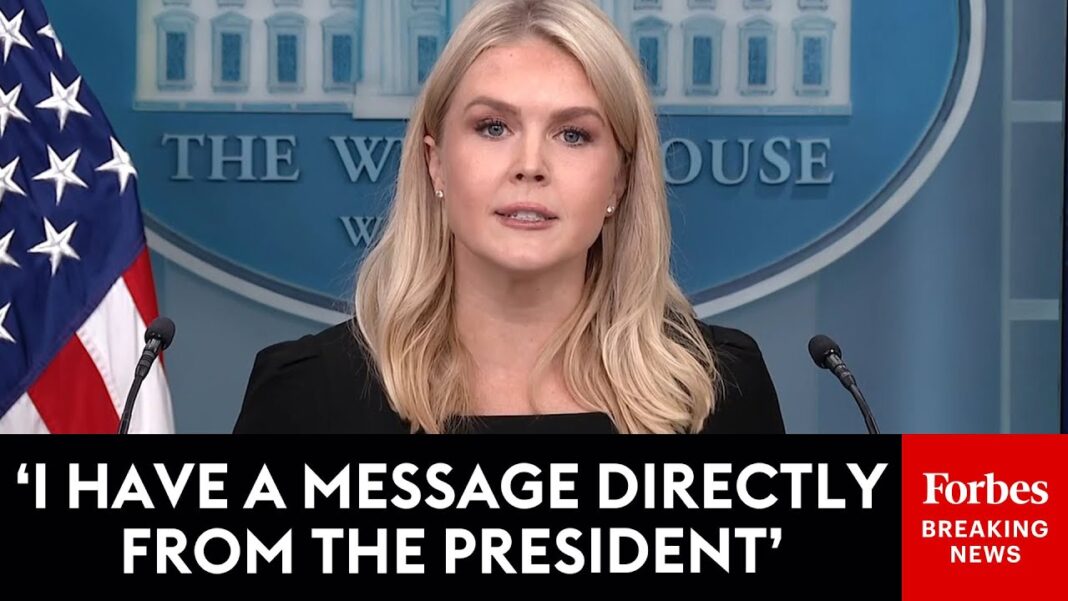
“I have a message directly from the president,” Leavitt told reporters in the White House briefing room. “And I quote: ‘Based on the fact that there’s a substantial chance of negotiations that may or may not take place with Iran in the near future, I will make my decision whether or not to go within the next two weeks.’”
Though couched in conditional language, the president’s words suggest that diplomacy, while still on the table, is no longer assumed to be the default resolution mechanism—a shift that reflects the complex and increasingly perilous calculus surrounding Iran’s escalating aggression and its nuclear ambitions.
As media outlets have reported, President Trump has been conducting frequent briefings in the White House Situation Room, consulting top national security advisers, military commanders, and regional intelligence analysts. According to senior administration sources, the deliberations have focused on a spectrum of options ranging from intensified economic sanctions and cyber operations to targeted airstrikes on Iranian Revolutionary Guard Corps (IRGC) facilities in Syria, Iraq, and possibly within Iran’s borders.
The mere invocation of the Situation Room—often reserved for decisions involving active theaters of war— emphasizes the seriousness with which the administration views the present crisis.
While the White House has not confirmed whether a National Security Council (NSC) vote is forthcoming, aides privately acknowledge that the military’s readiness posture has been elevated across several Central Command (CENTCOM) assets, including aircraft carriers now operating in the Persian Gulf and Eastern Mediterranean.
Trump’s remarks, although brief, were notably deliberate in their ambiguity. His phrasing—“may or may not get involved”—is reminiscent of the rhetorical tactics he employed during the North Korea missile crisis and the 2020 Soleimani operation, where unpredictability became a tool of deterrence as much as diplomacy.
Analysts are divided on whether the current stance reflects a genuine commitment to negotiation or a calibrated threat designed to pressure Tehran into de-escalation.
“The two-week window is not just a timeline—it’s a warning,” said Dr. Evelyn Parker, senior fellow at the Atlantic Security Institute. “It’s designed to force Iran’s hand, to either come to the table or brace for a targeted, forceful response. The ambiguity is the point.”
Iranian officials, for their part, have not signaled an interest in open diplomacy, though unofficial channels—via European intermediaries and Gulf backchannels—are reportedly being tested.
Back in Washington, the potential for U.S. military engagement in another Middle Eastern conflict has reignited partisan debate. Supporters of the president, including key congressional allies, have framed Trump’s stance as a necessary show of strength in the face of Iranian provocation, particularly following reports of cluster bomb missile strikes on Israeli cities and the targeting of hospitals and civilian infrastructure.
Critics, however, warn that a miscalculation could lead to a regional conflagration with grave humanitarian and economic consequences. Already, oil markets have registered spikes in futures pricing, and the Pentagon has issued a “force protection condition” alert for bases across the Gulf region.
Foreign governments are watching closely. While Israel has openly welcomed the possibility of increased U.S. coordination, European capitals have urged restraint, cautioning that even a limited strike could unravel fragile regional balances and trigger further proxy confrontations.
President Trump’s decision—expected before early July—could define the next phase of American foreign policy in the Middle East and set the tone for broader global security architecture. Whether through a carefully negotiated off-ramp or a precision-guided military campaign, the stakes for both Washington and Tehran could not be higher.
In the words of one senior administration official speaking on background: “The president knows this is a moment that will be judged by history. He’s listening. He’s weighing. But make no mistake—he’s ready to act.”
