



|
Getting your Trinity Audio player ready...
|
By: Fern Sidman
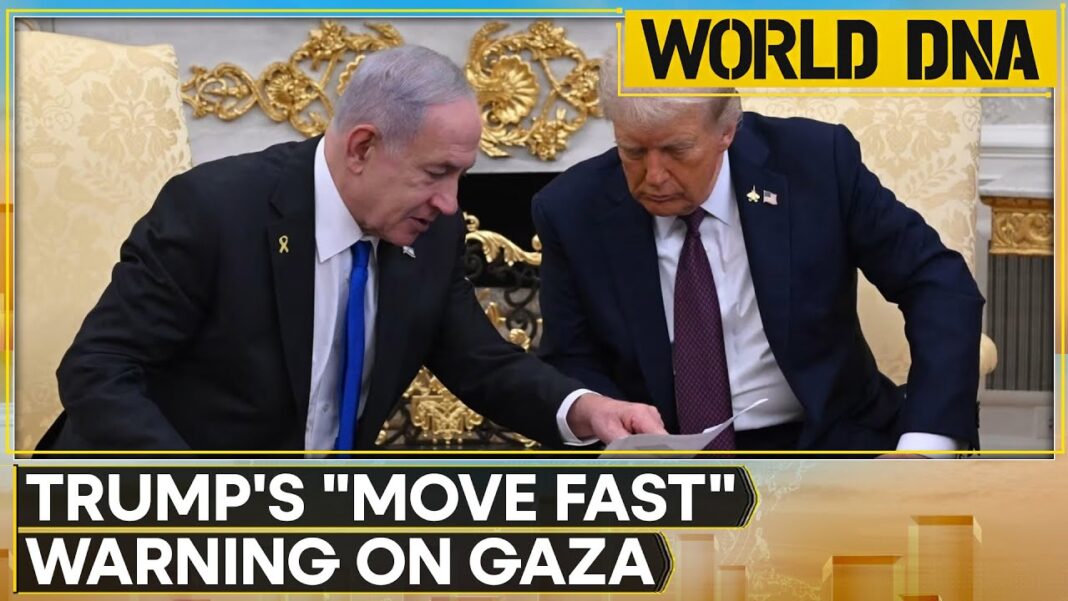
As the Gaza conflict grinds toward another critical juncture, President Donald Trump on Sunday issued his most pointed warning yet to Hamas: agree to his ceasefire and hostage release proposal immediately, or risk what he described as “massive bloodshed.” His remarks, delivered on his Truth Social platform, underscored both the urgency and fragility of negotiations set to resume in Egypt this week.
According to a report that appeared on Sunday at Israel National News (INN), an Israeli delegation led by senior envoys arrived in Sharm el-Sheikh alongside representatives from Hamas, with Egyptian officials serving as hosts and Qatari mediators in attendance. The stakes could not be higher, as the talks are expected to address both the immediate return of hostages held since the October 7 massacres and the longer-term question of Gaza’s governance after the war.
“There have been very positive discussions with Hamas, and countries from all over the world (Arab, Muslim, and everyone else) this weekend, to release the hostages, end the war in Gaza but, more importantly, finally have long-sought PEACE in the Middle East,” Trump wrote on Sunday. “The technical teams will again meet Monday, in Egypt, to work through and clarify the final details. I am told that the first phase should be completed this week, and I am asking everyone to MOVE FAST. I will continue to monitor this centuries-old conflict. TIME IS OF THE ESSENCE OR, MASSIVE BLOODSHED WILL FOLLOW — SOMETHING THAT NOBODY WANTS TO SEE!”
The rhetoric echoed comments he made a day earlier, when he warned that Hamas risked “complete obliteration” if it clung to its hold over Gaza and rejected concessions.
The Israel National News (INN) report noted that Trump’s threats were designed not merely as bluster but as a calculated attempt to accelerate negotiations that have too often stalled amid Hamas’s demands for ceasefires without disarmament and Israel’s insistence on hostages being freed before any major withdrawal of forces.
On Friday, Trump had already signaled cautious optimism, declaring it “a big day” and describing Hamas’s initial response as “unprecedented.” The president, who has framed himself as the only global leader capable of forging an end to the war, suggested that both Israel and Hamas were closer to agreement than at any previous stage.
“The first phase should be completed this week,” he said, referring to the exchange of hostages for a temporary repositioning of Israeli troops within Gaza. Yet Trump’s insistence on speed reflects a deep concern that Hamas could use the negotiations as a delaying tactic, while mounting pressure on Israel to halt its military operations.
Prime Minister Benjamin Netanyahu has publicly confirmed that Israel has agreed to Trump’s framework but conditioned its implementation on the full release of all remaining hostages, both living and deceased. As INN reported, Netanyahu told bereaved families at a Heroes Forum gathering that Israel “will not proceed to any of the 21 clauses until the first clause — the release of all the hostages, the living and the dead — until the very last hostage, all of them, have crossed into Israeli territory.”
Defense Minister Israel Katz added further pressure, warning that if Hamas attempted to stall or renegotiate, Israel would resume intensified military operations. “The strength of the pressure exerted by Israel and the intensity of the IDF’s maneuver in Gaza City are the reasons for the possible shift in Hamas’s position,” Katz said at a memorial ceremony.
Reports carried by Arab media suggest Hamas has attempted to straddle the line between agreement and defiance. According to Al-Arabiya, Hamas has begun locating and collecting the bodies of deceased hostages, asking Israel to halt airstrikes to facilitate this process. At the same time, Hamas has conveyed willingness — through Qatari intermediaries — to hand over weapons to a Palestinian-Egyptian body under international supervision.
The INN report emphasized that Hamas’s response remains riddled with caveats. While it signaled readiness to release hostages, it has tied their return to “field conditions” and sought assurances of Israeli withdrawal. For Jerusalem, such ambiguity is a red flag, fueling concerns that Hamas is maneuvering to secure concessions while preserving its core leadership and military apparatus.
Trump’s voice has dominated the weekend’s exchanges. By leveraging his credibility with both Arab partners and Israel’s leadership, he has injected new urgency into a process that has repeatedly faltered since the war began.
INN reported that American officials have privately acknowledged “flexibility” in Trump’s plan, including phased implementation and the potential for international oversight of Gaza’s demilitarization. Such concessions may be critical to securing Hamas’s compliance, but they raise questions in Israel about the risk of legitimizing a terror group responsible for the deadliest single-day massacre of Jews since the Holocaust.
For the families of hostages, the weekend’s developments brought both hope and renewed anxiety. The Hostages and Missing Families Forum welcomed signs of progress but warned against premature celebration. “We have heard promises before,” one spokesperson told INN, “but what matters is not statements from Hamas or Trump’s optimism. What matters is our loved ones returning alive.”
The more hawkish Heroes Forum, representing families of October 7 victims and fallen soldiers, took a firmer stance, backing Netanyahu’s refusal to proceed with any concessions until all hostages are released. “There can be no next stage, no demilitarization, no withdrawal lines until every last hostage is home,” members declared.
Diplomats involved in the process caution that Monday’s meetings in Egypt may be decisive. Technical experts are tasked with ironing out details such as sequencing of releases, monitoring of Israeli withdrawals, and mechanisms for verifying compliance. Trump’s demand that the “first phase” be completed this week has placed negotiators under enormous pressure, but failure could trigger a rapid escalation.
The INN report observed that Netanyahu’s government has deliberately refrained from announcing a public timetable, wary of creating expectations that Hamas could exploit. Instead, officials have stressed the importance of maintaining military pressure while pursuing diplomacy.
Trump’s involvement is not without political undertones. As he mounts a campaign for re-election, success in brokering a ceasefire and hostage release would bolster his image as a statesman capable of achieving what his predecessors could not: peace in the Middle East. Yet his stark warning of “massive bloodshed” if talks collapse also reflects a recognition that failure could plunge the region into even greater chaos.
INN analysts suggest that Trump’s dual approach — offering Hamas a chance for legitimacy through negotiations while threatening annihilation if it refuses — is a calculated gamble designed to box the group into compliance. Whether Hamas interprets his threats as credible remains to be seen.
As delegations gather in Sharm el-Sheikh, the world’s eyes are fixed on a narrow diplomatic corridor that could reshape the trajectory of the Gaza war. Trump’s blunt warning — “time is of the essence” — encapsulates both the urgency of the moment and the peril of delay.
For Israel, the priority remains clear: the safe return of its hostages and the dismantling of Hamas as a military power. For Hamas, survival may depend on navigating concessions without appearing to capitulate. For Trump, success or failure in this effort could define not only his legacy but the future stability of the Middle East.
As the INN report observed, “The coming days will determine whether Gaza enters a path toward peace or whether the region descends into yet another round of devastation. Either way, the stakes could not be higher.”
