



|
Getting your Trinity Audio player ready...
|
By: Fern Sidman
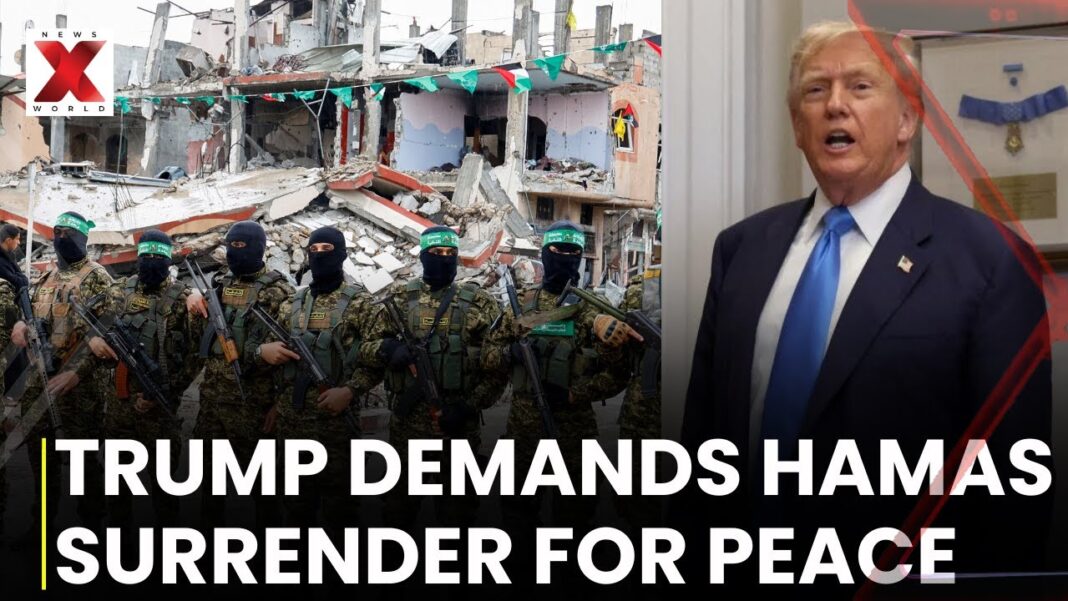
President Donald Trump issued a direct warning to Hamas on Thursday, urging the Iranian-backed terrorist group to surrender and release the remaining hostages in Gaza, as ceasefire negotiations in Doha broke down and humanitarian conditions in the enclave continued to deteriorate.
“The fastest way to end the Humanitarian Crises in Gaza is for Hamas to SURRENDER AND RELEASE THE HOSTAGES!!” Trump declared in a post on his Truth Social platform. His remarks, widely cited by Reuters and The Algemeiner, were the clearest indication yet of Washington’s frustration with Hamas’s negotiating stance and the group’s continued detention of hostages seized during the October 7, 2023, assault on Israel.
The statement came shortly after U.S. special envoy Steve Witkoff arrived in Israel to meet Prime Minister Benjamin Netanyahu, following the collapse of indirect ceasefire talks in Qatar. As Reuters reported, Israel and the United States recalled their negotiating teams after Hamas introduced new conditions at the last minute, derailing a U.S.-drafted proposal that included a 60-day ceasefire and a phased release of hostages in exchange for Palestinian prisoners.
On X, Witkoff accused Hamas of acting in bad faith, saying, “While the mediators have made a great effort, Hamas does not appear to be coordinated or acting in good faith. We will now consider alternative options to bring the hostages home and try to create a more stable environment for the people of Gaza.”
Israeli officials, cited by The Algemeiner, confirmed that Hamas had altered its demands just as progress seemed possible, prompting Jerusalem to suspend its delegation’s participation in Doha. Central points of contention include the extent of an Israeli military withdrawal from Gaza and Hamas’s refusal to disarm — conditions Netanyahu has identified as non-negotiable.
The breakdown of talks comes as international pressure intensifies over Gaza’s humanitarian crisis. According to Reuters, UN agencies and NGOs have warned of extreme food insecurity, with the Hamas-run Gaza Health Ministry claiming at least 156 deaths from malnutrition in recent months. Reports of malnourished children, published by aid organizations and widely shared on social media, have amplified demands for an immediate ceasefire and expanded aid access.
Israel insists it has facilitated the entry of thousands of aid trucks, blaming international agencies for distribution failures at border crossings. On Sunday, Israeli officials announced a 10-hour daily pause in fighting across parts of Gaza to allow aid convoys safe passage. As Reuters noted, the UN Office for the Coordination of Humanitarian Affairs confirmed that food deliveries increased during the pauses, but volumes remained “far from enough.”
The Algemeiner reported that Witkoff’s visit will include an inspection of an aid distribution site, underscoring U.S. concern that humanitarian channels remain blocked despite Israel’s ceasefire pauses.
Hamas continues to hold approximately 50 hostages, with around 20 believed to be alive. The group seized 251 hostages during its October 7 attack, which killed 1,200 people and triggered the war, according to Israeli tallies cited by The Algemeiner.
Netanyahu has vowed to continue military operations until Hamas is dismantled and the hostages are freed. “The war will not end until Hamas no longer rules Gaza and lays down its arms,” the prime minister has repeatedly said, as reported by Reuters. Hamas, however, has rejected demands to disarm.
Efforts to bridge the gap between the parties continue through multiple channels. Qatar and Egypt, acting as mediators, have supported a joint declaration issued this week by France and Saudi Arabia. That plan calls for Hamas to cede control of Gaza and hand its weapons to the Palestinian Authority (PA) as part of a roadmap toward a two-state solution.
Israel has firmly opposed the proposal, with officials stressing that the PA’s corruption scandals and its long-standing “pay-for-slay” program, which provides stipends to terrorists and their families, disqualify it from governing Gaza. Estimates suggest that roughly 8 percent of the PA’s annual budget funds such payments.
The debate has intensified as France, Britain, and Canada signaled they may recognize a Palestinian state unilaterally, a move Israel denounces as “rewarding terrorism.” Trump, echoing Israel’s concerns, told reporters on Tuesday that recognition at this juncture amounted to legitimizing Hamas’s October 7 assault. “I’m not about to do that,” he said.
While Trump and Netanyahu remain aligned on opposing recognition, divisions are emerging among Western powers. German Foreign Minister Johann Wadephul, cited by Reuters, said that Germany continues to support negotiations toward a two-state solution, but insisted recognition of Palestine must come only at the conclusion of the process — not as a precondition.
As the conflict nears the two-year mark, the situation in Gaza remains volatile, with periodic escalations along the Lebanese border and ongoing Israeli airstrikes against Hamas infrastructure. With no truce in sight, humanitarian suffering grows, even as Israel signals readiness to allow more aid under tightly controlled conditions.
Trump’s declaration that Hamas should “surrender” reflects both frustration and a shift in tone. His direct call highlights Washington’s conviction that Hamas bears sole responsibility for prolonging the conflict, while signaling diminishing patience with protracted mediation.
With truce talks stalled, humanitarian agencies under strain, and Western capitals debating the recognition of a Palestinian state, the road ahead for Gaza remains uncertain. For now, as Reuters and The Algemeiner both emphasize, the fate of the 50 hostages still in Hamas’s custody remains the fulcrum on which any ceasefire will turn. Until they are released, Trump and Netanyahu appear resolute: the war will continue.

Witkoff says “we will now consider other options …” It begs the question, “What are they?”