



|
Getting your Trinity Audio player ready...
|
By: Fern Sidman
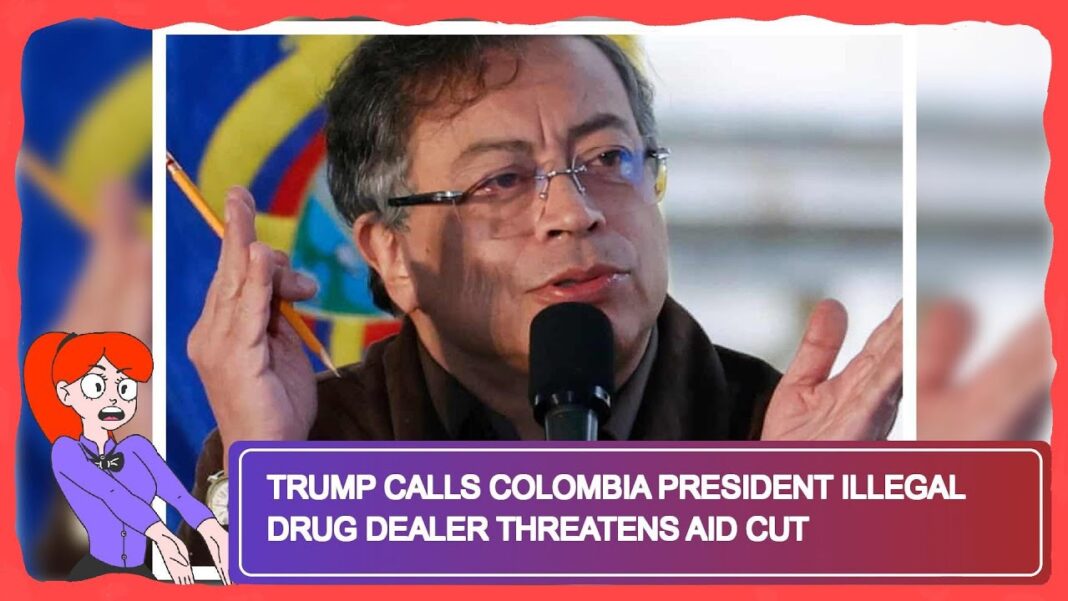
In an extraordinary broadside on Sunday, President Donald Trump announced that he would slash U.S. funding to Colombia, accusing the country’s leftist president, Gustavo Petro, of “doing nothing to stop” the explosive surge in drug production and for embracing a virulently anti-Israel and anti-American worldview that has rattled regional diplomacy.
As The Associated Press reported, the former U.S. ally has seen a rapid deterioration in its relationship with Washington — a collapse fueled by Petro’s ideological crusade against the United States, his open hostility toward Israel, and his apparent sympathy for authoritarian and extremist movements across the globe.
Trump, writing from his Mar-a-Lago resort in Florida, minced no words. Calling Petro “an illegal drug dealer” and “very unpopular,” Trump warned that “if he doesn’t shut down the drug operations, the United States will shut them down for him — and it won’t be done nicely.”
The statement marked one of the sharpest rebukes of a Latin American leader since Trump’s return to office, underscoring growing U.S. frustration with Petro’s defiance and Colombia’s spiraling coca cultivation. As The Associated Press report noted, Colombia remains the world’s largest exporter of cocaine, and United Nations figures show that coca leaf cultivation — the raw material for cocaine — reached an all-time high last year.
But beyond the drug crisis, what has truly poisoned relations between Washington and Bogotá is Petro’s relentless ideological extremism — an anti-Western posture that, as The Associated Press reported has alienated allies, endangered Colombia’s Jewish community, and undermined the country’s standing in the international arena.
Once hailed as a reformist democrat, President Gustavo Petro has devolved into a demagogue with authoritarian impulses and antisemitic leanings.
According to the report in The Associated Press, the trouble began when Petro, speaking during the United Nations General Assembly in New York, urged U.S. soldiers to “disobey the orders of President Trump” and “refuse to point their rifles against humanity.” The incendiary remarks — effectively calling for insubordination within the U.S. armed forces — prompted the State Department to revoke Petro’s visa while he was still in the United States.
The U.S. Embassy in Bogotá, citing the president’s “anti-American rhetoric” and repeated “interference in domestic U.S. affairs,” confirmed that Washington viewed the episode as a serious breach of diplomatic conduct.
That moment, The Associated Press report observed, was a breaking point — the clearest sign yet that Colombia, long one of Washington’s most dependable allies in Latin America, had veered sharply off course under Petro’s radical leadership.
If Petro’s anti-American tirades have alarmed Washington, his anti-Israel and antisemitic statements have horrified the global Jewish community.
In July, B’nai B’rith International, one of the oldest Jewish human rights organizations in the world, issued a blistering statement condemning Petro’s “ongoing anti-Jewish rhetoric” and his government’s “openly hostile attitude toward the Colombian Jewish community.”
The organization’s president Robert Spitzer and CEO Daniel S. Mariaschin cited Petro’s repeated claims that “the Jewish people are not the chosen people,” and his assertion that “those who believe they are superior to others lead to the massacres of the other people.”
Petro has also accused “international Zionism” of controlling the media — a trope with chilling echoes of Nazi propaganda — and equated the Holocaust with what he calls “Israel’s treatment of Gaza.” “The Holocaust,” he said recently, “was just training for the real thing: Gaza.”
These comments, condemned across Latin America, have left Colombia’s Jewish community — numbering roughly 5,000 — in a state of fear. Synagogues have tightened security, and Jewish leaders warn of a new wave of antisemitic hostility spreading through the country.
Even more troubling, Petro’s administration appointed an obscure rabbi — whose legitimacy is rejected by Colombia’s mainstream Jewish community — as the country’s Director of the Office of Religious Freedom. This official has previously called Colombia’s Jewish organizations “heretical,” “apostate,” and “Nazi,” citing their support for Israel.
The move was widely viewed as a calculated insult — part of a pattern in which Petro appears intent on isolating and delegitimizing Colombia’s Jewish citizens.
Colombia has been a signatory to international agreements that safeguard minority rights and adopted the IHRA (International Holocaust Remembrance Alliance) definition of antisemitism in June 2022. Petro has systematically ignored that commitment since assuming power in August of that same year.
B’nai B’rith’s leadership has urged “all relevant national and international bodies to intervene immediately” to demand an end to what it called “systematic antisemitic harassment perpetrated by the Colombian president.”
“The recurrent hostile statements and postings by President Petro are creating a deeply uncomfortable environment for the Jewish community in Colombia,” the organization’s statement read. “They may endanger the security of Jewish institutions, leaders, and individuals.”
The condemnation has not been limited to Jewish groups. Even long-standing allies within Latin America’s moderate left have expressed alarm at Petro’s toxic rhetoric. Chilean officials, speaking anonymously to reporters, described his tone as “reckless and destabilizing,” while European diplomats warned that Bogotá’s international credibility was “eroding by the day.”
For decades, Colombia was a model U.S. ally in the Western Hemisphere — a democracy that cooperated on counterterrorism, trade, and anti-narcotics efforts. That partnership, anchored by Plan Colombia, helped weaken powerful cartels and stabilize the nation after decades of civil war.
But under Petro’s presidency, that legacy is unraveling.
As The Associated Press has detailed, Colombia’s coca cultivation has reached its highest recorded levels, even as the Petro government dismantles long-standing eradication programs. The president’s declared policy of “total peace” — an amnesty initiative aimed at negotiating with guerrilla groups and drug gangs — has instead emboldened criminal networks and allowed narcotics production to flourish.
“Petro’s pacifist approach has become a green light for traffickers,” one U.S. counter-narcotics official told The Associated Press. “He has taken apart what was working and replaced it with ideology.”
Meanwhile, violence linked to drug trafficking has surged, and rural communities once protected by joint Colombian–U.S. operations are now reporting an alarming resurgence of guerrilla activity.
The Trump administration has warned that Petro’s policies threaten to reverse two decades of progress. Yet Petro, increasingly defiant, has accused the United States of “imperial arrogance” and claimed that the global drug war is a “tool of oppression.”
President Trump’s Sunday remarks, while characteristically blunt, reflect what The Associated Press describes as “mounting bipartisan frustration” in Washington. The administration has already accused Colombia of failing to meet anti-drug cooperation benchmarks but stopped short of imposing sanctions — a leniency that now appears to be ending.
“Trump’s patience has clearly run out,” said a senior diplomatic analyst quoted by The Associated Press. “He sees Petro not as a partner but as an obstacle — an anti-American ideologue whose sympathies lie with the enemies of the West.”
Indeed, Petro’s public praise for figures such as Venezuela’s Nicolás Maduro and his flirtation with Iranian officials have deepened concerns that Colombia, once the linchpin of U.S. influence in South America, is sliding toward the orbit of anti-Western regimes.
Petro’s anti-Israel and anti-American stance has not only alienated allies — it has isolated Colombia on the world stage and further weakened its economy. As The Associated Press noted, foreign investment has slowed, tourism has dipped, and business leaders warn of an atmosphere of uncertainty and fear.
“Colombia used to be the reliable partner in Latin America,” said one Western diplomat. “Now it feels like a country adrift — with a president who prefers to pick fights rather than govern.”
Petro’s domestic approval ratings have plummeted amid scandals, economic stagnation, and accusations of corruption within his administration. Yet he continues to lash out, scapegoating the West, Israel, and the United States.
It is a dangerous game — and one that risks not just Colombia’s prosperity, but the stability of the entire region.
As The Associated Press report observed, “President Petro has chosen isolation over partnership, ideology over pragmatism, and confrontation over cooperation.”
In doing so, he has alienated Washington, endangered Colombia’s Jewish community, and surrendered moral authority on the global stage.
President Trump’s ultimatum may have been blunt, but it carries the weight of a hard truth: Colombia’s future prosperity and international standing depend on abandoning Petro’s reckless antagonism and restoring the values that once made the nation a trusted ally.
Until that happens, Colombia risks becoming not just another cautionary tale of failed leadership — but a symbol of how anti-American and antisemitic demagoguery can corrode even the strongest of democracies.