



|
Getting your Trinity Audio player ready...
|
By: Fern Sidman
In a surprising turn that may mark a pivotal moment in the U.S.-China trade war, President Trump suggested Tuesday that his administration is preparing to ease the crushing tariff burden on Chinese imports — but stopped short of promising a full rollback. His remarks, made during an impromptu Q&A session at the White House, represent a significant rhetorical shift from the hardline stance that has defined his administration’s recent policy posture.
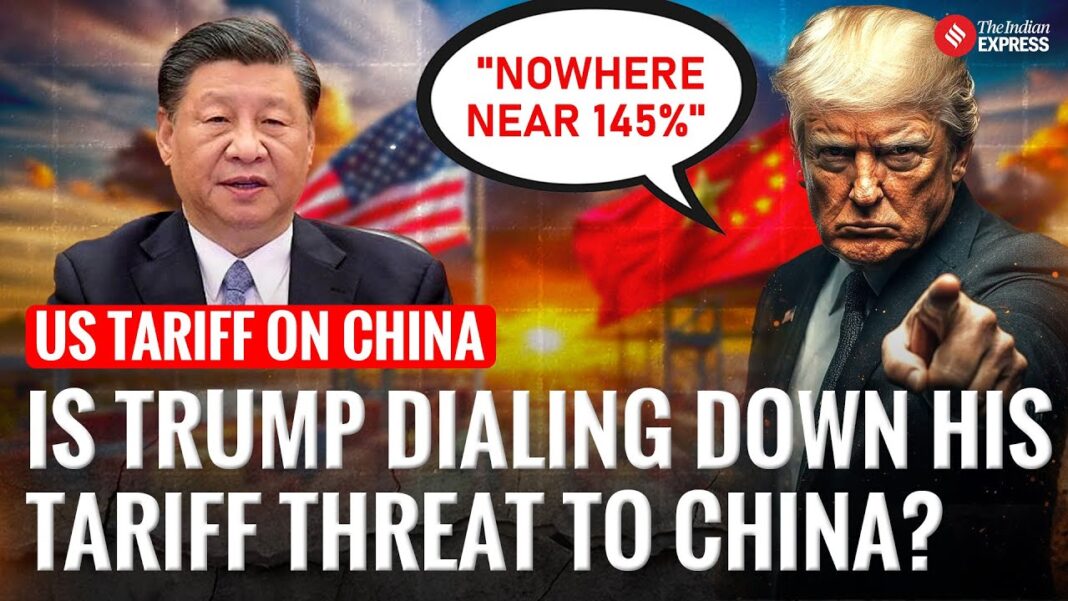
As reported by CNN, Trump acknowledged that the current tariff rate of 145% on Chinese goods — a historic peak in modern U.S. trade history — is “very high” and will “come down substantially.” However, he was quick to add that “it won’t be zero,” indicating that the U.S. will not return to pre-trade war norms anytime soon.
“It won’t be anywhere near that high,” Trump said from the Oval Office, referring to the punitive tariffs his administration has levied in recent months. “But it won’t be zero. We need to protect American workers.”
According to the information provided in the CNN report, the President’s statement came in response to earlier remarks by Treasury Secretary Scott Bessent, who signaled a more conciliatory tone at a closed-door investment conference hosted by JP Morgan Chase. Speaking privately to a room full of financial heavyweights, Bessent reportedly described the U.S.-China trade war as “unsustainable” and suggested that both nations are “closer than ever” to de-escalation.
A source familiar with the event told CNN that Bessent emphasized the White House is not aiming for a full economic decoupling but rather a “rebalancing of trade” that addresses long-standing concerns about intellectual property theft, technology transfer, and China’s state-backed industrial policy.
While Bessent’s comments were not made publicly, their release by CNN prompted a swift and positive reaction on Wall Street. By Tuesday afternoon, all three major U.S. stock indices — the Dow Jones Industrial Average, S&P 500, and Nasdaq — hit session highs. The rally continued to ripple across global markets on Wednesday, with Hong Kong’s Hang Seng Index surging 2.5%, Japan’s Nikkei 225 rising 2%, and South Korea’s Kospi gaining 1.5%, CNN reported.
As CNN has closely documented over the past year, the trade war between the world’s two largest economies has severely disrupted global supply chains, sowed fear across export-dependent industries, and stoked warnings of a global recession.
Under Trump’s direction, the U.S. imposed sweeping tariffs — topping out at 145% — on a wide range of Chinese goods, from electronics and automotive components to clothing and consumer goods. In retaliation, Beijing raised its own tariff rate on U.S. goods to 125%, while targeting strategic U.S. industries through non-tariff means.
CNN confirmed that China has now restricted exports of critical minerals vital to industries ranging from smartphone manufacturing to defense systems. Chinese authorities also hit back symbolically and economically, reducing the number of Hollywood films permitted to screen in China — a major blow to American studios — and returning at least two Boeing jets to U.S. manufacturers.
The fact that both Trump and Bessent spoke publicly (and semi-publicly) about reducing tensions suggests a coordinated softening of the administration’s trade rhetoric. Still, neither the President nor his Treasury Secretary provided specifics on the timing or extent of any tariff reductions.
Trump’s insistence that tariffs “won’t be zero” appears designed to maintain pressure on China while signaling to U.S. manufacturers and farmers that relief could be on the horizon.
According to CNN, the former Biden administration sought to reduce or reverse tariffs on Chinese imports in hopes of curbing inflation and stabilizing global trade. Trump, by contrast, had doubled down in recent months on “economic nationalism,” framing the tariffs as a bulwark against Chinese industrial domination.
Yet as CNN analysts have noted, the political calculus is shifting. Domestic industries are hurting, U.S. exporters are losing competitiveness, and global investors are growing wary of an indefinite trade standoff.
Beijing has so far refused to make major concessions, according to CNN, maintaining that U.S. tariffs are unjustified and politically motivated. At the same time, China has engaged in backchannel communications and has not closed the door on negotiations. Analysts believe that economic pressures on both sides may soon push the two countries back to the negotiating table.
Despite record-setting tariffs of up to 145% on Chinese imports — and equally sharp retaliatory measures from Beijing — Trump remains steadfast in his belief that Xi will eventually “come to the table,” CNN reported. However, Chinese officials appear in no rush, choosing instead to pursue a diplomatic campaign with other nations to counterbalance what Beijing views as Washington’s attempts to isolate China economically.
Speaking to reporters at the White House on Tuesday, Trump reiterated his expectation that China, not the U.S., must initiate renewed trade talks, according to CNN. While dismissing the idea of escalating pressure or revisiting tensions over COVID-19 origins, the President said, “No, no, we’re going to be very nice. They’re going to be very nice, and we’ll see what happens.”
“Ultimately, they have to make a deal, because otherwise they’re not going to be able to deal in the United States, and we want them involved,” Trump added, expressing optimism that the two global superpowers will eventually “live together very happily and ideally work together.”
While Trump repeatedly portrays himself as a pragmatic and personally respectful partner to Xi, CNN noted that his administration’s policies — and the incendiary rhetoric of some Cabinet officials — have sent mixed signals to Beijing.
Rather than reaching out directly to Trump, CNN reported that Xi and his foreign ministry have intensified efforts to strengthen ties with other trade partners, launching a diplomatic charm offensive designed to counteract Washington’s global economic pressure campaign.
This includes high-level summits with EU leaders, expanded infrastructure deals with countries across the Global South, and deepened trade engagements with Brazil, South Korea, and the Gulf states. As the CNN report confirmed, Beijing is determined to show that it does not depend on Washington for access to markets or global economic leadership.
A Chinese government insider told CNN that Beijing remains open to negotiations with the United States, but insists any dialogue must be based on mutual “respect,” “consistency,” and “reciprocity.” The source emphasized that China prefers structured negotiations and finds Trump’s desire to handle talks personally incompatible with China’s traditional, hierarchical model of diplomacy.
One major stumbling block, according to CNN, is a lack of clarity about who in the Trump administration is the appropriate point of contact for high-level trade talks. Prior to the President’s “Liberation Day” tariff announcement on April 2, China had already designated a lead negotiator — but Beijing was uncertain whether to coordinate with the U.S. Trade Representative, Treasury Secretary, National Economic Council, or the President himself.
While Trump’s preference for direct personal diplomacy has characterized his international style, this has led to confusion and diplomatic bottlenecks, CNN reported. A Chinese official close to the matter said that Trump’s failure to distance himself from hardline anti-China voices in his Cabinet — some of whom advocate total economic decoupling — has made Beijing question the sincerity of his overtures.
Tensions were further inflamed earlier this month after CNN reported that U.S. Vice President JD Vance made dismissive comments about “Chinese peasants” during a televised interview. The backlash in China was swift and fierce, with the term trending on Chinese social media as users ridiculed and denounced what they called a display of “arrogant American racism.”
The incident underscored one of China’s key concerns: while Trump may publicly profess admiration for Xi, he often fails to push back against members of his own team whose rhetoric Beijing finds insulting and destabilizing.
Despite escalating economic pain on both sides and widespread disruption to global markets, the impasse between Washington and Beijing shows no signs of immediate resolution. As CNN continues to report, the U.S. has taken a “we’re open to talks if they call” posture, while China is waiting for the U.S. to clarify its intentions and tone down the hostile messaging.
What is clear, as CNN has emphasized throughout its coverage, is that neither nation has closed the door on diplomacy. Yet, without a clear negotiating framework, mutual trust, or even agreement on who should lead talks, the world’s two largest economies remain locked in a prolonged standoff — one that is beginning to test the limits of resilience for both governments, their citizens, and global supply chains.
For now, President Trump says he is “ready to be very nice.” But whether niceties alone can break through the current freeze remains to be seen.
