



|
Getting your Trinity Audio player ready...
|
By: Chaya Abecassis
In a statement that has jolted diplomatic circles and further muddied the already fraught narrative surrounding the conflict in Iran, President Donald Trump declared on Thursday that he must play a personal and direct role in determining the country’s next supreme leader. The comments, delivered in a phone interview with Axios and reported by media including The Times of Israel, significantly undercut repeated U.S. assertions that the ongoing military campaign against Tehran is not intended to effect regime change.
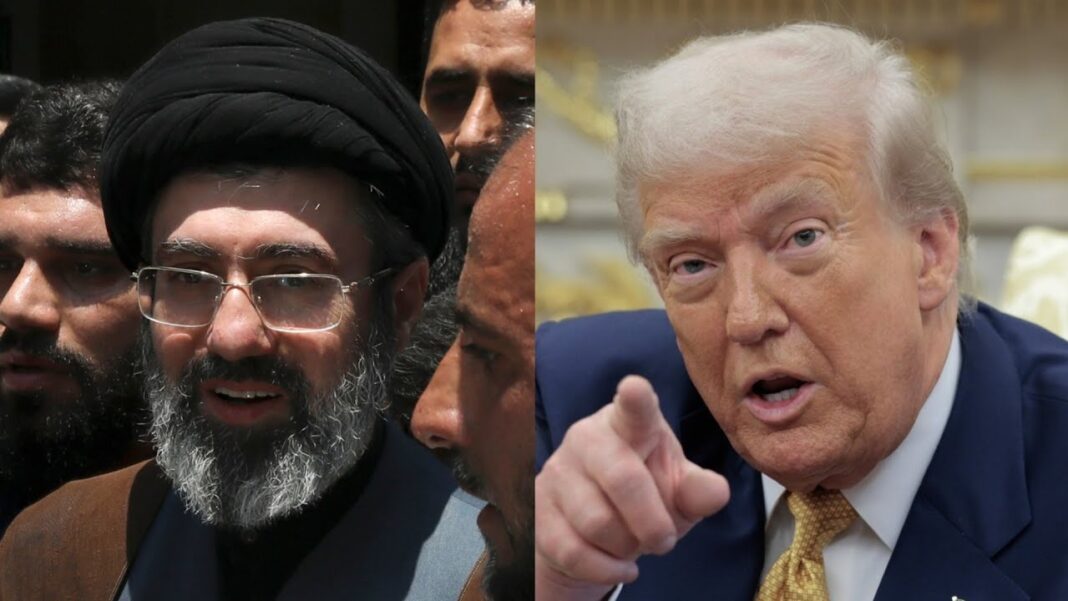
Trump’s remarks came against the backdrop of one of the most consequential moments in modern Middle Eastern history. The U.S.-Israeli air campaign against Iran — triggered by coordinated strikes that killed Supreme Leader Ayatollah Ali Khamenei — has plunged Tehran into political uncertainty and provoked retaliatory attacks across the region. As Iranian authorities weigh succession, Trump weighed in with unambiguous insistence: Washington, he says, should not simply accept the presumptive next leader, Mojtaba Khamenei, the son of the late ayatollah.
“They are wasting their time,” Trump told Axios when asked about the succession process. “Khamenei’s son is a lightweight. I have to be involved in the appointment, like with Delcy [Rodríguez] in Venezuela.”
The president’s reference to Delcy Rodríguez, a prominent Venezuelan politician whom Trump supported during the tumultuous political struggle in Caracas, illustrates his broader view of U.S. influence abroad. In Venezuela, the Trump administration recognized opposition leaders and sought to shape the trajectory of leadership after disputes over Nicolás Maduro’s legitimacy. Now, Trump asserts, Washington must similarly help determine Iran’s future leadership — a position that many foreign policy experts say flies in the face of longstanding American principles of non-interference.
The timing of Trump’s intervention is particularly striking. Iran has not yet announced a successor to Ali Khamenei, and the clerical establishment’s internal procedures for selecting a new supreme leader — involving the Assembly of Experts and senior religious authorities — have long been opaque to outside observers. The Times of Israel report noted that Mojtaba Khamenei has been widely discussed as a likely contender, given his prominence in Tehran’s political circles and close ties to the Islamic Revolutionary Guard Corps (IRGC).
Yet Trump’s description of Mojtaba as “unacceptable” and a “lightweight” dismisses Iran’s own system of governance and injects a provocative element into an already volatile situation. “We want someone that will bring harmony and peace to Iran,” Trump said, framing his desired involvement in moral terms.
The pronouncement complicates the official U.S. position on the objectives of the Iran war. Administration officials, including Defense Secretary Pete Hegseth, have repeatedly asserted that the campaign — dubbed Operation Epic Fury — is not aimed at regime change. Yet Trump’s insistence on involvement in choosing the next supreme leader suggests an implicit endorsement of such an outcome, even if he stops short of using the term.
Analysts say Trump’s comments reflect a broader strategic vision in which leadership change in Tehran is seen — by some in Washington and Jerusalem alike — as a desirable byproduct of a military campaign that has already shaken the foundations of the Islamic Republic. The Times of Israel has reported that Israeli political and military leaders have openly discussed the possibility that weakening Iran’s ruling apparatus could facilitate internal fracturing and empower reformist or moderate elements.
For many observers, however, the assertion that the U.S. president should influence the selection of Iran’s supreme leader raises profound questions about sovereignty and international law. Even among staunch critics of the Iranian regime, there is a consensus that internal political transitions should be determined by the country’s own institutions, not imposed or directed by foreign powers.
Trump’s comments also touched on support for Kurdish forces and the stability of key regional chokepoints such as the Strait of Hormuz. In the same interview, he expressed enthusiasm for Kurdish offensives into Iranian territory and affirmed U.S. commitment to keeping vital maritime routes open, signaling that Washington’s interest in the conflict extends beyond narrow military objectives.
Domestically, the remarks stirred controversy across the political spectrum. Critics argue that advocating for influence over another nation’s leadership represents a departure from American norms and could entangle the U.S. in protracted geopolitical commitments. Supporters of the president’s stance counter that the extraordinary circumstances of Iran’s destabilization merit robust engagement to prevent the rise of a leadership that could perpetuate aggression against the U.S. and its allies.
Internationally, the implications are equally fraught. Tehran has framed the U.S. and Israeli campaign as an existential threat, and direct intervention in succession matters, were it to materialize, would likely be seen by Iranian hardliners as a declaration of deep hostility. Already, Iranian officials have expanded missile and drone attacks beyond Israel to target U.S. bases and allied territories across the Gulf, a pattern that highlights the danger of escalation when sovereignty is perceived to be under assault.
The shifting power dynamics in Iran’s political structure further underscore the complexity of the moment. With the sudden death of Ali Khamenei, the clerical hierarchy faces a critical juncture in determining Tehran’s future. Succession discussions, historically shrouded in secrecy and guided by religious as well as political considerations, are now unfolding amid active conflict and unprecedented external pressure.
Trump’s invocation of the Venezuelan comparison complicates the narrative by suggesting a level of U.S. control over foreign political outcomes that many foreign policy experts view as unrealistic and unwise. Unlike Venezuela, where internal institutions were already deeply contested and divided, Iran’s system is anchored in centuries of religious authority and constitutional frameworks that resist facile manipulation.
Moreover, Trump’s statements may strain relations with key U.S. allies and partners who support a stable resolution to the conflict but reject the notion of direct American intervention in another country’s leadership selection. The United States’ role in global governance has always balanced principles of self-determination with strategic interests; Trump’s remarks — intentionally or not — have tilted that balance toward interventionist rhetoric.
As The Times of Israel reported, the broader strategic implications of Trump’s stance remain a subject of intense debate among policymakers, analysts, and international observers. The question at the core of this controversy is not simply who will lead Iran, but who has the authority — and the legitimacy — to influence that decision.
