



|
Getting your Trinity Audio player ready...
|
By: Fern Sidman – Jewish Voice News
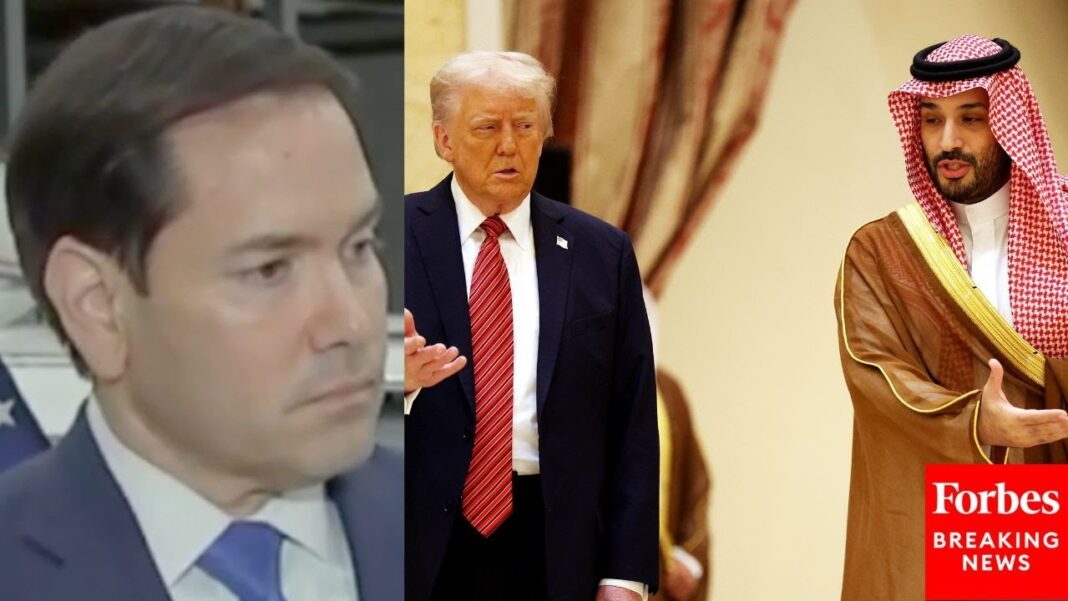
In a development that could reshape the diplomatic map of the Middle East, President Trump has reportedly urged Saudi Crown Prince Mohammed bin Salman (MBS) to advance steps toward formal normalization with Israel, according to a report on Thursday at Axios and cited by Israel National News.
The phone conversation between Trump and the Saudi heir, which had not been publicly disclosed until now, reportedly took place shortly after the Gaza Peace Summit in Egypt last month. According to senior U.S. officials with direct knowledge of the exchange, Trump told MBS that the cessation of hostilities in Gaza — an achievement the administration has touted as a signature diplomatic breakthrough — now opens a historic opportunity for Saudi-Israeli normalization, a long-sought objective that could mark the culmination of Trump’s broader Middle East strategy.
As reported by Israel National News on Thursday, the Trump-MBS phone call was described by one senior U.S. official as “direct, pragmatic, and forward-looking.” During the conversation, Trump reportedly told the Crown Prince, “You wanted peace — we delivered peace in Gaza. Now it’s time to move forward with normalization.”
MBS, according to U.S. sources quoted in the Axios report and relayed by Israel National News, responded that he was open to discussing the matter further and “willing to work on it with the Trump administration.” While the Saudi Embassy in Washington declined to comment, officials close to both sides have confirmed that preparations are underway for a high-profile meeting between Trump and MBS at the White House next week — one that could pave the way for renewed Arab-Israeli diplomacy.
The timing of the call, coming in the aftermath of the Gaza conflict’s resolution, underscores the Trump administration’s broader ambition to leverage post-war reconstruction into a regional diplomatic realignment. As the report at Israel National News noted, U.S. officials hope to demonstrate tangible progress on normalization talks before MBS’s arrival in Washington, though significant gaps remain between Saudi and Israeli positions.
As Israel National News reported, one of the central obstacles remains Riyadh’s long-standing condition that any formal normalization with Israel be contingent upon progress toward a Palestinian state. Saudi leaders have consistently stated that Palestinian self-determination must precede full diplomatic recognition — a principle that was reaffirmed in the weeks following Hamas’ October 7, 2023, massacre, which temporarily froze normalization efforts across the region.
Prior to that attack, Saudi Arabia and Israel had been quietly edging toward a U.S.-brokered agreement, building on the momentum of the Abraham Accords that Trump initiated during his first term. Those accords — signed by Israel with the United Arab Emirates, Bahrain, Morocco, and Sudan — were seen as a historic diplomatic revolution, reshaping alliances in the Middle East around shared interests in security, trade, and countering Iran.
Now, as the Israel National News report emphasized, the Trump administration is seeking to revive and expand the accords with a renewed focus on Riyadh. In an interview last month, Trump told reporters, “I hope to see Saudi Arabia go in, and I hope to see others go in. I think when Saudi Arabia goes in, everybody goes in.”
According to Thursday’s Axios report, U.S. officials believe that many of the Saudi demands raised during earlier negotiations have now been addressed. Chief among the incentives is an anticipated U.S. security pledge — short of a full mutual defense treaty but significant enough to formalize Washington’s strategic commitment to Riyadh.
“The upcoming visit is expected to yield a major announcement on security cooperation,” one American official told Israel National News. “The President is prepared to offer a structured security guarantee, which could lay the groundwork for a more comprehensive pact in the future.”
The Trump administration has also pointed to the final clauses of its Gaza peace framework as evidence of its responsiveness to Arab concerns. According to excerpts reviewed by Israel National News, the plan stipulates that if the Palestinian Authority “faithfully implements governance and anti-corruption reforms” during Gaza’s reconstruction phase, conditions will emerge for “a credible pathway to Palestinian self-determination and statehood.”
In diplomatic terms, the provision creates what U.S. officials call a “political horizon” — a mechanism that promises Palestinians eventual statehood, contingent upon good governance and demilitarization. The plan further envisions a U.S.-led dialogue to promote what the administration describes as “peaceful and prosperous co-existence” between Israel and its Arab neighbors.
As the Israel National News report observed, the inclusion of this clause appears tailored to satisfy Saudi Arabia’s symbolic requirements while maintaining Israel’s security prerogatives. It echoes the formula that underpinned the earlier Abraham Accords: concrete security guarantees for Arab states, economic incentives, and an incremental approach to the Palestinian issue.
Yet the road to normalization remains fraught with domestic sensitivities in Riyadh. A former U.S. official familiar with Saudi decision-making told Israel National News that while MBS remains personally inclined toward normalization, he faces growing public hostility toward Israel in the wake of the Gaza war.
“The Crown Prince wants to move forward, but he needs something tangible he can point to — a real concession from Israel that demonstrates commitment to Palestinian dignity,” the former official explained. “Without that, he risks alienating a Saudi public that has been deeply affected by the images of the war.”
MBS has long pursued a policy of balancing modernization and pragmatism with domestic conservatism. Under his Vision 2030 program, Saudi Arabia has sought to transform itself into a diversified economic power, attract foreign investment, and position itself as a global diplomatic player. Normalization with Israel would advance those ambitions, opening new channels for technology transfer, security cooperation, and regional integration.
However, as the Israel National News report noted, the political cost of such a move could be steep if the Palestinian issue is not adequately addressed. Saudi officials have privately indicated that they will require “clear commitments” from Israel on restraint in Judea and Samaria and support for Palestinian governance structures before any formal agreement can proceed.
Senior administration sources quoted in the Israel National News report characterized the current U.S. position as one of cautious optimism but firm expectation. “We did all the things you asked for,” one official said. “Now there are things President Trump wants — like normalization with Israel. So how are you going to move in that direction?”
This rhetorical shift underscores Washington’s growing impatience with what it perceives as Saudi strategic hesitation. Having invested significant diplomatic capital in ending the Gaza conflict, the Trump administration views normalization as the next logical — and politically rewarding — step.
The White House hopes that a Trump-MBS summit next week could produce at least a joint declaration of intent, if not a formal normalization accord. Even a symbolic gesture — such as the announcement of bilateral working groups on technology or security — could signal momentum toward what the Israel National News report called “a second wave of Abraham Accords.”
For now, the question remains whether Crown Prince Mohammed bin Salman will seize the moment. Analysts cited in the Israel National News report suggest that Riyadh’s ultimate decision will depend not only on diplomatic assurances from Washington but also on Israel’s willingness to articulate a clearer vision for coexistence with the Palestinians.
Still, the political calculus for both leaders is compelling. For Trump, expanding the Abraham Accords would cement his legacy as the architect of a new Middle East order built on Arab-Israeli reconciliation rather than perpetual conflict. For MBS, normalization could secure Saudi Arabia’s status as a global power broker, reinvigorate ties with Washington, and unlock vast economic opportunities.
Yet, as the report at Israel National News cautioned, the region remains unpredictable. “The path to peace in the Middle East has always been narrow,” one Israeli analyst told the outlet. “But when Washington, Riyadh, and Jerusalem align — even briefly — history tends to move.”
Whether next week’s meeting yields a tangible breakthrough or merely a diplomatic overture, the implications are clear: the post-Gaza political landscape is shifting, and Saudi Arabia now holds the key to the next chapter in Arab-Israeli relations.