



|
Getting your Trinity Audio player ready...
|
By: Jerome Brookshire
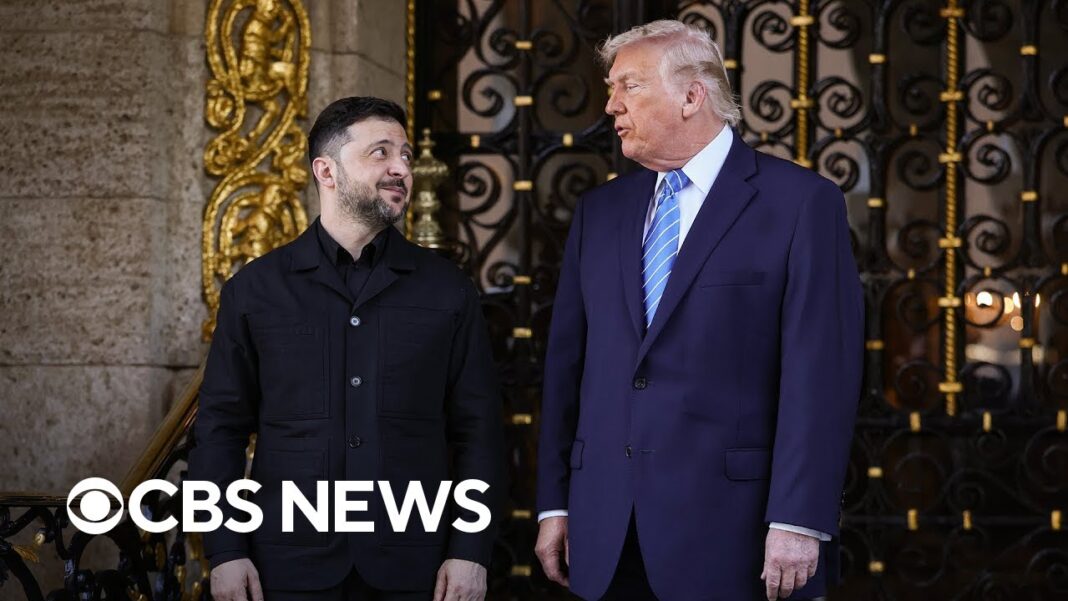
In the gilded salons of Mar-a-Lago, beneath chandeliers more accustomed to political theatre than wartime diplomacy, President Trump and Ukrainian President Volodymyr Zelensky stepped before the cameras this week to offer what the BBC described as their most optimistic public assessment yet of efforts to bring an end to Europe’s bloodiest conflict since the Second World War. The joint news conference, held after extended face-to-face talks at Trump’s Florida estate, produced a cascade of cautiously hopeful soundbites — and just enough unresolved ambiguity to remind the world how far a final peace still lies.
According to the BBC report on Sunday afternoon, both leaders appeared eager to project momentum, even as they conspicuously avoided timelines or definitive breakthroughs. Trump praised the encounter as a “terrific meeting,” while Zelensky thanked his American counterpart for what he termed a “great meeting,” adding that a 20-point peace plan was now “90% agreed.” Yet the gaps between rhetoric and reality were evident in the details they declined to provide — or perhaps could not yet provide.
The BBC reported that Trump spoke with characteristic bravado, insisting that negotiators were “getting a lot closer, maybe very close” to a deal. Zelensky’s language was more measured, yet no less hopeful. He told reporters that most of the framework had already been hammered out, with teams on both sides now working to “finalize all discussed matters.”
Still, the conspicuous absence of a timeline underscored the fragile nature of these claims. As the BBC report pointed out, neither side would commit to when the next round of talks would take place, nor when — or if — the 20-point framework might be converted into a binding agreement.
In diplomatic terms, such vagueness is often strategic. It buys space for compromise while shielding leaders from the backlash of unmet expectations. But it also leaves observers guessing whether this meeting represented a genuine inflection point or simply another orbit around unresolved fault lines.
If there was one area where the two leaders sounded unequivocally aligned, it was security guarantees. Zelensky described these as “100% agreed,” calling them the “key milestone in achieving lasting peace.” Trump echoed that optimism, asserting that the parties were “close to 95% done” on this front.
The BBC report noted that such language reflects Ukraine’s core demand: assurances that any ceasefire will not simply grant Russia time to regroup before renewing its offensive. For Kyiv, security guarantees are existential — the difference between a durable settlement and a temporary pause in hostilities.
Yet here again, specifics were scarce. What form these guarantees would take — NATO membership, bilateral defense pacts, or some novel multilateral mechanism — remains unclear. As the BBC report observed, the leaders seemed keen to emphasize progress without revealing the compromises required to achieve it.
The thorniest sticking point, by Trump’s own admission, remains territory — particularly the Donbas region in eastern Ukraine. Trump characterized the issue as “unresolved,” even as he insisted that negotiators were edging closer to agreement. Zelensky was more explicit about the gulf separating Kyiv’s position from Moscow’s.
“Our attitude is very clear,” he said, according to the BBC report, reaffirming Ukraine’s rejection of Russian claims over occupied lands. Yet clarity does not equal consensus, and neither leader offered a concrete proposal for resolving the territorial dispute.
The BBC report emphasized that this silence was telling. Land, after all, is not merely a bargaining chip; it is the physical embodiment of sovereignty. Any compromise here would reverberate through Ukrainian politics for generations, making it perhaps the most intractable dimension of the entire negotiation.
One of the more startling assertions of the news conference came when Trump suggested that Russia would play a role in rebuilding Ukraine. “They’re going to be helping,” he said, adding that Moscow wanted to see Ukraine succeed and might even provide energy and electricity at “very low prices.”
The BBC report described this as a striking departure from the prevailing narrative in Western capitals, where Russia is typically portrayed not as a benefactor but as the principal architect of Ukraine’s devastation. Trump’s remarks suggested a vision in which post-war reconstruction becomes a shared project — a radical reimagining of the relationship between aggressor and victim.
Yet even here, the optimism was tempered by realism. Trump acknowledged that Vladimir Putin had not agreed to a ceasefire that would permit referendums in Ukraine, explaining that the Russian president did not want to stop fighting only to “have to start again.” Trump added, “I understand that position,” a comment that the BBC said raised eyebrows among analysts accustomed to Washington’s harsher tone toward Moscow.
Perhaps the most tantalizing possibility floated at Mar-a-Lago was the notion of a future trilateral meeting involving Russia, Ukraine, and the United States. Trump said he believed such a summit could occur “at the right time” and even suggested that Putin “wants to see it happen too.”
The BBC report cautioned that this idea remains highly speculative. Any trilateral meeting would require a level of trust and preparatory agreement that currently seems elusive. Nevertheless, the mere mention of such a gathering hints at a diplomatic architecture that goes beyond bilateral talks — one in which Washington positions itself not merely as a supporter of Kyiv but as an active broker between adversaries.
Zelensky, for his part, also raised the possibility of a subsequent meeting in Washington alongside European leaders, a move that could bring the EU more formally into the negotiating framework.
What struck the BBC most, however, was not what the leaders said but what they did not. Despite speaking of a deal that was “90% agreed,” neither Trump nor Zelensky offered even a rough timetable for the next steps. Instead, both vowed to have their teams meet again in the coming weeks.
In diplomacy, such open-ended phrasing often signals that negotiators are grappling with trade-offs too sensitive to be disclosed prematurely. It also reflects the reality that any agreement between Washington and Kyiv is only one piece of a much larger puzzle.
Any ceasefire or peace deal will ultimately require Russian assent. Putin’s willingness to engage — let alone compromise — remains the great unknown.
Throughout the news conference, the specter of Vladimir Putin loomed large, even in his absence. Trump’s comments about understanding Russia’s reluctance to pause fighting suggested a desire to empathize with Moscow’s strategic calculus — a posture that the BBC report said marked a notable shift from the language used by previous administrations.
Yet Trump also acknowledged that Putin had not agreed to a ceasefire, underlining the limits of U.S. influence. The idea that Russia might assist in Ukraine’s reconstruction, supply cheap energy, or participate in a trilateral summit all hinge on decisions that have yet to be made in the Kremlin.
As the dust settled on the Mar-a-Lago meeting, analysts were left parsing percentages. Was the peace plan truly “90% agreed,” as Zelensky claimed? Or does that figure mask the reality that the remaining 10% encompasses the most intractable issues: territory, sovereignty, and the architecture of long-term security?
The BBC report leaned toward the latter interpretation, suggesting that while progress has undeniably been made, the hardest work still lies ahead. History is replete with negotiations that collapsed at precisely this stage — when consensus on broad principles gives way to acrimony over specific concessions.
For now, the image that will linger is of two leaders standing side by side under the Florida sun, speaking the language of rapprochement while war continues thousands of miles away. The BBC concluded that the Mar-a-Lago summit represented both a breakthrough in tone and a reminder of the immense obstacles still to be overcome.
Trump’s optimism — that Russia wants to see Ukraine succeed, that a trilateral summit is within reach, that a deal is nearly done — collided with Zelensky’s insistence on security guarantees and territorial integrity. Somewhere between those positions lies the elusive middle ground on which any lasting peace must be built.
Until Moscow is ready to occupy that space, the percentages, the praise, and the promises will remain provisional — hopeful words waiting for the hard reality of agreement.