



|
Getting your Trinity Audio player ready...
|
By: Jason Ostedder
President Trump on Tuesday signed a far-reaching presidential proclamation significantly expanding U.S. entry restrictions on foreign nationals from dozens of countries, marking one of the most sweeping immigration actions of his current term and reviving a central pillar of his long-standing border and national security agenda.
The proclamation strengthens and broadens travel restrictions on countries deemed by the administration to have persistent, systemic deficiencies in screening, vetting, documentation integrity, and information-sharing with the United States. According to the White House, the move is intended to prevent national security and public safety threats while compelling foreign governments to improve cooperation with U.S. immigration and law-enforcement authorities.
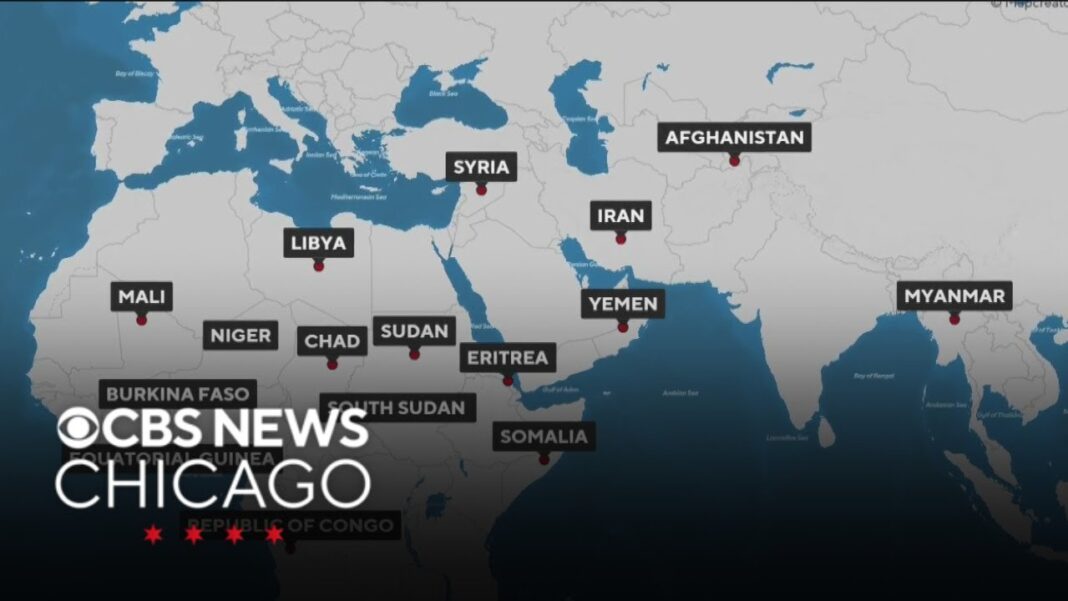
Under the new directive, the administration maintained full entry restrictions on nationals from the original 12 countries identified as high-risk under Proclamation 10949. Those countries are Afghanistan, Burma (Myanmar), Chad, the Republic of the Congo, Equatorial Guinea, Eritrea, Haiti, Iran, Libya, Somalia, Sudan, and Yemen.
In addition, five more countries were added to the list of nations subject to full entry bans following what the administration described as updated intelligence assessments and interagency reviews. Those countries are Burkina Faso, Mali, Niger, South Sudan, and Syria.
The proclamation also introduces full restrictions on individuals traveling on Palestinian Authority–issued or endorsed travel documents. While the United States does not recognize Palestine as a sovereign state, the administration said the designation reflects concerns about the inability to reliably verify identity and background information for travelers using such documents, particularly amid ongoing conflict and weakened governance structures in the West Bank and Gaza.
White House officials stated that U.S.-designated terrorist organizations continue to operate actively in those areas and that the prolonged instability has severely compromised screening and vetting mechanisms. As a result, the administration concluded that individuals seeking entry under Palestinian Authority documentation cannot currently be approved without unacceptable risk.
Two countries previously subject to partial restrictions—Laos and Sierra Leone—have now been moved into the category of full entry limitations. Conversely, the proclamation eases restrictions on Turkmenistan, citing what officials described as meaningful progress in cooperation with the United States. While the ban on nonimmigrant visas for Turkmen nationals has been lifted, immigrant visa restrictions remain in place.
Partial entry restrictions were continued for four countries that had already been subject to limited measures: Burundi, Cuba, Togo, and Venezuela. In addition, partial restrictions were newly imposed on 15 other countries, including Angola, Antigua and Barbuda, Benin, Côte d’Ivoire, Dominica, Gabon, The Gambia, Malawi, Mauritania, Nigeria, Senegal, Tanzania, Tonga, Zambia, and Zimbabwe.
According to the administration, these partial measures may include limits on certain visa categories, enhanced scrutiny, or restrictions tied to high visa-overstay rates and failures to repatriate nationals ordered removed from the United States.
The proclamation includes a series of exemptions designed to mitigate humanitarian and diplomatic concerns. Lawful permanent residents, individuals holding valid visas issued prior to the proclamation, and specific visa categories—such as diplomats, athletes participating in major international events, and individuals whose entry is deemed to serve U.S. national interests—are exempt. Case-by-case waivers remain available, though the administration has narrowed broad family-based immigrant carve-outs that officials say carry elevated fraud risks.
In announcing the measures, the White House emphasized that the restrictions are country-specific rather than ideological, arguing that each designation reflects unique circumstances tied to governance failures, corruption, or security threats. Many of the listed countries, the administration said, suffer from unreliable civil registries, nonexistent birth-registration systems, fraudulent identity documents, or an unwillingness to share passport exemplars and law-enforcement data with U.S. authorities.
Some governments were also criticized for operating citizenship-by-investment programs that, according to U.S. officials, allow individuals to obscure their identities and bypass vetting standards. Others were cited for exceptionally high visa-overstay rates or persistent refusals to accept the return of nationals ordered removed from the United States.
The administration further pointed to the presence of terrorist organizations, transnational criminal networks, and extremist activity in several of the affected countries, arguing that weak central authority and lack of territorial control make reliable screening virtually impossible.
President Trump framed the proclamation as a fulfillment of his constitutional duty to protect Americans, reiterating that border security and immigration enforcement remain foundational elements of his presidency. “It is the President’s duty to take action to ensure that those seeking to enter our country will not harm the American people,” the White House said in a statement accompanying the announcement.
The decision follows weeks of heightened rhetoric from the administration linking global terrorism to mass migration. Earlier this year, Trump declared what he described as a “permanent pause” on migration from what he called “Third World countries” following the fatal shooting of two National Guard troops in Washington, D.C. The expanded travel restrictions, officials said, are a direct outgrowth of that policy posture.
National Intelligence Director Tulsi Gabbard publicly praised the move, citing recent terrorist attacks abroad as evidence of the risks posed by unvetted migration. In a social media post, she argued that extremist ideologies represent a global threat and warned that Western democracies face increasing danger if border controls are not enforced rigorously.
Several Republican lawmakers echoed that sentiment, portraying the proclamation as a necessary step to preserve national sovereignty and public safety. Senator Tommy Tuberville, in a controversial statement earlier this week, urged aggressive action against what he described as ideological extremism, language that drew criticism from civil-rights organizations and Muslim advocacy groups.
The expanded restrictions revive one of the most contentious policies of Trump’s first term, when he imposed travel bans on several Muslim-majority countries shortly after taking office in 2017. Those measures were challenged repeatedly in federal court before being upheld by the U.S. Supreme Court, which ruled that the president acted within his lawful authority and that the policy was grounded in legitimate national security concerns.
The administration cited that ruling as legal precedent, noting that the Court recognized the president’s power to restrict entry to induce cooperation from foreign governments and prevent the admission of individuals who cannot be adequately vetted.
While supporters hailed the proclamation as a decisive response to global instability, critics warned it could strain diplomatic relations, disrupt families, and disproportionately affect vulnerable populations. Advocacy groups are expected to challenge aspects of the policy in court, arguing that the restrictions amount to collective punishment rather than targeted security measures.
For now, the administration appears undeterred. Officials insist the proclamation is dynamic and subject to revision as countries improve—or fail to improve—their cooperation with U.S. authorities. “This is about accountability,” one senior official said. “If countries want their citizens to travel freely to the United States, they must meet basic standards of governance, transparency, and security.”
As the policy takes effect, it underscores the enduring centrality of immigration enforcement in Trump’s presidency—and signals that, in an era of global volatility, the United States is prepared to wield border control as both a security instrument and a tool of foreign policy.
Fantastic work
How do we get the illegals or legals spreading anti American rhetoric in our K-12 on campuses and in government out of our country