



|
Getting your Trinity Audio player ready...
|
By: Andrew Carlson
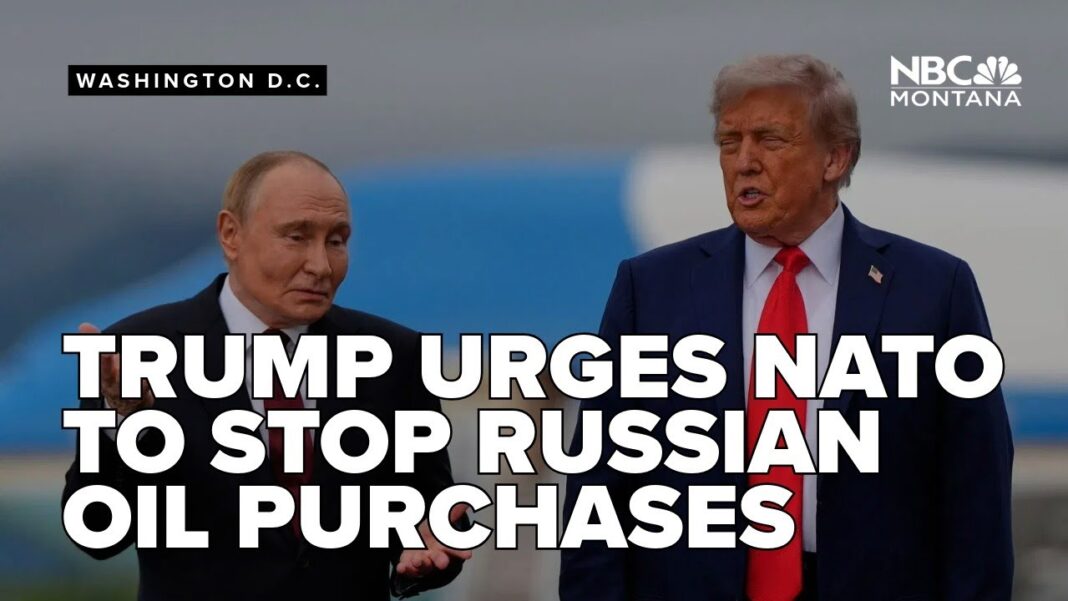
President Donald Trump on Saturday unveiled a new plan that he claims could bring the grinding Russia-Ukraine war to an end: a coordinated ban by NATO on Russian oil purchases, coupled with punitive tariffs of 50% to 100% on China for its continued imports of Russian petroleum.
As Newsmax reported on Saturday, Trump made the proposal in a pointed message on his social media platform, criticizing NATO for what he described as a lack of unity and seriousness in its commitment to defeating Russian aggression. “NATO’S commitment to winning the war has been far less than 100%,” Trump declared, calling the continued purchase of Russian oil by alliance members “shocking.”
According to Trump, the most effective way to weaken Russia’s war machine is to sever its economic lifeline: oil revenues. He chastised NATO members for undermining their own bargaining power by importing Russian crude while simultaneously pledging solidarity with Ukraine.
“It greatly weakens your negotiating position, and bargaining power, over Russia,” Trump wrote, as cited in the Newsmax report. He then argued that a complete embargo on Russian oil by NATO states, when paired with heavy tariffs on China for its purchases, would force Moscow into a corner and accelerate an end to the war.
The proposal comes against the backdrop of continued Western sanctions on Russia, which have attempted to reduce the Kremlin’s revenue streams since the February 2022 invasion of Ukraine. Yet loopholes remain, particularly as some NATO members—including Turkey, Hungary, and Slovakia—continue to buy Russian energy.
Trump’s proposal places unusual emphasis on Beijing’s role in sustaining Moscow. He contended that China exerts “a strong control, and even grip, over Russia,” and that punitive tariffs on Chinese imports tied directly to its purchases of Russian oil would “break that grip.”
As the Newsmax report highlighted, Trump suggested tariffs of between 50% and 100% on Chinese imports, with the promise to withdraw them if the war comes to an end. He described such measures as “a great help in ENDING this deadly, but RIDICULOUS, WAR.”
Trump’s focus on China reflects both his long-standing skepticism of Beijing and his belief that Moscow cannot continue financing its military without China’s massive energy purchases. According to the Centre for Research on Energy and Clean Air, China, India, and Turkey are the top three buyers of Russian oil, with NATO member Turkey holding third place.
Trump’s proposal also exposes a rift within NATO, where economic realities clash with security commitments. As the Newsmax report noted, Turkey has been a leading buyer of Russian oil since 2023, and both Hungary and Slovakia continue to rely on Russian imports, despite alliance-wide pledges to isolate Moscow.
This internal division, Trump argued, is more than a matter of economics. He insisted it directly undermines NATO’s leverage, weakening the alliance’s ability to pressure the Kremlin into ending the conflict. His remarks raise difficult questions for NATO members balancing domestic energy needs with geopolitical imperatives.
Trump’s comments came just days after Russia escalated tensions by sending multiple drones into Polish airspace. Poland, a NATO member, shot down the drones, sparking alarm about the war spilling over into alliance territory.
Yet Trump downplayed the incident, telling his supporters that the drone incursion “could have been a mistake.” As the Newsmax report observed, this cautious tone contrasted with the alarm expressed by European leaders, who have warned that Russian provocations against NATO states could trigger a dangerous widening of the conflict.
Trump has long promised that he would end the Russia-Ukraine war “quickly” if given the chance, but critics argue he has yet to apply the necessary pressure on Moscow. As the Newsmax report pointed out, last month Trump hosted Russian President Vladimir Putin in Alaska for direct talks, which failed to produce tangible progress toward peace.
Congress is currently pressuring Trump to back tougher sanctions, with lawmakers arguing that his reluctance to confront Putin risks prolonging the war. For now, Trump appears more focused on leveraging economic tools—energy bans and tariffs—rather than direct political or military confrontation.
In his social media post, Trump again deflected blame for the war away from Putin, instead pointing fingers at his predecessor, Democrat Joe Biden, and Ukrainian President Volodymyr Zelenskyy. According to the information provided in the Newsmax report, Trump has consistently argued that Biden’s “weak leadership” emboldened Moscow, while also suggesting that Kyiv bears responsibility for escalating tensions with Russia.
This framing stands in contrast to most Western leaders, who hold Putin directly accountable for launching the invasion in February 2022. Trump’s critics see this as evidence of his reluctance to criticize the Russian leader, though his supporters frame it as a pragmatic attempt to shift the dynamics of negotiation.
Trump’s proposal also builds on conversations at the Group of Seven (G7) meeting held Friday. According to the Newsmax report, U.S. Trade Representative Jamieson Greer and Treasury Secretary Scott Bessent urged their counterparts to adopt a “unified front” aimed at cutting off revenues that fuel Putin’s war effort.
While the G7 has already imposed a price cap on Russian oil exports, Trump’s plan goes much further, calling for a total ban by NATO and punishing tariffs on China—a step not currently supported by other major democracies.
Trump noted in his post that his administration has already placed a 25% import tax on goods from India as punishment for its continued purchase of Russian energy. Extending this tariff-based approach to China would mark a major escalation, potentially igniting a broader trade war with Beijing.
As the Newsmax report observed, such a move could reshape global markets, given China’s central role in the international energy trade. It also risks pushing Moscow and Beijing closer together in defiance of Western pressure.
The president’s proposal is sure to spark debate both within the United States and among America’s allies. Advocates will argue that cutting off Russia’s oil revenue is the surest way to force Putin to negotiate, while critics warn that tariffs of 100% on China could destabilize the global economy without guaranteeing an end to the war.
Nevertheless, Trump’s plan reflects his willingness to tie together trade policy, energy security, and foreign policy into one package—an approach that, as Newsmax frequently notes, distinguishes him from more conventional leaders.
Trump’s latest proposal to end the Russia-Ukraine war underscores his belief that economic leverage, rather than battlefield outcomes, holds the key to peace. By targeting Russian oil exports and Beijing’s role as Moscow’s largest customer, Trump envisions a strategy that forces both Russia and China to recalculate their positions.
As the Newsmax report emphasized, however, questions remain about whether NATO members would accept such a radical plan, especially those still dependent on Russian energy. Equally uncertain is how China would respond to crippling tariffs, or whether such measures would indeed “break its grip” on Russia as Trump insists.
For now, Trump has once again placed himself at the center of the debate over how to end Europe’s deadliest conflict since World War II—offering a characteristically bold and controversial plan, one that critics say risks global economic fallout, but that supporters argue could finally bring Moscow to the negotiating table.