



|
Getting your Trinity Audio player ready...
|
By: Fern Sidman
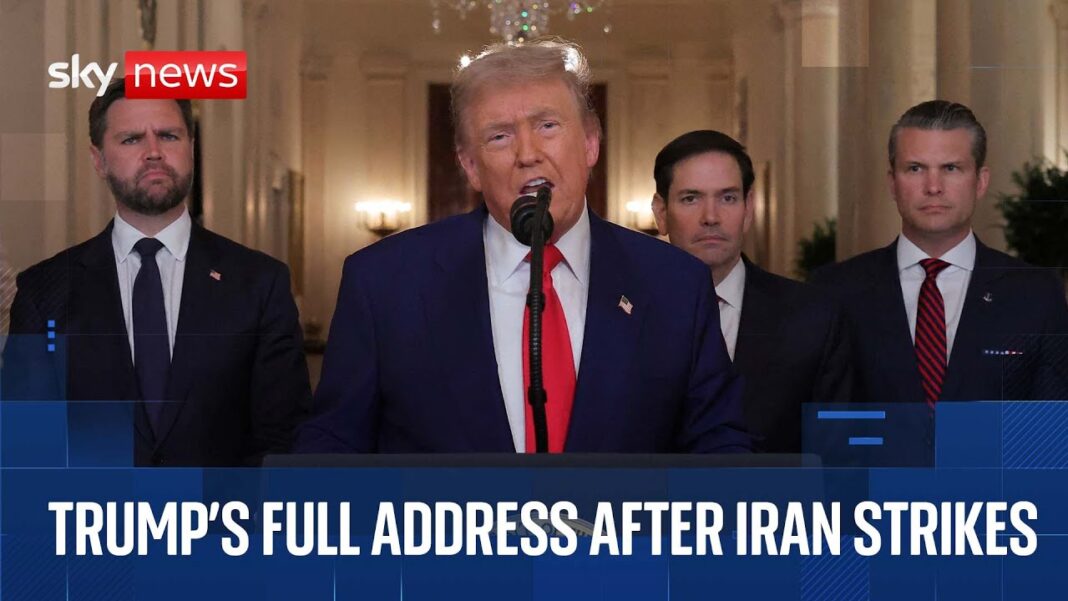
In a moment of extraordinary geopolitical consequence, President Donald J. Trump addressed the nation Saturday night to confirm what he called a “spectacular military success” following U.S. airstrikes on three of Iran’s most heavily fortified nuclear enrichment sites: Fordow, Natanz, and Isfahan.
Flanked by Vice President J.D. Vance, Secretary of State Marco Rubio, and Defense Secretary Mike Pompeo, Trump announced that the United States had “completely and totally obliterated” key Iranian nuclear facilities in an effort to eliminate the Islamic Republic’s nuclear threat.
“Our objective was the destruction of Iran’s nuclear enrichment capacity and a stop to the nuclear threat posed by the world’s number one state sponsor of terror,” Trump declared. “Tonight, I can report to the world that the strikes were a spectacular military success.”
As reported by The Jewish News Syndicate (JNS), the strikes represented the most significant military action by the United States against Iran since the assassination of General Qassem Soleimani in 2020. Unlike previous strikes aimed at curbing Iran’s regional influence, this campaign directly targeted Iran’s nuclear core — including Fordow, a site once thought impervious to air attack due to its location beneath hundreds of feet of rock and reinforced concrete.
Trump’s remarks were not only a celebration of tactical success but also a stern warning. “Iran must now enter into peace talks. If they do not, future attacks will be far greater and a lot easier,” the president warned. “Remember, there are many targets left.”
According to the information provided in the JNS report, the U.S. Air Force deployed the GBU-57 Massive Ordnance Penetrator (MOP) bomb — a 30,000-pound bunker-buster — to penetrate Fordow’s subterranean defenses. Six of the bunker-buster bombs were used by the US B-2 bombers to destroy the nuclear facility buried deep with a mountain near Tehran. Natanz and Isfahan, both critical to Iran’s uranium enrichment and centrifuge production efforts, were also heavily bombarded with hundreds of Tomahawk missiles launched from US submarines.
“Tonight, President Trump and the United States acted with a lot of strength,” said Israeli Prime Minister Benjamin Netanyahu, praising the coordinated operation between U.S. and Israeli defense forces. “We worked as a team like perhaps no team has ever worked before, and we’ve gone a long way to erasing this horrible threat to Israel.”
Netanyahu, speaking shortly after Trump’s address, thanked the U.S. for its “extraordinary commitment to peace through strength.” He reaffirmed Israel’s position that diplomacy without military credibility would never deter Iran.
“This is a decision that will change Iran, the region, and have major implications for America’s position in the world,” said Jason Brodsky, policy director at United Against Nuclear Iran, in comments to JNS. “It sends a message to China and Russia, reinforces American credibility, and bolsters U.S. deterrence.”
Brodsky underscored the significance of the moment, observing that every U.S. president since Bill Clinton has declared that Iran must not acquire nuclear weapons—but only Trump had authorized direct military strikes to prevent it. “Ali Khamenei has always known the U.S. has the capability to destroy his nuclear program,” Brodsky added. “What he doubted was American will. Tonight, that doubt is gone.”
Fox News: Israel destroyed 75% of Natanz and Isfahan facilities, and the American strikes with Tomahawk missiles completed the mission. @FoxNews @Israel @Iran @realDonaldTrump #Natanz #Isfahan #Tomahawk pic.twitter.com/cix6e6oYx1
— The Jewish Voice (@TJVNEWS) June 22, 2025
John Spencer, chair of urban warfare studies at West Point’s Modern War Institute, echoed that assessment, telling JNS, “Now is the chance for Iran to end the conflict with an agreement to end their nuclear pursuits. President Trump has done what was needed to end the violence.”
In Washington, support for the strike crossed partisan lines, though reactions reflected broader divisions over America’s posture in the Middle East.
“As I’ve long maintained, this was the correct move by the president,” said Sen. John Fetterman (D-Pa.). “Iran is the world’s leading sponsor of terrorism and cannot have nuclear capabilities.”
Sen. Lindsey Graham (R-S.C.) was even more effusive. “Good. This was the right call. The regime deserves it. Well done, President Trump. To my fellow citizens: We have the best air force in the world. It makes me so proud. Fly, Fight, Win.”
Thanking Trump, Netanyahu says US strike on Iran nuke sites ‘will change history’ @netanyahu @realDonaldTrump @Iran @Israel pic.twitter.com/8J6Qpp49Zt
— The Jewish Voice (@TJVNEWS) June 22, 2025
Despite the strong bipartisan praise, concerns about escalation were also voiced. JNS reported that U.S. military commanders have increased readiness levels across the Middle East and bolstered embassy security measures. Israel’s military remains on high alert, anticipating possible retaliatory action by Iranian proxies, particularly Hezbollah in Lebanon or the Houthis in Yemen.
Jewish organizations in the U.S. and abroad overwhelmingly endorsed the strike. The Conference of Presidents of Major American Jewish Organizations stated that “this decisive action represents a critical and justified step to confront the existential threat posed by the Islamic Republic of Iran’s pursuit of nuclear weapons.”
“We commend the United States for its leadership at this historic moment,” the organization’s chair and CEO said in a statement published by JNS. “We commend President Trump in particular for his clear-eyed recognition of the danger and for taking bold, preventative steps that may reshape the strategic landscape for generations.”
The Jewish Federations of North America applauded “the decisive and historic action taken to dismantle Iran’s key nuclear facilities, including the critical site at Fordow.”
Still, these groups expressed concern about potential backlash. “We are deeply concerned about the potential for Iranian-inspired retaliation, both in the region against U.S. forces and allies, and globally against Jewish communities and institutions,” said the Conference of Presidents. “We urge heightened vigilance, coordination with security authorities, and proactive measures to protect Jewish life and property around the world.”
Trump’s address concluded with a note of resolve and patriotic fervor. “The program is now set back,” he said. “Most of their infrastructure is gone. And if peace does not come quickly, we will go after those other targets with precision, speed and skill. Most of them can be taken out in a matter of minutes.”
He ended with a forceful blessing: “God bless the Middle East, God bless Israel, and God bless America.”
The strikes, described by JNS as “one of the most complex and successful aerial operations in recent American history,” signal not only a break from decades of rhetorical red lines but also a redefinition of American policy in the region—one that prizes deterrence over de-escalation and clarity over ambiguity.
As one senior Israeli military official told JNS, “This was not just a military operation. It was a statement of intent. The message is: Iran will not be allowed to go nuclear. Not now. Not ever.”
With U.S. bombers safely outside Iranian airspace and a battered nuclear program left smoldering beneath the desert terrain, the international community now braces for Tehran’s next move—diplomacy, defiance, or a dangerous escalation. All eyes are now on the Supreme Leader.
