



|
Getting your Trinity Audio player ready...
|
By: Fern Sidman
By all accounts, what occurred in Melbourne over the weekend was not merely a protest — it was a violent, targeted assault. According to a report that appeared on Tuesday in The Algemeiner, an Israeli-owned restaurant in the heart of Melbourne’s central business district became the flashpoint in an escalating trend of antisemitic incidents sweeping across Australia in recent months.
On Friday, around 20 individuals aligned with the Whistleblowers, Activists and Communities Alliance — a fringe pro-Palestinian group — stormed Miznon, a popular Israeli restaurant owned by Shahar Segal. Eyewitnesses described scenes of terror: patrons cowering as demonstrators overturned tables, hurled food, smashed windows, and shouted chilling slogans such as “Death to the IDF.” The Algemeiner reported that many customers feared for their lives during the rampage, which bore the hallmarks of an orchestrated riot rather than a spontaneous demonstration.
Victoria State Police swiftly intervened. As of Tuesday, three individuals — a 50-year-old man and two women aged 48 and 28 — have been formally charged with assault, affray, riotous behavior, and criminal damage. Authorities confirmed to The Algemeiner that the investigation is ongoing, with additional arrests likely as CCTV footage is reviewed.
In a statement released after the attack, Miznon’s management emphasized its foundational values of inclusivity and hospitality: “We are a restaurant, a place of warmth and welcome… Our greatest joy is to feed people from every background and viewpoint.” The restaurant stressed its staff come from diverse nationalities, and called for the public to embrace “mutual respect and understanding.”
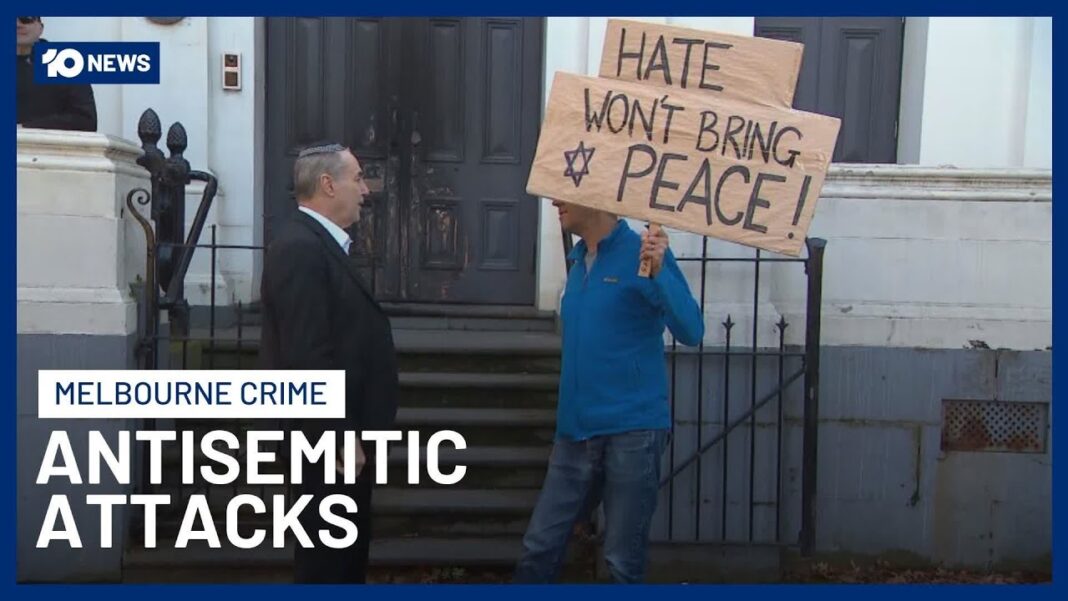
But the violence didn’t end there. On the same evening, a synagogue in Melbourne was targeted in an arson attack while congregants were praying inside. Several cars owned by Jewish families in the area were torched and defaced with antisemitic graffiti. In response, The Algemeiner report noted, local police arrested a 34-year-old man from Sydney and charged him with criminal damage by fire, among other offenses. Fortunately, the attack ended without physical harm — a “miraculous” outcome, as one worshipper told The Algemeiner.
The coordinated nature and timing of these incidents have drawn nationwide condemnation. Australian Prime Minister Anthony Albanese denounced the synagogue arson as a “cowardly act of violence and antisemitism” and pledged justice for the victims. “There is no place for hate in our country — not now, not ever,” he said in a televised statement.
Nonetheless, Jewish leaders across Australia are expressing deep concern over what The Algemeiner described as an “alarming erosion of safety and trust” for Jewish citizens. The Combat Antisemitism Movement (CAM), a global watchdog organization, characterized the weekend’s events as “a new and dangerous threshold” in the normalization of hate-fueled activism under the guise of political protest.
CAM CEO Sacha Roytman was blunt in his appraisal. “We are witnessing what amounts to attempted murder,” he said, referring specifically to the synagogue arson. “This is terrorism — and it must be treated as such.” Roytman urged the Australian government to recognize the gravity of the situation and take decisive measures to safeguard Jewish Australians.
Adding fuel to the fire, the Whistleblowers, Activists and Communities Alliance doubled down on their justification for targeting Miznon. In a social media post cited by The Algemeiner, the group stated that any business “openly supporting the terrorist state of Israel” — a reference to owner Shahar Segal’s ties to the Gaza Humanitarian Foundation — was “a fair target.” Their rhetoric closely mirrored classic antisemitic tropes: the conflation of Jewish identity, Israeli nationality, and government policy.
Segal’s foundation, which operates with oversight from Israeli and U.S. humanitarian agencies, has come under fire from hardline activists for distributing aid in cooperation with Israeli authorities. But critics such as CAM argue that attacking private businesses and individuals for perceived affiliations with the Israeli government crosses every moral and legal line — and represents a dangerous reversion to scapegoating Jews for geopolitical grievances.
According to the information provided in The Algemeiner report, Friday’s assault was not an isolated incident. Over the past nine months, antisemitic incidents in Australia have surged at an unprecedented rate, tracking closely with the escalation of the war between Israel and Hamas. Community centers, synagogues, schools, and Jewish-owned businesses have reported dozens of threats, harassment campaigns, and acts of vandalism.
At the heart of this crisis is a broader question of social cohesion and the rule of law. As The Algemeiner report observed, Australia has long prided itself on being a multicultural democracy. But the violent targeting of one of its most visible minority communities — at a restaurant, in a place of worship, and in residential neighborhoods — speaks to the erosion of civil norms in the face of radical ideology.
The Australian Jewish Association has called for increased security funding for communal institutions and more aggressive prosecution of hate crimes. Rabbi Dovid Slavin, a prominent community leader in Sydney, told The Algemeiner that the message must be clear: “You cannot intimidate a people into silence. We have survived far worse — and we will stand proudly in our identity.”
The government, for its part, has promised to act. Federal Attorney-General Mark Dreyfus said Tuesday that new legislation is under review to strengthen penalties for hate crimes, particularly those targeting religious and ethnic minorities. But many Jewish Australians remain skeptical. As The Algemeiner report pointed out, the burden of proof must now lie with the institutions — law enforcement, the courts, and political leaders — to restore faith in the system.
Meanwhile, Miznon has reopened its doors. Staff have replaced broken windows, cleaned overturned tables, and resumed service to a packed house of loyal patrons. The outpouring of support from the broader community, including messages of solidarity from interfaith organizations, has offered a glimmer of hope in an otherwise dark week.
“We will not be bullied into silence or fear,” one employee told The Algemeiner. “This is our city too. And we’re not going anywhere.”
