



|
Getting your Trinity Audio player ready...
|
By: Julie Herndon
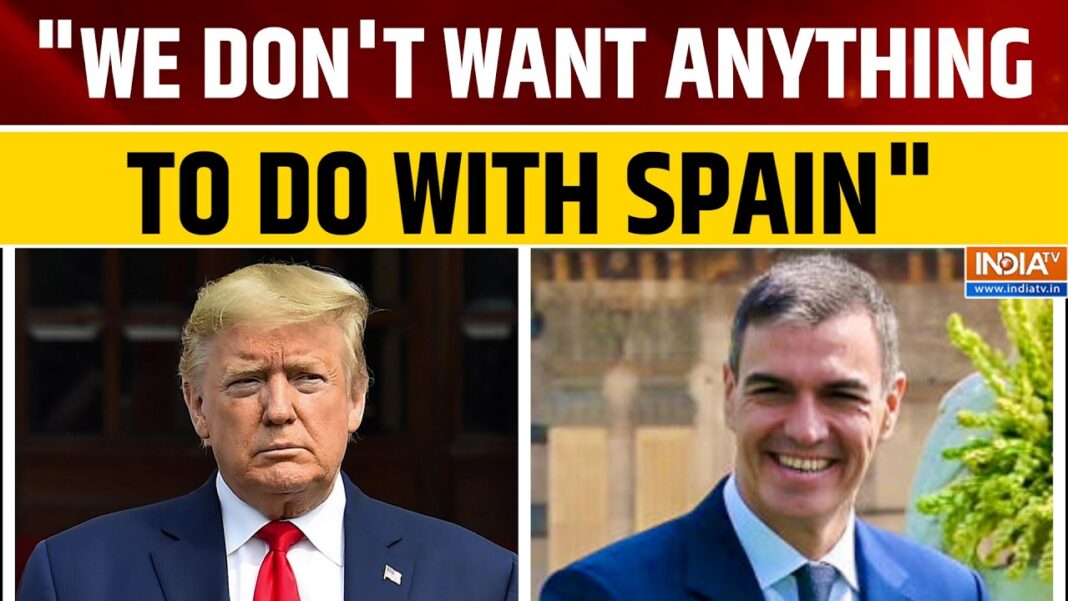
A dramatic diplomatic rupture is unfolding between Washington and Madrid after President Trump issued a stark warning that the United States could sever trade ties with Spain, accusing the European ally of obstructing NATO operations and undermining Western unity during the ongoing military campaign against Iran. The dispute, which has escalated rapidly in recent days, reflects the widening geopolitical divisions that have emerged among Western nations over the expanding conflict in the Middle East.
According to a report from Anadolu Agency, Trump delivered the threat during remarks to reporters on Wednesday, sharply criticizing Spain’s government for refusing to allow American forces to utilize jointly operated military bases on Spanish soil for air operations connected to the U.S.-Israeli campaign against Iran.
“I think they’re not cooperating at all. Spain. I think they’ve been very bad, very bad, not good at all,” Trump said, according to Anadolu Agency. “We may cut off trade with Spain.”
The statement signals what could become one of the most serious diplomatic confrontations between the United States and a major European partner in decades.
At the heart of the dispute lies Spain’s refusal to permit the United States to launch military strikes against Iran from bases jointly operated by both countries in southern Spain. These facilities—long regarded as strategic pillars of NATO’s Mediterranean defense architecture—have historically supported American and allied operations throughout the region.
Spain’s decision to deny their use during the current conflict has drawn sharp condemnation from Washington.
Trump accused Madrid of failing to fulfill its responsibilities as a NATO member, arguing that the country benefits from the alliance’s security umbrella while refusing to contribute adequately to its collective defense.
“They don’t want to pay their fair share,” Trump said, reiterating a long-standing criticism he has directed toward several European allies. The president pointed specifically to NATO’s newly proposed defense spending target of 5 percent of gross domestic product, a level few member states currently meet.
As reported by Anadolu Agency, Trump framed Spain’s stance as evidence of a broader reluctance within parts of Europe to support the U.S.-Israeli campaign against Tehran.
Spain’s government, led by Prime Minister Pedro Sánchez, has taken a sharply critical stance toward the military operation against Iran, which began earlier this year following a series of escalating confrontations between Tehran and Western forces.
Spanish officials have described the strikes as “reckless and illegal,” warning that the campaign risks igniting a wider regional war.
In response, Madrid barred U.S. aircraft involved in the offensive from using Spanish bases, a move that has significantly complicated logistical planning for American military operations in the Mediterranean and Middle East.
Despite the heated rhetoric from Washington, Spain’s foreign ministry has attempted to portray the situation as less confrontational. Foreign Minister José Manuel Albares said Tuesday that diplomatic relations between the two countries continue to function normally.
“Our relations with Washington remain operating normally,” Albares said, according to statements cited by Anadolu Agency. “Our embassies continue to maintain regular diplomatic contacts.”
Withdrawal of Spain’s Ambassador to Israel
The diplomatic dispute intensified further on Wednesday when Spain announced the permanent withdrawal of its ambassador to Israel, a move widely interpreted as a symbolic protest against Israeli military operations both in Gaza and against Iran.
As reported by Israel National News, the Spanish Foreign Ministry confirmed that the position of ambassador had been formally terminated, with the country’s embassy in Tel Aviv now to be managed by a chargé d’affaires.
According to the report at Israel National News, the decision represents a continuation of a policy shift that began months earlier when Spain initially recalled its ambassador amid rising tensions with Israel.
That earlier step followed Madrid’s decision to ban ships transporting weapons and ammunition destined for Israel from docking at Spanish ports. The cumulative effect of these measures has produced what analysts describe as one of the most strained periods in Israeli-Spanish relations in modern history.
Spain’s position has drawn strong criticism from American lawmakers and pro-Israel advocates in Washington. Senator Lindsey Graham sharply condemned Madrid’s decision to withdraw its ambassador from Israel, warning that such actions could embolden the Iranian regime.
“I was just informed that the Spanish government has permanently recalled their ambassador to Israel,” Graham said in a statement. “This is hard for me to absorb.” Graham argued that the conflict with Iran represents a fundamental struggle against a regime that has repeatedly called for the destruction of Israel and has sponsored attacks against Western interests.
“The religious Nazi regime in Iran is the problem, not the Jewish State,” Graham said.
His remarks underscore the deep ideological divide that now shapes the international response to the Iran conflict.
The war of words has also taken on a historical dimension. Israel’s government reacted with fury to earlier remarks by Prime Minister Sánchez that critics interpreted as suggesting Spain would use nuclear weapons to deter Israeli military actions if it possessed them.
According to statements cited by Israel National News , Sánchez said during a previous discussion of the Gaza conflict that Spain could not stop Israeli strikes because “Spain does not have nuclear weapons.”
Israeli officials described the comment as dangerously provocative. In an unusually sharp statement, the Israeli Prime Minister’s Office accused Sánchez of invoking rhetoric that could be interpreted as a genocidal threat against the Jewish state.
“Apparently the Spanish Inquisition, the expulsion of the Jews of Spain and the systematic mass murder of Jews in the Holocaust is not enough for Sánchez,” the statement said. The remark referenced the centuries-long history of Jewish persecution in Spain, including the expulsion of Jews in 1492 and the broader tragedies that befell European Jewry in the twentieth century.
The confrontation between Washington and Madrid highlights the growing strain within NATO as member states grapple with the implications of the expanding Middle East conflict. While many European governments have offered varying degrees of political support to the United States and Israel, others have expressed concern about the legality and potential consequences of the military campaign against Iran.
Spain has emerged as one of the most vocal critics within the alliance. Defense analysts warn that such divisions could complicate NATO’s ability to respond collectively to emerging security threats.
The alliance has long relied on close cooperation among member states to coordinate military logistics, intelligence sharing, and strategic planning. Restrictions on base access—such as those imposed by Spain—could undermine these efforts if replicated by other countries.
Trump’s threat to impose a trade embargo on Spain has raised alarms among economists and diplomats alike. The United States and Spain maintain significant commercial ties, with bilateral trade exceeding $50 billion annually.
American companies maintain major investments in Spain’s energy, technology, and financial sectors, while Spanish firms operate extensively within the United States. A full trade cutoff would therefore carry substantial economic consequences for both countries.
Market analysts say the mere possibility of such sanctions could introduce uncertainty into transatlantic commerce at a time when global markets are already under pressure from geopolitical instability.
For now, it remains unclear whether Trump’s warning will translate into concrete policy. Diplomats from both countries are reportedly working behind the scenes to prevent the dispute from escalating further.
However, the rhetoric emerging from Washington suggests that the administration views Spain’s actions as more than a simple policy disagreement.
Instead, the dispute is being framed as a test of Western solidarity during a moment of profound geopolitical confrontation.
The standoff between the United States and Spain illustrates how the war with Iran has begun to reshape alliances far beyond the Middle East itself. What began as a military confrontation has evolved into a global diplomatic struggle involving questions of international law, alliance obligations, and ideological alignment.
As the conflict continues to unfold, the cohesion of Western alliances may face increasing strain.
For Washington, the message appears clear: cooperation in the Iran campaign is not merely a matter of policy—it is a measure of loyalty within the broader strategic contest shaping the twenty-first century.
Whether Spain ultimately alters its stance remains uncertain.
But one fact is undeniable: the dispute has opened a new front in the geopolitical drama surrounding the Iran war, revealing fractures within the very alliances that have long defined the Western world.
