



|
Getting your Trinity Audio player ready...
|
(Jewish Voice News) After fading quietly toward the end of summer, the long-dormant trade war is suddenly back — and this time, Iran is at the center of it.
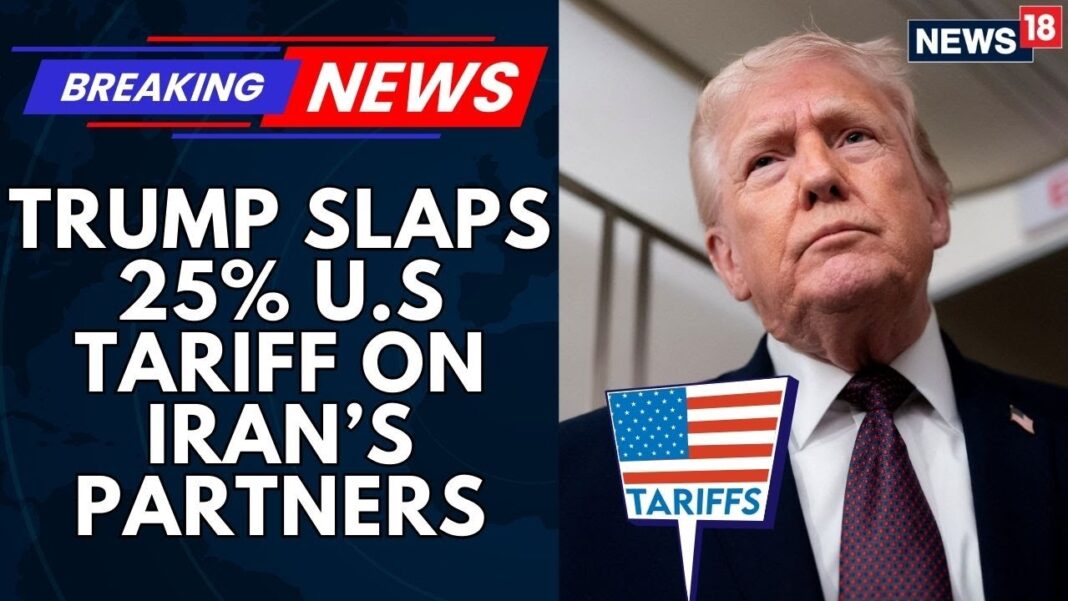
As Zero Hedge reported, President Trump reignited global market jitters after announcing on Truth Social that the United States will immediately impose a sweeping 25% tariff on goods from any country doing business with Iran. The move is widely seen as a direct shot at China, Tehran’s largest oil customer, but its reach could extend far beyond Beijing.
The announcement came amid an already overwhelming flood of headlines, adding another layer of uncertainty to global markets. Trump offered no clarity on how the tariffs would be enforced or which products would be targeted, declaring only that the measure would take effect “immediately.” As Zero Hedge noted, the lack of detail left traders scrambling, fueling volatility in already thin and conviction-less markets.
“Any Country doing business with the Islamic Republic of Iran will pay a Tariff of 25% on any and all business being done with the United States of America. This Order is final and conclusive,” Trump wrote.
According to Bloomberg, the policy has the potential to disrupt major U.S. trading relationships across multiple continents. Iran’s commercial partners include not only nearby states but major economies such as India, Turkey, and China. China, in particular, is the world’s largest buyer of Iranian crude, with independent refiners increasing their purchases as recently as last month, Bloomberg reported.
Trump has used similar tactics before. As Zero Hedge pointed out, his administration previously imposed tariffs as high as 50% on Indian goods linked to New Delhi’s purchases of Russian oil. While India briefly scaled back imports, it later resumed them. China, by contrast, largely ignored those earlier warnings.
If enforced, the new 25% tariff on countries trading with Iran risks unraveling the fragile trade truce Trump negotiated late last year with Chinese President Xi Jinping. Any escalation could reverberate through supply chains already strained by geopolitical tensions.
Compounding the uncertainty is an impending U.S. Supreme Court ruling on the legality of Trump’s global tariff authority. As Zero Hedge reported, a decision against the administration could limit the president’s ability to swiftly impose duties on Iran’s trading partners. The court’s next opinion day is scheduled for Wednesday.
Meanwhile, pressure is mounting inside Iran itself. The country has been rocked by weeks of mass protests initially triggered by a collapsing currency and deepening economic distress. The demonstrations have since evolved into a broader challenge to the Islamic Republic’s leadership — the most serious, according to analysts cited by Zero Hedge, since the 1979 revolution.
Despite the regime’s history of suppressing unrest, the current wave appears larger and more widespread. The Human Rights Activists News Agency reports that more than 500 people have been killed and over 10,000 arrested as authorities attempt to crush the demonstrations.
Trump has openly voiced support for the protesters and warned Tehran against violent repression. In a recent interview on Fox News, he said the United States would hit Iran “very hard” if the regime continued firing on demonstrators.
Over the weekend, Trump told reporters that Iranian officials had reached out to request talks and that a meeting was being arranged, though he declined to provide details. He said his administration was actively reviewing its options and coordinating with allies.
“We’re looking at it very seriously,” Trump said. “The military is looking at it, and we’re looking at some very strong options.”
A White House official, speaking anonymously, told reporters that Trump has been briefed on potential military strikes inside Iran, including against nonmilitary targets. Still, there are signs diplomacy may not be off the table. Iranian Foreign Minister Abbas Araghchi has reportedly opened communication channels with Trump’s Middle East envoy, Steve Witkoff, according to Iran’s foreign ministry.
Tensions remain high across the region. Iran has warned both the U.S. and Israel — which coordinated strikes on Iranian nuclear facilities last year — against any intervention. With memories still fresh of a recent U.S. strike in oil-rich Venezuela that resulted in the capture of strongman Nicolás Maduro, analysts warn that any new conflict could spiral quickly.
As Zero Hedge reported, a U.S. or Israeli intervention risks dragging neighboring countries into the crisis and threatening shipping through the Strait of Hormuz, a critical artery for global energy markets — and a potential flashpoint with worldwide consequences.
