



|
Getting your Trinity Audio player ready...
|
By: Fern Sidman
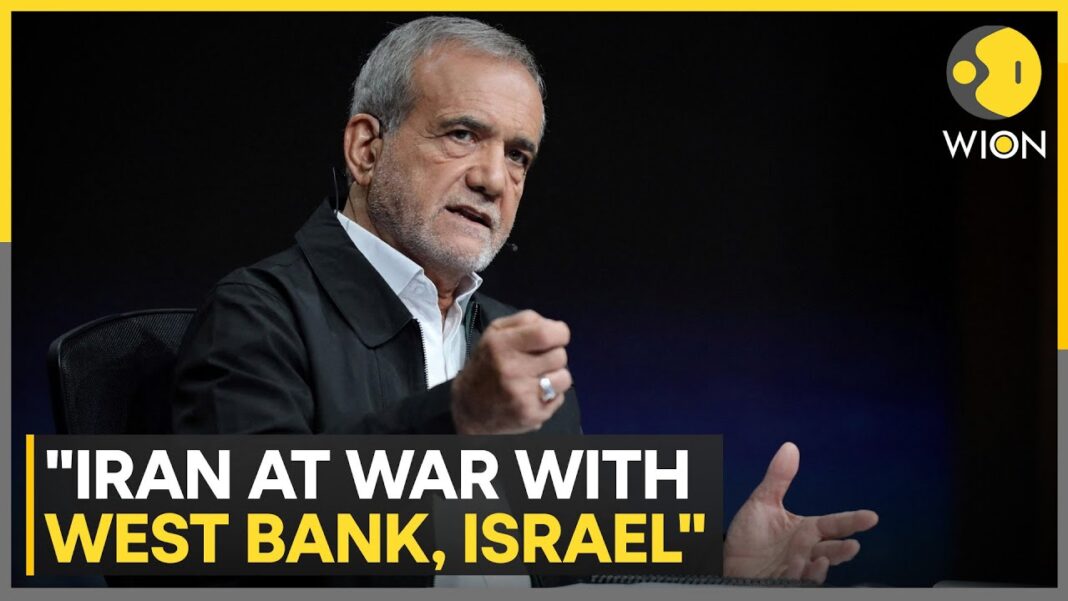
Iran’s newly installed president, Masoud Pezeshkian, has detonated a rhetorical bombshell that reverberated far beyond Tehran’s marble halls, declaring that the Islamic Republic is now engaged in what he described as a “total war” with the United States, Israel, and Europe. His words, published on the official website of Supreme Leader Ayatollah Ali Khamenei and reported by AFP, mark one of the most uncompromising statements by an Iranian head of state in recent years. As Israel National News reported on Sunday, Pezeshkian’s declaration is not merely bluster but a window into how Iran now perceives the strategic environment after months of military, economic, and diplomatic pressure.
“In my opinion, we are at total war with the United States, Israel and Europe. They want to bring our country to its knees,” Pezeshkian said. The remarks were made six months after coordinated U.S. and Israeli strikes on Iranian targets, an episode that, according to the Israel National News report, shattered longstanding assumptions in Tehran about the limits of Western and Israeli military restraint.
Perhaps the most striking element of Pezeshkian’s statement was his comparison between the current confrontation and the catastrophic Iran-Iraq War of 1980–1988. That eight-year conflict claimed hundreds of thousands of Iranian lives, devastated infrastructure, and shaped a generation’s political consciousness.
“This war is worse than the one launched against us by Iraq,” Pezeshkian said. “On closer inspection, it is far more complex and difficult.”
The Israel National News report noted that such language is unprecedented in its intensity. Iranian leaders have long portrayed sanctions and diplomatic pressure as existential threats but rarely have they equated them with the horrors of trench warfare, chemical attacks, and mass casualties that defined the Iran-Iraq War. By doing so, Pezeshkian is signaling to domestic audiences that Iran is once again in a struggle for survival, even if the front lines are invisible.
This framing comes at a moment when the White House has re-embraced an aggressive posture toward Tehran. Since returning to office in January, President Trump has revived his “maximum pressure” campaign, reimposing and expanding sanctions designed to strangle Iran’s oil exports and sever its access to global financial markets.
Israel National News reported that these measures are not symbolic. They are aimed at crippling the Iranian economy, depriving the regime of revenue needed to fund its military apparatus and regional proxies, from Hezbollah in Lebanon to militias in Iraq and Syria.
France, Britain, and Germany have added their own weight to this campaign. In September, the so-called E3 powers were instrumental in reimposing United Nations sanctions on Iran, citing violations connected to Tehran’s nuclear program. The move represented a collapse of Europe’s post-2015 strategy of engagement and diplomacy, and Israel National News has described it as a turning point in Western policy toward the Islamic Republic.
Iran, for its part, continues to deny that it seeks nuclear weapons, despite years of Israeli and Western intelligence assessments to the contrary. Yet Pezeshkian’s “total war” rhetoric suggests a leadership that no longer views the conflict as confined to centrifuges and enrichment levels.
This week, NBC News reported that Prime Minister Benjamin Netanyahu intends to raise Iran’s ballistic missile buildup — and the possibility of another Israeli strike — when he meets with President Trump in Washington. This meeting could prove pivotal, potentially shaping the next phase of Israeli-American coordination against Tehran.
According to Israeli intelligence cited by Israel National News, Iran’s missile forces suffered heavy losses during the 12-day war in June. Stockpiles reportedly fell from approximately 3,000 missiles to around 1,500, while the number of launchers was halved from 400 to 200. But the same sources now warn that Iran is rebuilding its arsenal with renewed determination, potentially at a pace exceeding anything seen since that brief but intense conflict.
These concerns have been sharpened by reports from Iran International, which cited Western intelligence sources describing “unusual aerial activity” by the Islamic Revolutionary Guard Corps’ Aerospace Force. The nature of that activity remains classified, but Israel National News notes that such language is rarely used lightly by intelligence professionals.
Adding to the sense of urgency, Axios reported last Sunday that Israeli officials have warned the Trump administration that a recent IRGC missile exercise could in fact be preparations for an attack on Israel. If confirmed, such preparations would mark a dangerous shift from proxy warfare to the brink of direct confrontation.
For Israel, these developments fit into a broader pattern. Over the past year, Jerusalem has repeatedly warned that Iran is no longer content to project power through Hezbollah, Hamas, or Shiite militias alone. Instead, it is seeking to reassert itself as a direct military actor capable of striking Israeli territory from its own soil.
Israeli defense officials increasingly view Iran’s missile program as the linchpin of this strategy. Unlike Hezbollah’s rocket arsenal in Lebanon, Iranian ballistic missiles represent a sovereign threat — one that cannot easily be neutralized through limited operations.
Europe’s reimposition of sanctions is also altering Tehran’s calculus. For years, Iranian diplomats attempted to exploit transatlantic divisions, portraying Washington as the intransigent party while casting Europe as a potential mediator. That narrative now lies in tatters.
By backing renewed UN sanctions, France, Britain, and Germany have aligned themselves more closely with U.S. and Israeli concerns. Israel National News has reported that Iranian officials privately see this as a betrayal — proof, in Pezeshkian’s words, that the West is unified in its attempt to “bring our country to its knees.”
Pezeshkian’s remarks were not delivered at a rally or in a televised address, but on the official website of Ayatollah Khamenei — a detail that Israel National News considers significant. The venue underscores that this is not merely a presidential opinion but part of a broader messaging strategy sanctioned at the highest level of the regime.
By invoking “total war,” Pezeshkian is laying the psychological groundwork for hardship. Sanctions are expected to deepen inflation, worsen unemployment, and strain public services. Framing these consequences as the price of resistance allows the regime to deflect blame and suppress dissent, arguing that economic pain is not the result of mismanagement but of foreign aggression.
Yet rhetoric has a way of becoming reality. When leaders speak of war — even metaphorically — they create expectations among supporters and adversaries alike. Israel National News has warned that Pezeshkian’s language may reduce diplomatic flexibility at a moment when channels of communication are already constricted.
Netanyahu’s impending meeting with Trump could therefore mark a watershed. If Washington and Jerusalem conclude that Iran is not merely posturing but actively preparing for confrontation, the logic of pre-emption may once again take hold.
The June conflict, brief though it was, left deep scars on all sides. For Iran, it exposed vulnerabilities in its missile infrastructure and air defenses. For Israel, it confirmed that Iranian territory is no longer a distant theater but a potential launchpad for direct attacks.
Israel National News reported that within Israeli security circles, the lesson drawn from that war is stark: deterrence must be restored not only in Lebanon and Gaza, but in Tehran itself.
In this volatile atmosphere, Pezeshkian’s declaration of “total war” is both a symptom and a catalyst. It reflects a regime that feels cornered by sanctions, isolated diplomatically, and wounded militarily. At the same time, it risks hardening positions on all sides, narrowing the space for compromise.
Whether this war remains rhetorical or spills into open conflict may depend on decisions made in the coming weeks — in Washington boardrooms, Israeli cabinet chambers, and Tehran’s guarded offices. As Israel National News has repeatedly observed, the Middle East has entered a phase where miscalculation is no longer a theoretical risk but an ever-present danger.
For now, the front lines of this “total war” run through bank accounts, missile silos, intelligence briefings, and televised statements. But history suggests that when leaders speak in the language of war long enough, battlefields eventually follow.
Maybe it is time for Israel to declare ‘total war without a battlefield’ on Iran. That could include computer viruses that destroys its water supplies, oil fields, electric grid etc. The Mossad can do that and other stuff with ease.