



|
Getting your Trinity Audio player ready...
|
By: Fern Sidman
For thirteen relentless days, the streets of Iran have convulsed with a fury unseen in decades. What began as scattered demonstrations has metastasized into a nationwide uprising, even as mounting evidence suggests that the Islamic Republic is responding with a brutality that has pushed the country to the brink of catastrophe. Hospitals are overflowing, families are searching through piles of bodies, and young Iranians — many scarcely beyond adolescence — are paying for their defiance with blood.
A comprehensive investigation by The Guardian of the UK has cast a harrowing light on the scope of the repression. Its reporting, drawing on satellite communications, verified video footage, and testimony from inside Iranian hospitals, depicts a country where the normal rhythms of life have collapsed under the weight of violence. According to the paper, a video authenticated by an Iranian human rights organization shows grieving relatives at Ghadir Hospital in Tehran sifting through rows of corpses — bodies the organization says belong to protesters gunned down by security forces.
This image, more than any other, has become emblematic of the present moment in Iran: citizens forced to navigate between hope and horror, between an unquenchable thirst for freedom and the regime’s determination to extinguish it at any cost.
The scale of the repression has been conveyed through fragmented but consistent accounts smuggled out of the country via satellite internet. One protester in Tehran told The Guardian that snipers had been deployed in central districts of the capital, and that live ammunition was being used against demonstrators with chilling regularity.
“Dead bodies are becoming normal,” the protester said in messages to the newspaper. “It feels like a ruthless war.”
That phrase — ruthless war — recurs across nearly every testimony emerging from Iran. The confrontations no longer resemble crowd control; they look increasingly like a military campaign against the population itself.
Even as gunfire reverberates through city centers, the regime is wielding another weapon in parallel: terror by spectacle. Fars News Agency, which is affiliated with Iran’s security services, has broadcast videos of what appear to be forced confessions by detained protesters. Human rights organizations warn that these televised statements are a prelude to something far more ominous.
In Iran’s grim judicial tradition, such confessions are frequently extracted under duress and later cited as justification for executions. Activists argue that their reappearance in the current crisis is not coincidental but part of a deliberate strategy to fracture the protest movement by sowing fear among families and communities.
Official tallies of the dead remain elusive, not least because Iranian authorities have systematically restricted access to information. The Human Rights Activists News Agency (HRANA) has confirmed at least 65 deaths since the protests began, including 50 demonstrators. Yet medical testimonies paint a far darker picture.
A Tehran doctor told Time magazine that in just six hospitals in the capital, at least 217 people had been killed — most of them by live fire. According to the physician, many victims were shot near police stations after security forces opened machine-gun fire into crowds.
The discrepancy between HRANA’s conservative figures and the doctor’s account underscores a central truth: no one yet knows the real death toll, and it may ultimately reach into the hundreds or beyond.
Inside Iran’s hospitals, the infrastructure of care is collapsing under the sheer volume of casualties. Doctors and paramedics speaking to the BBC via satellite internet described scenes that belong more to wartime field clinics than to civilian medical centers.
Non-urgent surgeries have been suspended. Corridors are lined with wounded protesters, many suffering from gunshot injuries to the head and eyes. Surgeons are in desperately short supply, forced to work marathon shifts as new patients arrive faster than beds can be cleared.
A paramedic in Shiraz recounted how the emergency department had become a revolving door of trauma. “They come in bleeding from the head,” he said. “We do what we can, but there are too many of them.”
On Thursday, the authorities imposed a near-total internet shutdown, severing much of the population from the outside world. Yet the blackout has failed to extinguish the protests themselves.
Despite the digital isolation, videos that trickled out overnight into Saturday morning showed thousands of people once again filling the streets of Tehran. Their chants were as defiant as they were historically charged: “Death to Khamenei,” in reference to Supreme Leader Ayatollah Ali Khamenei, and “Long live the shah,” a striking invocation of Iran’s pre-revolutionary monarchy.
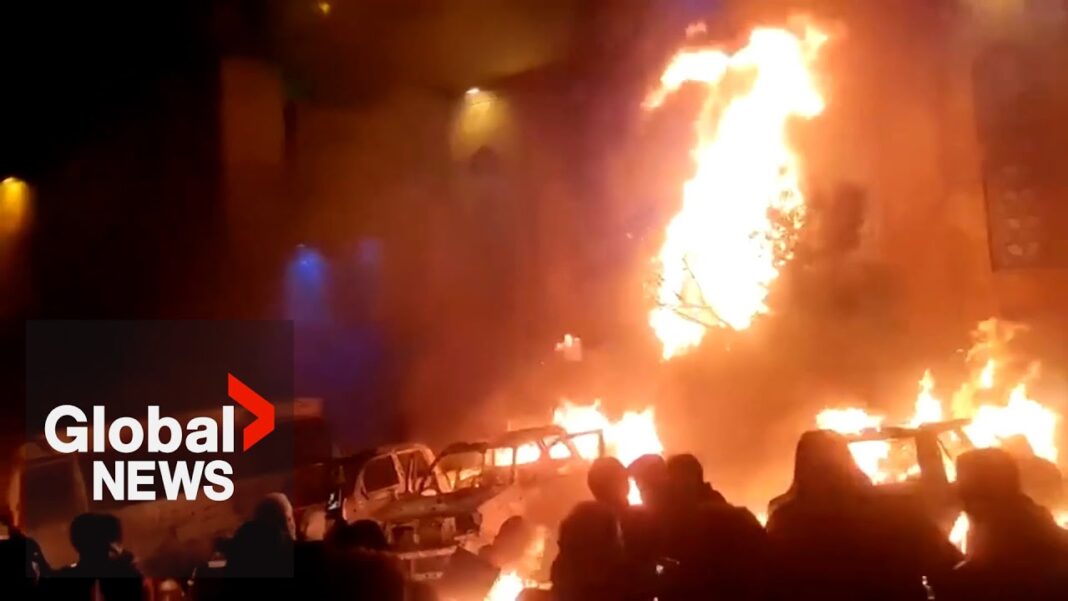
In Mashhad, Khamenei’s hometown, crowds marched through smoke-filled streets as fires burned around them — a tableau of rebellion in the city that symbolizes the very core of the Islamic Republic’s authority.
As protests rage in city after city, The Telegraph of the UK reported that Iran’s Supreme Leader has placed the country’s security apparatus on its highest state of alert — even more severe, the paper noted, than during the recent war with Israel.
According to the report, the regime has activated its underground missile bases in preparation for potential external threats, a move that suggests Tehran now perceives the unrest not merely as an internal challenge but as a strategic vulnerability.
Iranian officials have attempted to quell rumors that Khamenei might flee the capital. An unnamed source told The Telegraph: “He will not leave Tehran even if B-52 bombers fly overhead.” Another senior figure added that the leader has instructed the Revolutionary Guards to maintain a level of readiness “even higher than during the war in June.”
Perhaps most revealing was the admission that Khamenei is now in closer contact with the Revolutionary Guards than with the regular army or police. “He has entrusted his fate to the Revolutionary Guards,” the official said — a statement that underscores where real power lies in moments of existential peril.
The same Telegraph report said that more than 2,277 people were arrested in a single night, including 166 minors and 48 students. These figures, if accurate, hint at the breadth of the crackdown and the youthfulness of the movement it seeks to crush.
The image of teenagers and university students hauled into detention centers has further inflamed public anger. For many Iranians, it confirms that this is no longer a dispute over policy or economics but a struggle over the very future of the nation.
The unrest in Iran has reverberated far beyond its borders, drawing pointed rhetoric from the White House. President Trump has repeatedly warned Tehran against using lethal force on protesters, remarks that have been met with fierce rebukes from Iranian officials.
On Friday, Trump declared that Iranian authorities were “in big trouble,” adding a blunt admonition: “You better not start shooting, because we’ll start shooting too.”
By Saturday night, his tone had shifted toward rhetorical solidarity. “Iran is looking at FREEDOM, perhaps like never before,” he wrote in a post on Truth Social. “The USA stands ready to help!!!” He did not elaborate on what form that help might take.
For Iranian leaders already convinced that foreign powers are orchestrating the unrest, such statements only deepen the sense of siege.
Iran now finds itself suspended between two irreconcilable trajectories. On one side is a population that, even after thirteen days of bloodshed, continues to flood the streets, chant the unthinkable, and defy an apparatus of repression built over four decades. On the other is a regime that appears willing to deploy snipers, broadcast forced confessions and mobilize missile bases rather than concede an inch of authority.
The images emerging from Ghadir Hospital — families stooped over anonymous bodies — capture the cost of this confrontation in its starkest form. They are the human ledger of a political system that has chosen domination over dialogue.
No one can yet say how this confrontation will end. But one fact is already clear: Iran has entered a chapter that will be remembered not merely for the number of days it lasted, but for the ferocity with which a generation dared to challenge the Islamic Republic — and the price it was made to pay.