



|
Getting your Trinity Audio player ready...
|
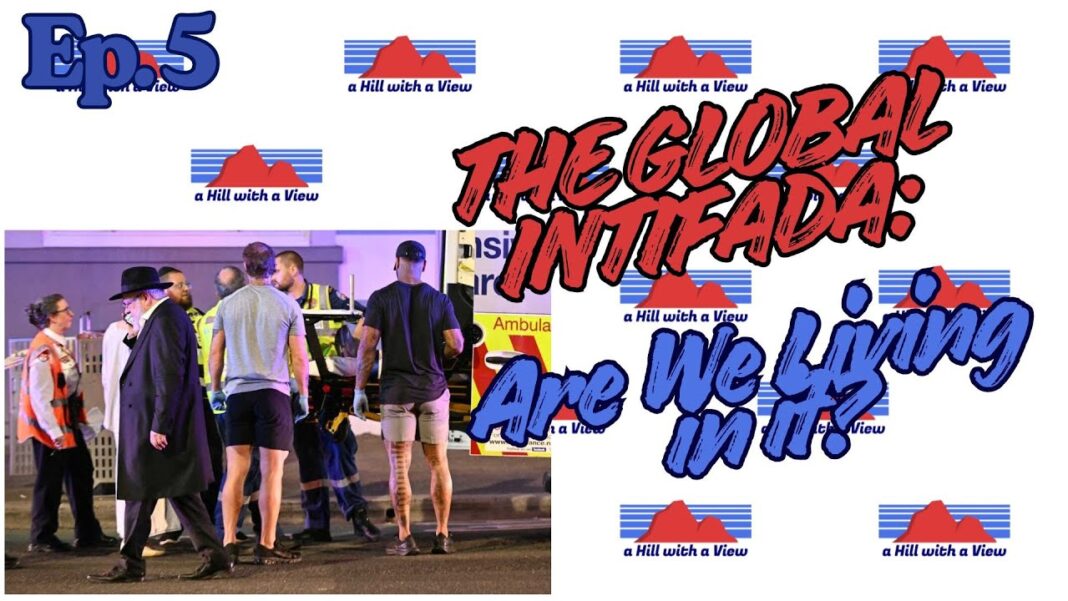
In a recent podcast episode, commentator Moshe Hill delivers a stark and cautionary analysis of what he describes as the emergence of a “third intifada,” warning that its implications extend far beyond Israel and pose profound risks to Jewish communities worldwide as well as to the stability of Western democracies in which these movements often take root.
Hill begins by unpacking the historical and linguistic origins of the term “intifada,” an Arabic word meaning “uprising” or “shaking off.” While the phrase can, in theory, denote popular resistance, Hill emphasizes that in modern political history it has become closely associated with sustained campaigns of violence and terrorism directed primarily at Israeli civilians. He situates his argument within the context of two prior uprisings that have left indelible marks on the Israeli–Palestinian conflict and on global perceptions of political violence in the name of nationalism.
The First Intifada, which erupted in 1987 and continued into the early 1990s, is described by Hill as a period marked by mass protests, civil disobedience, and frequent violent confrontations. Although often framed in some narratives as a grassroots uprising, Hill underscores that it also involved widespread attacks on Israelis, contributing to an atmosphere of fear and instability that reverberated throughout the region.
The Second Intifada—also known as the Al-Aqsa Intifada—represented, in Hill’s assessment, a far more lethal and devastating escalation. Beginning in late September 2000 and lasting until approximately 2005, this period was characterized by a wave of suicide bombings, shootings, and other terror attacks, many of them deliberately targeting civilian populations. Buses, cafés, shopping centers, and other public spaces became frequent sites of bloodshed. Hill notes that close to a thousand Israelis were killed or injured during this time, with countless others left traumatized by the sustained campaign of violence. The intensity and scale of the attacks, he argues, fundamentally altered Israeli society and security policy while also reshaping international discourse on terrorism.
Against this historical backdrop, Hill turns his attention to contemporary rhetoric and activism, particularly the slogan “Globalize the Intifada.” He characterizes the phrase not as a benign call for political solidarity, but as an explicit invitation for international actors to participate in a struggle that has historically manifested through violence against Jews and the Jewish state. According to Hill, the globalization of such language effectively exports the conflict beyond the Middle East, encouraging hostility toward Jewish communities far removed from the original geopolitical dispute.
Hill warns that this phenomenon has tangible consequences. He argues that when calls for “intifada” are echoed on university campuses, in public demonstrations, and across social media platforms in Western countries, they normalize a worldview in which violence against Jews is framed as political resistance. This, he contends, creates fertile ground for radicalization, intimidation, and, ultimately, physical attacks on Jewish individuals and institutions around the world.
Central to Hill’s thesis is the assertion that what he terms a third intifada is no longer confined to Israel or the Palestinian territories. Instead, it manifests as a transnational movement that exploits the openness of democratic societies. He cautions that Western democracies—prized for their protections of free speech and assembly—can become inadvertent incubators for extremist ideologies when rhetoric that glorifies violence is tolerated or excused as political expression.
Hill points to recent acts of mass violence and terror, including high-profile attacks on Jewish gatherings, as evidence that this new phase has already begun. Such incidents, he argues, are not isolated anomalies but part of a broader pattern in which incendiary language translates into real-world bloodshed. In his view, these attacks serve as grim confirmation that the ideology underpinning the intifada has crossed borders and found new arenas in which to operate.
Throughout the podcast, Hill stresses that the stakes extend beyond the Jewish community alone. He warns that ideologies which justify violence against one group in the name of political liberation ultimately undermine the social fabric of pluralistic societies. If left unchecked, he argues, they threaten the very principles—rule of law, mutual tolerance, and civic responsibility—that underpin Western democratic life.