



|
Getting your Trinity Audio player ready...
|
By: Jerome Brookshire
The arc of Saif al-Islam Gaddafi’s life traced, in many ways, the tortured trajectory of modern Libya itself: a nation oscillating between authoritarian order and violent fragmentation, between promises of reform and the brutal gravity of clan loyalties, between fleeting engagement with the world and a stubborn retreat into cycles of retribution. Once heralded as the cosmopolitan heir to his father’s four-decade rule, Saif al-Islam spent the better part of the last decade in captivity, seclusion and political purgatory before re-emerging to stake a controversial claim on Libya’s fractured future.
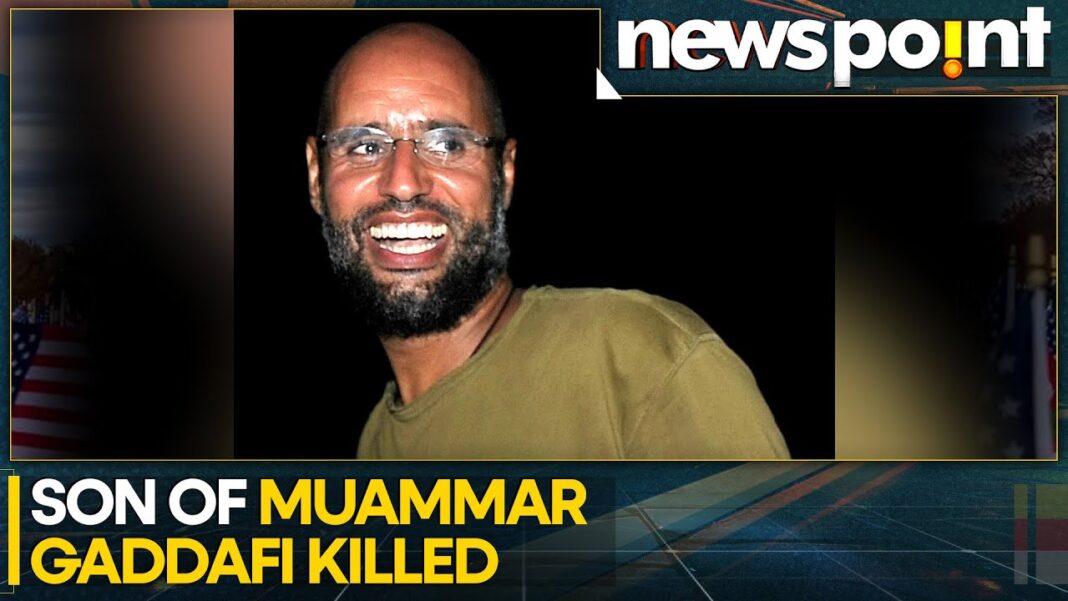
Now, according to a statement from his office reported by Reuters on Tuesday, that trajectory has been violently terminated. Saif al-Islam Gaddafi, the son of Libya’s slain strongman Muammar Gaddafi, was killed in what his aides described as a “direct confrontation” with four unidentified gunmen who broke into his home.
The circumstances of his death remain shrouded in ambiguity. Reuters reported that his office provided no further details about the identity of the attackers or the precise location of the killing, reflecting the opacity that has long defined Libya’s security environment. Yet the symbolism of his demise resonates far beyond the immediate violence of the encounter. For a figure who once embodied both the promise of Libya’s reintegration into the international community and the specter of its authoritarian past, Saif al-Islam’s death closes one chapter of a political saga that has haunted Libya since the collapse of the old regime in 2011.
To understand the significance of his killing, one must return to the period when Saif al-Islam was widely regarded as the most powerful man in Libya after his father. As Reuters has chronicled, he was not merely a privileged scion but an active architect of policy and diplomacy. He helped shepherd Libya out of pariah status by leading negotiations that culminated in Tripoli’s decision to abandon its weapons of mass destruction programs. He was central to the painstaking talks over compensation for the families of victims of the 1988 bombing of Pan Am Flight 103 over Lockerbie, Scotland, a gesture that symbolized Libya’s tentative re-entry into the international fold.
Educated at the London School of Economics and fluent in English, Saif al-Islam cultivated an image of reformist modernity. The Reuters report noted that he spoke the language of constitutionalism and human rights, presenting himself to Western governments as a bridge between Libya’s authoritarian past and a more open future. In the salons of European capitals and the corridors of international institutions, he was received as the acceptable face of a regime eager to shed its isolation. For a time, the narrative held: that Saif al-Islam might one day oversee a controlled transition, preserving stability while easing repression.
That narrative collapsed with the outbreak of the 2011 uprising. When rebellion erupted against Muammar Gaddafi’s long rule, Saif al-Islam cast aside his reformist persona and embraced the ruthless imperatives of regime survival. Reuters reported that he became an architect of the crackdown, deriding rebels as “rats” and warning in televised addresses that rivers of blood would flow. “We fight here in Libya, we die here in Libya,” he told Reuters during the revolt, articulating a grim credo of existential confrontation. His rhetoric, infused with apocalyptic foreboding, mirrored the regime’s descent into violence. He cautioned that the country would be destroyed, that decades would be required to stitch it back together, and that every faction would demand dominion over the ruins.
The fall of Tripoli marked the end of the Gaddafi era, but not the end of Saif al-Islam’s ordeal. As the Reuters report recounted, he attempted to flee toward Niger disguised as a Bedouin tribesman, only to be captured on a desert road by the Abu Bakr Sadik Brigade militia. His arrest, just weeks after his father was hunted down and summarily killed by rebels, was a spectacle of humiliation for a man once ensconced in luxury. “I’m staying here. They’ll empty their guns into me the second I go out there,” he was recorded saying as hundreds of armed men surrounded the aircraft that transported him to the western town of Zintan.
What followed was a prolonged period of detention that underscored the stark contrast between Saif al-Islam’s former life and his new reality. He spent six years in Zintan, largely isolated from the world, missing a tooth and confined for much of the time in solitary conditions. Human Rights Watch officials who met him raised concerns about his isolation, though he did not allege physical mistreatment. He was permitted access to satellite television and books, small concessions that underscored the peculiar limbo in which he existed: neither free nor fully erased from the political landscape.
In 2015, a court in Tripoli sentenced Saif al-Islam to death by firing squad for war crimes, a verdict rendered in absentia given his detention outside the capital’s control. He was also the subject of an arrest warrant from the International Criminal Court, which accused him of murder and persecution. Yet in the fractured legal geography of post-revolutionary Libya, these pronouncements carried limited practical force. He was released in 2017 under an amnesty law, only to retreat into years of clandestine existence to avoid assassination.
From that underground existence, Saif al-Islam gradually reinserted himself into Libya’s political imagination. By 2016 he was again communicating with contacts inside and outside the country, receiving visitors and engaging in political debate. When he emerged publicly in the southern city of Sabha in 2021 to file his candidacy for the presidency, the spectacle was as startling as it was divisive. Dressed in traditional robes and a turban, he appeared to embody a nostalgic appeal to a pre-2011 order that some Libyans remembered, however selectively, as more stable than the chaos that followed.
His candidacy, the Reuters report observed, became a lightning rod. To supporters, particularly those disillusioned by a decade of militia rule and political paralysis, Saif al-Islam represented a familiar, if flawed, alternative. To opponents—especially those who had suffered under the old regime—his bid was an affront to justice and memory. Armed groups born of the 2011 rebellion rejected his candidacy outright, and the legal challenges to his eligibility became emblematic of Libya’s broader institutional breakdown. When a court blocked his appeal of disqualification, fighters reportedly prevented proceedings from even taking place, a vivid illustration of how force supplanted law.
The ensuing collapse of the 2021 election process owed much to these unresolved disputes. Reuters cited analysts who argued that Saif al-Islam’s symbolic significance—more than any concrete policy agenda—became one of the chief obstacles to consensus. In an interview with The New York Times Magazine, he spoke with striking candor about his strategy, likening his return to a gradual psychological seduction of the Libyan public. Such remarks underscored both his political ambition and his unsettling detachment from the traumas his family’s rule had inflicted.
Now, with Saif al-Islam dead, Libya confronts a paradoxical reckoning. Reuters quoted Jalel Harchaoui of the Royal United Services Institute as observing that his death will likely dampen the morale of pro-Gaddafi factions while simultaneously removing a major impediment to elections. The vacuum left by his absence may ease certain political blockages, but it also risks provoking fresh anger among those who still identified with the old regime’s legacy.