

























|
Getting your Trinity Audio player ready...
|
Terror in Golders Green: Brutal Assault on Jewish Man Sparks Alarm Amid Escalating Wave of Antisemitic Violence in London
By: Fern Sidman
In a harrowing episode that has intensified fears within Britain’s Jewish community, a young Jewish man was brutally assaulted in the early hours of Sunday morning in Golders Green, North London, in what authorities are investigating as a targeted antisemitic hate crime. As reported on Monday by The Algemeiner, the attack represents yet another disturbing escalation in a pattern of violence and harassment that has gripped Jewish neighborhoods across the United Kingdom in recent months.
The victim, a 22-year-old resident of Golders Green—long regarded as one of the most prominent centers of Jewish life in London—was attacked at approximately 2:00 am outside his home after allegedly being overheard speaking Hebrew on a mobile phone. According to multiple accounts cited by The Algemeiner, a group of 4 to 5 masked individuals began pursuing the man upon hearing the language, shouting antisemitic insults as they closed in on him.
What followed, according to witness testimony and reports referenced in The Algemeiner report, was an act of violence both calculated and savage. The attackers reportedly confronted the victim, demanding to know whether he was Jewish. Upon confirming their suspicion, they allegedly dragged him across the roadway, tore at his clothing, and removed one of his shoes before launching into a sustained physical assault.
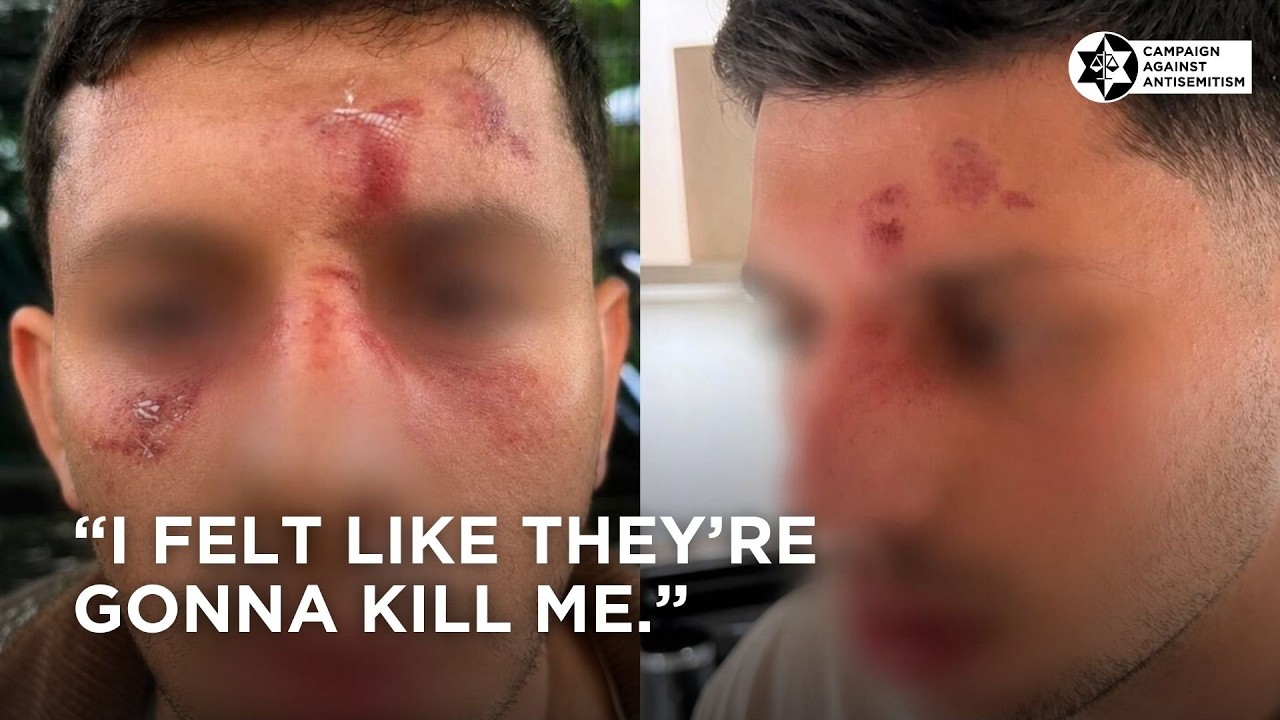
The brutality of the beating has shocked even seasoned observers of hate crimes. The victim was repeatedly kicked and struck, with reports indicating that he was left on the verge of losing consciousness. Images circulating in the aftermath, as described in The Algemeiner report, depict a young man whose face was marked by severe bruising, cuts, and swelling—visual testimony to the ferocity of the attack.
A relative of the victim, speaking to The Jewish Voice, recounted the terrifying sequence of events and the narrow margin by which the situation may have been even worse. “Thankfully, a neighbor heard the commotion and called the police,” the cousin said. “The incident has also been reported to CST, who are assisting in trying to find those responsible.”
By the time law enforcement arrived, however, the assailants had fled the scene, leaving behind a victim in urgent need of medical attention. He was subsequently transported to a hospital, where he has been receiving treatment for his injuries. As of this writing, no arrests have been made, though the investigation remains active.
The attack has been formally classified as an antisemitic hate crime, a designation that reflects both the apparent motive and the broader context in which the incident occurred. Indeed, as The Algemeiner reported, this assault is not an isolated event, but rather part of a troubling surge in antisemitic violence that has swept across the United Kingdom in the aftermath of the October 7, 2023 Hamas-led attacks in Israel.
The Campaign Against Antisemitism, a prominent British advocacy organization, responded swiftly and forcefully to the incident, issuing a statement that underscored the gravity of the moment. “It is plain for all to see that Jewish lives are under threat in their own communities,” the group declared, as cited in The Algemeiner report. “We cannot wait any longer for real intervention against this horrific wave of violence against Britain’s Jews. We are in dire need of urgent action.”
The victim’s cousin echoed these concerns while also offering practical guidance aimed at preventing further tragedies. “Please, especially parents of teenagers and young adults coming home late at night, speak to your children about staying alert and becoming aware of their surroundings,” the cousin urged. “Encourage them to avoid walking alone where possible, keep their phones charged, and save both police and CST emergency numbers.”
In a statement that encapsulates the anguish and frustration felt by many, the relative added, “No one should ever be attacked for speaking their language or for being Jewish. We cannot stay silent. We deserve to be protected.”
The assault in Golders Green comes amid a broader pattern of increasingly brazen antisemitic incidents across London and other parts of the United Kingdom. As The Algemeiner has reported, the past several months have witnessed a sharp escalation in both the frequency and severity of such acts, ranging from harassment and vandalism to physical assaults and attempted murder.
One particularly disturbing trend highlighted in recent coverage involves a series of antisemitic videos circulating on social media platforms. In these clips, individuals are seen entering predominantly Jewish neighborhoods and using fishing rods with money attached to the line in an apparent attempt to “fish for Jews”—a grotesque spectacle that combines mockery with intimidation. The phenomenon has already led to arrests and convictions, yet its emergence underscores the evolving and often performative nature of contemporary antisemitism.
Equally alarming are a series of violent incidents that have unfolded in rapid succession. In Stamford Hill, a man reportedly assaulted several Haredi Jewish women with a belt, subsequently spitting at volunteer responders while hurling racist and antisemitic abuse. Witnesses described a scene marked by both physical aggression and verbal hatred, further illustrating the multifaceted nature of the threat.
In another episode, a Jewish child was allegedly attacked outside a school in Amhurst Park, where a woman reportedly shouted antisemitic insults before physically assaulting the minor. Such events involving the targeting of vulnerable individuals, have deepened concerns about the safety of Jewish residents in everyday settings.
Perhaps most chillingly, The Algemeiner report noted that three weeks prior to the Golders Green assault, two Jewish men were stabbed in the same neighborhood—an attack that prompted the British government to elevate the national terrorism threat level from “substantial” to “severe” for the first time in more than four years. This escalation reflects official recognition of the seriousness of the threat environment, even as incidents continue to occur.
Acts of property destruction have also contributed to the sense of crisis. In March, arsonists set fire to 4 ambulances belonging to the Jewish Hatzola emergency response organization, a move widely condemned as both reckless and profoundly dangerous. Weeks later, a synagogue and the former premises of a Jewish charity were similarly targeted, reinforcing the perception that no institution is immune.
Against this backdrop, the attack on the 22-year-old in Golders Green assumes a symbolic as well as practical significance. It is emblematic of a broader climate in which visible expressions of Jewish identity—whether through language, dress, or communal affiliation—have increasingly become triggers for hostility.
The persistence of such incidents raises pressing questions about the adequacy of existing measures to protect vulnerable communities. While law enforcement agencies have pledged to intensify their efforts, critics argue that a more comprehensive approach is needed—one that addresses not only the immediate perpetrators of violence but also the underlying attitudes and narratives that enable it.
As The Algemeiner report indicated, the current wave of antisemitism represents a complex and multifaceted challenge, requiring coordinated action across multiple sectors of society. From education and community engagement to policing and legal accountability, the response must be as robust and sustained as the threat itself.
For the victim of the Golders Green assault, the path to recovery will undoubtedly be both physical and psychological. Yet his experience has already reverberated far beyond the confines of a single neighborhood, serving as a stark reminder of the vulnerabilities faced by Jewish communities in contemporary Europe.
In the final analysis, the question confronting Britain is not merely how to respond to individual incidents, but how to restore a sense of security and belonging for a community that has, for generations, been an integral part of the nation’s social fabric. As the victim’s cousin poignantly stated, “We deserve to be protected.” Ensuring that this principle is upheld will require not only words, but decisive and sustained action.



