



|
Getting your Trinity Audio player ready...
|
By: Fern Sidman – Jewish Voice News
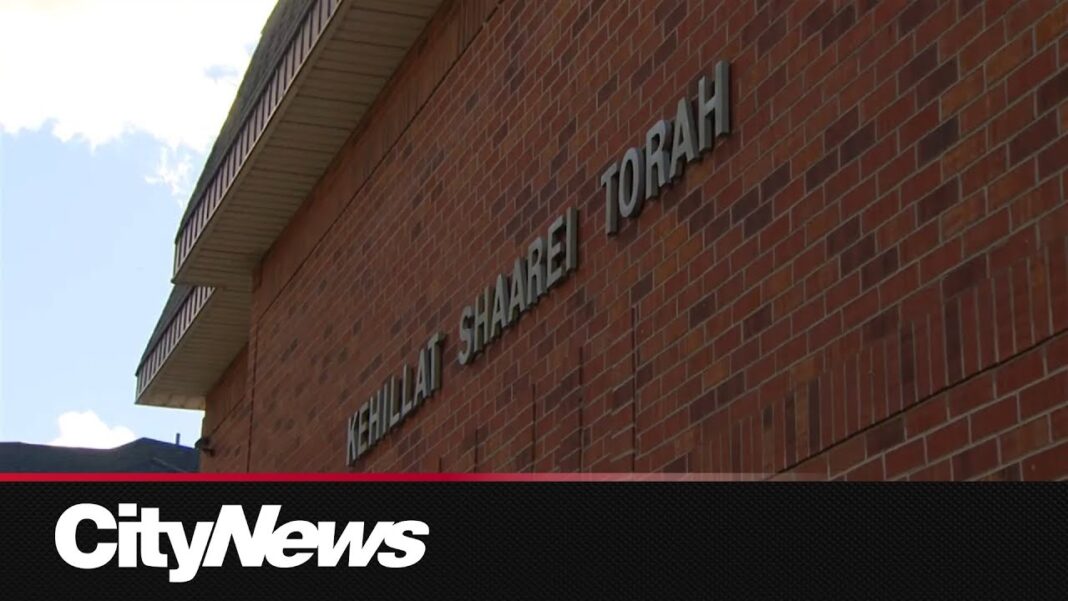
Toronto’s Jewish community was once again jolted by an act of hate this week as police launched a manhunt for a suspect caught on camera smashing windows at Kehillat Shaarei Torah (KST), a prominent synagogue in the city’s northern neighborhoods. The attack, which occurred in the early morning hours of Tuesday, marks the tenth targeted incident against the same synagogue in just 18 months — a disturbing trend emblematic of the broader surge in antisemitic crimes across Canada since the outbreak of the Israel–Hamas war in October 2023.
According to a report on Thursday at Israel National News, security footage from KST captured a hooded figure, dressed in black and wielding what appeared to be a hammer, leaping toward the building’s front window and shattering it in a single violent strike. Additional footage showed the individual sprinting past the synagogue’s main entrance before smashing two more windows and fleeing the scene.
Toronto Police Services confirmed to Israel National News that an investigation has been opened under the city’s hate-crimes division, treating the incident as “suspected hate-motivated mischief targeting religious property.” The suspect is described as wearing a black jacket with a hood, black pants, and black shoes with distinctive white markings. Authorities have urged anyone with information to come forward, emphasizing that “attacks on houses of worship are intolerable acts of intimidation that strike at the heart of community safety.”
As Israel National News reported, the recent attack is the latest in a relentless campaign of harassment against Kehillat Shaarei Torah — a congregation that has become a focal point of antisemitic hostility in Toronto since the start of Israel’s war against Hamas terrorists. The first act of vandalism took place in April 2024, followed by a similar attack just one month later. Since then, the synagogue has endured repeated assaults: windows smashed, anti-Israel stickers plastered on its walls, and even an arson attempt targeting lawn signs demanding the release of Israeli hostages.
Despite major investments in security upgrades, including new surveillance cameras and perimeter fencing, perpetrators continue to find ways to infiltrate the property. “It’s falling over,” Executive Director Michael Gilmore told The Canadian Jewish News, referring to a damaged section of the neighboring fence. “We’ve been trying to keep it propped up on our end.”
Gilmore, who oversees daily operations at the synagogue, said the community’s resilience has been repeatedly tested. Yet, remarkably, life inside the synagogue carries on undeterred. “Our 7 a.m. service went ahead as usual,” he said. “We just keep moving forward. At this point, early-morning alerts and repair costs have become a part of our reality.”
In an interview cited by Israel National News, Gilmore expressed particular frustration with recent remarks by Toronto Mayor Olivia Chow, who, at a November 1 gala, referred to “a genocide in Gaza.” Those comments, widely condemned by Jewish organizations, were seen as tacitly legitimizing the anti-Israel hostility that has spilled into physical violence.
“I don’t think she intends to incite violence,” Gilmore said, “but when she speaks without considering how her words can inflame tensions against the Jewish community, we’re left exposed. If our leaders won’t take our safety seriously, we have to seek protection elsewhere.”
The Israel National News report noted that Chow’s comments come amid a growing perception within Toronto’s Jewish community that local authorities have failed to confront the scale and nature of rising antisemitism. Many residents, particularly in neighborhoods surrounding Bathurst Street and Thornhill, report feeling unsafe wearing visible Jewish symbols or attending religious services after dark.
KST’s spiritual leader, Rabbi Joe Kanofsky, told The Canadian Press and later reiterated in comments carried by Israel National News that, while no one was physically injured in any of the attacks, the emotional toll on the congregation has been immense. “A synagogue is meant to be a place where people come together to thank God for life’s blessings and to pray for peace,” he said. “But lately, we’ve been forced to gather in fear, not faith.”
Rabbi Kanofsky emphasized that the community’s response must not be despair but perseverance. “Those who are determined to harm others seem tireless in their efforts,” he said. “So we must be even more determined in our commitment to kindness, to prayer, and to the sanctity of life. Every shattered window will be replaced. Every act of hate will be met with love and strength.”
The attack at Kehillat Shaarei Torah is part of a disturbing escalation of antisemitic incidents that has transformed Toronto into one of the world’s most affected Western cities since the Hamas-led massacre of October 7, 2023, in which 1,200 Israelis and foreign nationals were murdered.
Data released by the Toronto Police Service in May 2024 revealed that the city recorded its highest-ever number of hate crimes, with antisemitic offenses accounting for nearly 40% of the total. Jewish institutions—including schools, synagogues, and community centers—have borne the brunt of the attacks.
Just weeks before the KST incident, Toronto police launched an investigation after eggs were hurled at the Yorkville Jewish Centre while a man shouted obscenities. Surveillance video, reported by Israel National News, showed the assailant flinging eggs from a carton before fleeing on foot. In another case, vandals defaced Cedarvale Park with anti-Israel graffiti on the very day that Israel announced the release of 20 living hostages from Gaza—a moment meant for communal relief that was instead marred by hatred.
Israel National News further reported that, only a day after the latest vandalism at KST, a violent mob attacked a Students Supporting Israel event at Toronto Metropolitan University. Protesters shattered a glass door and injured one of the invited speakers before police intervened. Jewish student leaders said the riot left them “terrified” and “abandoned by the institutions meant to protect them.”
Community leaders, quoted by Israel National News, have described the situation not merely as a wave of vandalism but as a “war on Jewish presence.” They point to a confluence of factors fueling the crisis: unchecked social media incitement, extremist networks operating under the banner of anti-Zionism, and political rhetoric that blurs the line between legitimate criticism and hate speech.
Rabbi Kanofsky articulated the spiritual dimension of this challenge. “This isn’t just about broken glass,” he said. “It’s about broken trust—about the erosion of a sense of belonging for Jews in this city.”
Despite the fear and fatigue, the congregation at KST continues to demonstrate remarkable fortitude. “We will not be intimidated,” Gilmore told Israel National News. “Our doors will remain open, our prayers will continue, and our community will endure. For every act of hate, there will be ten acts of compassion.”
Local volunteers, including members of Toronto’s Jewish neighborhood watch groups, have increased patrols around synagogues, while interfaith allies have reached out to offer moral support and solidarity. Yet the sense of unease remains palpable.
As the Israel National News report observed, “The attacks on Kehillat Shaarei Torah are not only assaults on a building, but on the very concept of Jewish continuity in the diaspora—a test of whether faith can prevail amid fear.”
Jewish advocacy groups are now urging Canada’s federal government to expand security funding for religious institutions and strengthen hate-crime penalties. The Centre for Israel and Jewish Affairs (CIJA), in comments highlighted by Israel National News, called for a “national response commensurate with the scale of the threat.”
Meanwhile, members of KST continue to gather every morning in prayer, refusing to yield to intimidation. The synagogue’s shattered windows have already been replaced. “Glass can be broken,” said Rabbi Kanofsky, “but our spirit cannot.”
The haunting image of a lone vandal swinging a hammer in the night stands as a chilling reminder of the dangers that Jews now face even in one of the world’s most diverse and tolerant cities. But as the Israel National News report observed, the greater message of Kehillat Shaarei Torah’s resilience is one of defiance and dignity: that the Jewish people will not be driven from their sanctuaries, nor from their faith, no matter how many times the windows are broken.