



|
Getting your Trinity Audio player ready...
|
By: Fern Sidman
In a meeting framed publicly as cordial, strategic, and forward-looking, the encounter last week between U.S. President Donald Trump and Saudi Crown Prince Mohammed bin Salman (MBS) concealed a far more turbulent reality. According to a report on Tuesday at Axios—corroborated by insights shared with Israel National News—the long-anticipated conversation on the future of the Abraham Accords grew tense, punctuated by pointed disagreements over Saudi Arabia’s readiness to normalize relations with Israel.
The high-stakes closed-door session, held with the Gaza war finally concluded and Iran’s nuclear program neutralized following recent U.S. action, was intended by the White House to serve as the launchpad for a diplomatic breakthrough. Trump entered the meeting convinced that the moment was ripe for Saudi Arabia to join the Abraham Accords, an expansion he has touted as central to what he calls a “prosperous, integrated, peaceful Middle East.”
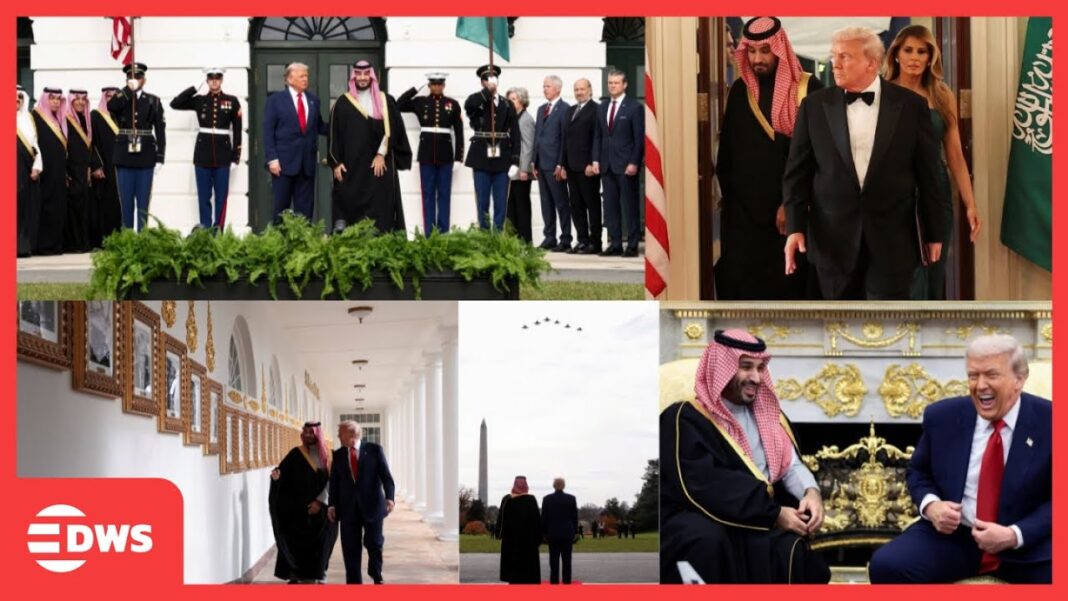
Publicly, both leaders praised one another, posed for amicable photos, and avoided any visible signs of friction. But as the Israel National News report indicated, behind the scenes, the exchange was far more fraught—and for the U.S. president, deeply disappointing.
Before the meeting, White House officials had unequivocally signaled to the Crown Prince that Trump expected tangible movement on normalization. Axios reported—and Israel National News confirmed through senior U.S. officials—that Trump “pressed very hard” for MBS to commit to joining the accords.
However, the Saudi leader stood firm.
MBS reiterated what Saudi officials have long stated publicly: Riyadh will not formally normalize relations with Israel without a concrete, irreversible path toward the creation of a Palestinian state. This condition—long resisted by Israel—was restated forcefully in the private meeting, and later publicly by MBS.
In the words of a source present during the discussion, cited by Israel National News: “The best way to say it is disappointment and irritation. The President really wants them to join the Abraham Accord. He tried very hard. But MBS is a strong man. He stood his ground.”
When Trump pushed for clarity, the Crown Prince pointed to the aftermath of the Gaza war, saying Saudi society remains deeply affected by the images of destruction and civilian casualties—and therefore unreceptive to a diplomatic shift perceived as embracing Israel.
“MBS never said no to normalization,” a U.S. official told Axios. “The door is open for doing it later. But the two-state solution is an issue.”
The implication was unmistakable: Saudi Arabia does not reject normalization in principle—but refuses to proceed without Israeli concessions that Prime Minister Benjamin Netanyahu and his government have repeatedly and emphatically ruled out.
The Crown Prince’s demand for a “credible, irreversible, and time-bound” path to Palestinian statehood is not new. For decades, Saudi Arabia has tied any formal relationship with Israel to significant movement on Palestinian sovereignty, most notably through the 2002 Arab Peace Initiative.
But as Israel National News notes, what is different now is the context.
Prior to Hamas’ October 7, 2023 massacre, the U.S. was on the verge of brokering a normalization agreement between Israel and Saudi Arabia. Diplomatic drafts were circulating. Security assurances were being negotiated. A historic trilateral deal seemed within reach.
Then Hamas attacked, Israel launched its war in Gaza, and Riyadh froze the process entirely.
Now, months after the conflict’s end, the Crown Prince has revived the demand—only in even sharper, more explicit terms. He wants written commitments. He wants deadlines. He wants guarantees.
And Israel, whose governing coalition is anchored by parties resolutely opposed to Palestinian statehood, will not accept such conditions.
Thus, the Trump–MBS meeting carried an underlying reality: the diplomatic roadblock is structural, not tactical.
Trump has repeatedly stated, both in public interviews and private meetings, that expanding the Abraham Accords remains one of his most deeply held foreign-policy priorities. As a White House official told Israel National News: “Now that Iran’s nuclear program has been totally obliterated and the war in Gaza has ended, it is very important to President Trump that all Middle Eastern countries join the Abraham Accords.”
From Trump’s perspective, Saudi Arabia is the linchpin. As he said last month: “When Saudi Arabia goes in, everybody goes in.”
His view is not without merit. Saudi participation would likely trigger a wave of follow-on agreements across the Arab and Muslim world, fundamentally reshaping Middle Eastern geopolitics. It would isolate Iran further, accelerate regional economic integration, and create new alliances stretching from the Gulf to the Mediterranean.
But as the Israel National News report stressed, MBS faces constraints—domestic, religious, geopolitical, and perceptual. Saudi Arabia is the custodian of Islam’s holiest sites. Public sentiment is deeply sympathetic to Palestinians. The kingdom has internal reform priorities that depend on stability. And MBS, despite his reputation for bold and sometimes radical modernization efforts, remains acutely sensitive to shifts in public opinion, especially following traumatic regional events.
According to sources cited by Axios and confirmed by U.S. officials speaking to Israel National News, the meeting took a notably heated turn when MBS pushed back against immediate normalization.
Trump reportedly placed an emphasis on his own political investment in the Abraham Accords and emphasized the strategic opportunity presented by Israel’s improved regional position following the Gaza conflict and Iran’s nuclear dismantling. He asked MBS to “seize the historic moment.”
MBS, however, reiterated that the time was not right. The Crown Prince’s argument reportedly rested on three pillars: Saudi public opinion cannot absorb normalization in the immediate aftermath of Gaza, internal legitimacy requires Saudi Arabia to demand concessions for the Palestinians and Saudi leadership of the Arab world depends on adherence to longstanding regional red lines on Palestinian sovereignty.
One source told Israel National News that MBS’s demeanor was “respectful but firm,” and that while he admires Trump personally and politically, “he will not move without domestic consensus.”
The exchange left Trump visibly disappointed. “He expected progress,” one official said. “He did not get it.”
Despite the friction, two key messages emerged from Saudi interlocutors:
1. Saudi Arabia has not rejected normalization.
MBS made clear he still envisions diplomatic relations with Israel. The kingdom recognizes the economic, technological, and security benefits. It sees Israel as a counterweight to Iran and a partner in innovation.
2. But Saudi Arabia will not move without concessions for the Palestinians.
Not symbolic gestures. Not verbal assurances. A concrete, irreversible political path.
As the Israel National News report highlighted, this condition reflects decades of Saudi policy continuity—stalled only briefly in 2022 and 2023 when pre–October 7 diplomacy hinted at a potential breakthrough.
But today’s Saudi landscape looks different: a population traumatized by Gaza images, an Arab world still angered, and a Crown Prince who must balance modernization with cultural legitimacy.
For Israel, the Trump–MBS meeting underscores an uncomfortable strategic reality: Saudi normalization remains a transformative opportunity—but one that cannot be achieved under current Israeli political constraints.
Prime Minister Benjamin Netanyahu has repeatedly declared his opposition to a Palestinian state “in any form.” Members of his coalition have gone even further, arguing that any concessions would endanger Israel’s security and sovereignty.
Thus, Israel’s government is positioned squarely opposite MBS’s demands.
As one analyst told Israel National News: “Normalization is possible. But not with this Israeli coalition. And MBS knows it.”
This may explain why the Crown Prince is not closing the door—only delaying until political conditions shift.
Diplomatic momentum has slowed, but not stalled. Saudi Arabia has not abandoned normalization. Trump remains committed to expanding the Abraham Accords. Israel sees Riyadh as the ultimate prize. And MBS believes normalization will ultimately serve Saudi interests.
But the timeline is now unclear. For the moment, the world is left with a paradox: The most consequential diplomatic breakthrough in decades is within reach—yet held back by an immovable political precondition.
As Israel National News reported, the meeting between Trump and MBS revealed not a collapse—but a standoff. The door remains open but the path through it depends on changes far bigger than any single meeting.
Behind the curated images and diplomatic smiles, last week’s Trump–MBS meeting exposed the complex fault lines shaping the next phase of Middle Eastern diplomacy.
The Abraham Accords remain alive, but their expansion will require the convergence of U.S. pressure, Saudi public readiness, Israeli political recalibration, and regional stability.
None of these conditions exist fully today. Yet none are impossible.
As the world’s attention shifts to the next phase of U.S.–Saudi–Israeli relations, one thing is clear from both Axios and Israel National News: History is rarely linear. The hardest breakthroughs often come after the hardest conversations.
And last week’s conversation was very hard indeed.
Meanwhile, our country is being sold out to these people.