



|
Getting your Trinity Audio player ready...
|
Tensions Afloat: U.S. Fighter Downs Iranian Drone Near Carrier as Confrontations Escalate in Middle East
By: Fern Sidman
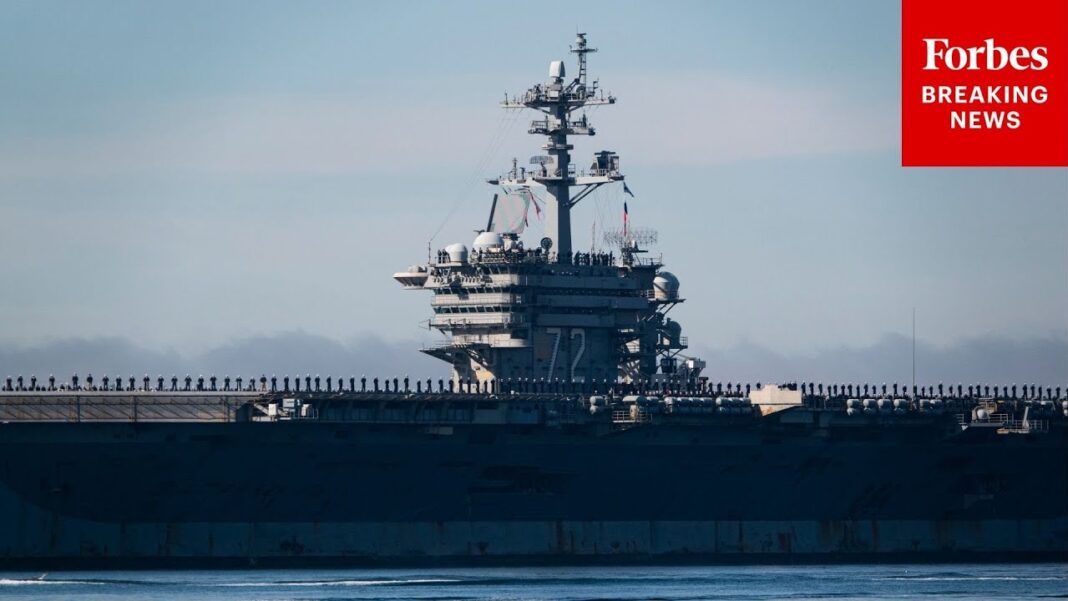
In a dramatic escalation of long-simmering tensions between Washington and Tehran, U.S. military forces shot down an Iranian unmanned aerial vehicle on Tuesday after it closed in on the USS Abraham Lincoln in the Arabian Sea, according to officials. The episode — which took place amid heightened American naval deployments and diplomatic posturing — underscores the fragile balance between deterrence and direct confrontation in a region already fraught with geopolitical volatility. On Tuesday, Fox News Digital reported extensively on the incident, situating it within the broader context of rising tensions over Iran’s nuclear ambitions, regional influence, and the United States’ expanding military presence.
U.S. Central Command (CENTCOM) identified the drone as an Iranian-produced Shahed-139, a variant of Tehran’s increasingly sophisticated drone fleet. CENTCOM spokesperson Capt. Tim Hawkins told Fox News Digital that the unmanned aircraft “aggressively approached a U.S. Navy aircraft carrier with unclear intent” while the supercarrier was transiting international waters roughly 500 miles from Iran’s southern coast. Despite what the U.S. described as “de-escalatory measures” by American forces, the drone continued on its course, prompting decisive action.
In response, an F-35C fighter jet launched from the USS Abraham Lincoln engaged and destroyed the Shahed-139 “in self-defense and to protect the aircraft carrier and personnel on board,” CENTCOM said. No injuries or damage to U.S. equipment were reported, but the shoot-down marks a significant military encounter that amplifies concerns about potential miscalculation between the two adversaries.
The Navy’s measured but resolute action reflects a strategic posture that has defined U.S. policy in the region in recent weeks: maintaining a robust deterrent presence while signaling readiness to protect American assets and personnel. President Donald Trump, who has presided over the buildup of a “massive armada” in the Middle East, reiterated U.S. resolve shortly before the incident occurred. In a Truth Social post, Trump wrote that the naval force, “headed by the great Aircraft Carrier Abraham Lincoln,” was “ready, willing, and able to rapidly fulfill its mission, with speed and violence, if necessary.” He added that the goal remained to bring Iran “to the table” to negotiate a fair agreement, particularly focused on preventing Tehran from acquiring nuclear weapons.
The downing of the drone was not the only provocative encounter involving Iranian forces that day. CENTCOM reported a separate incident in the Strait of Hormuz, one of the world’s most strategically vital maritime corridors. According to the information provided in the Fox News Digital report, two fast-attack craft affiliated with Iran’s Islamic Revolutionary Guard Corps (IRGC) along with an Iranian Mohajer drone approached the M/V Stena Imperative, a U.S.-flagged and U.S.-crewed merchant tanker, at high speed. The Iranian vessels and the Mohajer drone reportedly threatened to board and seize the tanker as it transited international waters — actions that, if carried out, would violate longstanding norms governing freedom of navigation in the strait. CENTCOM said that the guided-missile destroyer USS McFaul, operating nearby, immediately responded to the distress, providing escort and coordinating defensive air support with U.S. Air Force assets until the situation de-escalated and the tanker could proceed safely.
These back-to-back confrontations have inflamed an already combustible diplomatic landscape. For months, the United States has pressed Iran to re-enter negotiations over its nuclear program and to cease its support for proxy militias across the Middle East. Meanwhile, Tehran has resisted what it views as undue pressure, insisting that it will not accept demands that compromise its sovereignty or strategic capabilities. The region teeters between diplomacy and open conflict — a dynamic that the latest incidents may further destabilize.
Analysts have noted that Iranian drone technology, particularly variants like the Shahed-139, presents a persistent challenge for U.S. naval forces. Reports from Fox News Digital earlier this month highlighted concerns about Iran’s growing arsenal of unmanned systems, which could be deployed in saturating attacks designed to overwhelm traditional air defenses around high-value naval assets such as aircraft carriers. Low-cost drones, when launched in significant numbers, can complicate defensive operations and create operational dilemmas for commanders at sea.
Despite these pressures, Washington has sought to maintain a narrative that combines deterrence with diplomatic engagement. The Trump administration has publicly stated that while a military response remains an option, it prefers to see Iran engage in negotiations aimed at curtailing its nuclear ambitions and addressing concerns about its regional behavior. Diplomatic envoys continue to work through potential channels, even as military assets patrol waters and skies that remain tinder-dry.
Yet reactions from Tehran have reflected defiance rather than conciliation. Iranian state media and senior officials have previously warned that any military strike or pressure campaign would lead to broad regional repercussions, including threats to American interests and allied nations. Although Iranian leaders have at times signaled openness to “fair” negotiations, such language is often interspersed with rhetoric asserting national dignity and resistance to coercion. The complex interplay of threats and diplomacy underscores how fragile the current equilibrium has become.
The USS Abraham Lincoln strike group itself represents one of the most potent demonstrations of U.S. naval power. Aircraft carriers, with their complement of fighter aircraft, early-warning systems, and support vessels, serve both as deterrents and as symbols of strategic reach. The deployment of such a force into a theater of high tension conveys a message of American resolve, but it also increases the likelihood of encounters with adversarial forces whose motives and intentions may not always be transparent.
The economic implications of these confrontations are not insignificant. News of the shoot-down and the maritime harassment have already rippled through global markets. On Tuesday, oil prices briefly ticked upward following reports of the naval engagement, a reminder of how closely energy markets monitor stability in the Gulf and adjacent seas. Even without direct conflict, the specter of escalation can exert pressure on supply routes that account for a substantial portion of the world’s crude transport.
Moreover, the incidents have renewed debate in Washington over foreign policy strategy toward Iran. Supporters of a harder line praise the military’s actions as necessary to deter aggression and protect American interests, while critics warn that such engagements could entangle the United States in a broader conflict that may have unpredictable consequences. The administration’s dual emphasis on military readiness and diplomatic negotiation reflects that tension, with each side of the policy debate viewing the same developments through markedly different lenses.
What remains clear is that Tuesday’s events mark another inflection point in U.S.–Iran relations — one that illustrates both the dangers inherent in great-power competition and the challenges of managing confrontation without catastrophe. As the Lincoln and its accompanying vessels continue their mission, and as tankers and other commercial ships transit the region’s strategic chokepoints, the world watches a geopolitical standoff with implications that extend far beyond the Persian Gulf.
In the unpredictable calculus of Middle Eastern geopolitics, the downing of a single unmanned drone — and the near-boardings of a commercial vessel — may seem episodic. Yet such incidents carry disproportionate weight in a region where mistrust runs deep and history looms large. For now, the United States maintains that its actions were defensive and measured, designed to preserve stability and protect its forces. How Tehran responds, and whether diplomatic avenues can temper the risks of further escalation, will define the next chapter in this fraught standoff — one that observers say could shape the contours of regional security for years to come.
