



|
Getting your Trinity Audio player ready...
|
By: Fern Sidman
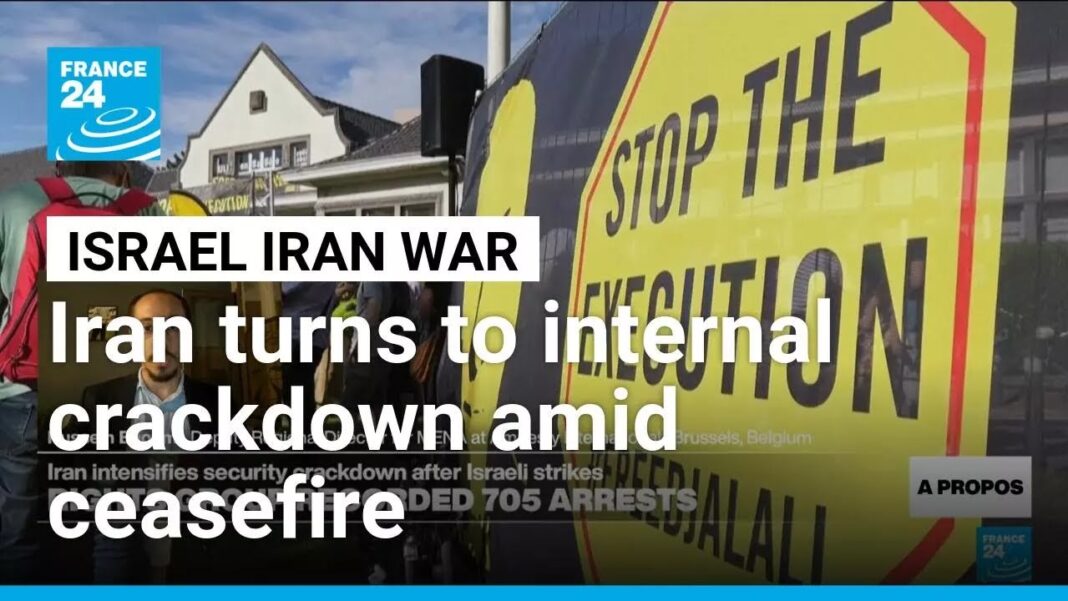
As the reverberations of Operation Rising Lion continue to spread across the Middle East, Iran’s internal crackdown has intensified, with at least 700 individuals arrested for alleged links to Israel, according to reports from the exiled women’s group Association Femme Azadi. In a post shared late Thursday, the France-based organization stated that Iranian authorities have swept up civilians, clerics, and community leaders under broad and often opaque allegations of espionage and Zionist collaboration.
According to a report on Friday in The Jerusalem Post, the mass arrests coincide with growing paranoia within the Iranian regime following the sweeping Israeli air campaign that began earlier this month. The operation — which targeted Iran’s nuclear infrastructure, missile arsenals, and military leadership — has, in turn, prompted Tehran to launch an internal purge seemingly aimed at projecting strength and reasserting regime control.
Among those arrested, according to Association Femme Azadi, are rabbis and Jewish religious figures based in Tehran and Shiraz. The organization claims the arrests were made “without credible evidence” and underscores the fragile position of Iran’s Jewish minority in times of national crisis. “The state has launched a deliberate campaign of intimidation against ethnic and religious minorities under the pretext of national security,” the group wrote.
The Jerusalem Post noted that these reports, while difficult to independently verify, are consistent with Iran’s historical pattern of conflating religious and ethnic identities with perceived loyalty to foreign powers. In previous periods of heightened tensions with Israel or the West, Iranian Jews — among the oldest Jewish communities in the diaspora — have often found themselves under suspicion or surveillance.
Further escalating the situation, KAN News reported on Thursday night that six additional individuals had been executed in recent days, all accused of collaborating with the Israeli Mossad intelligence agency. That brings the total number of espionage-related executions in Iran for 2025 to at least nine, according to the report. The executions are believed to have been carried out after closed-door Revolutionary Court sessions, known for denying defendants basic legal protections.
As The Jerusalem Post report emphasized, Iran’s crackdown is not occurring in a vacuum but as part of a broader strategic messaging campaign. The Islamic Republic is keen to portray itself as resilient and united in the face of what it has labeled “Zionist aggression.” Yet the cost of this narrative appears to be disproportionately borne by the country’s minority communities — most notably its Jews, estimated to number fewer than 10,000 today, down from over 80,000 before the 1979 Islamic Revolution.
In a striking and heavily publicized move, Tehran’s Jewish community held a government-sanctioned rally on Thursday to affirm their loyalty to the Islamic Republic and to celebrate what was described as the military’s “decisive response” to Israeli airstrikes. According to the report at KAN News, the event featured Jewish servicemen dressed in Iranian military uniforms and wearing traditional kippahs — a visual meant to convey both integration and allegiance.
Speaking at the gathering, Dr. Homayoun Sameyah Najafabadi, the sole Jewish member of Iran’s parliament, the Islamic Consultative Assembly, insisted that several Jewish community buildings were damaged during Israeli airstrikes — an unusual and pointed statement in the current climate. The Jerusalem Post report suggested that Najafabadi’s remarks may have been aimed at reinforcing the notion that Iranian Jews suffer alongside other citizens when foreign powers act against the regime.
Observers outside Iran have expressed skepticism about the event. “This is classic political theater,” one Middle East analyst told The Jerusalem Post. “Minority communities in authoritarian states are often compelled to perform loyalty, particularly when they are under scrutiny or suspicion.”
Despite Iran’s repeated insistence that its actions are necessary to maintain national security, international human rights organizations have raised alarm over the escalating use of capital punishment and arbitrary arrests. The Iranian judiciary remains largely opaque, and many of those accused of espionage are denied access to independent counsel or public trials.
In this increasingly volatile climate, the position of Iran’s Jews remains precarious — caught between their historical roots in the country and the regime’s adversarial stance toward the Jewish state.
The recent arrests and executions mark one of the largest internal purges linked to alleged Israeli ties since the early 1980s, and they underscore Tehran’s heightened sense of vulnerability following the precision airstrikes that crippled parts of its nuclear and missile infrastructure. Yet while the Islamic Republic attempts to rally nationalistic fervor, its heavy-handed response may only deepen domestic unease and international isolation.
The question remains whether Tehran’s strategy of domestic coercion and symbolic unity will reinforce its standing or further fray the fragile threads of its social fabric — particularly among those who have already paid the price for simply existing between two embattled worlds.
