



|
Getting your Trinity Audio player ready...
|
By: Fern Sidman
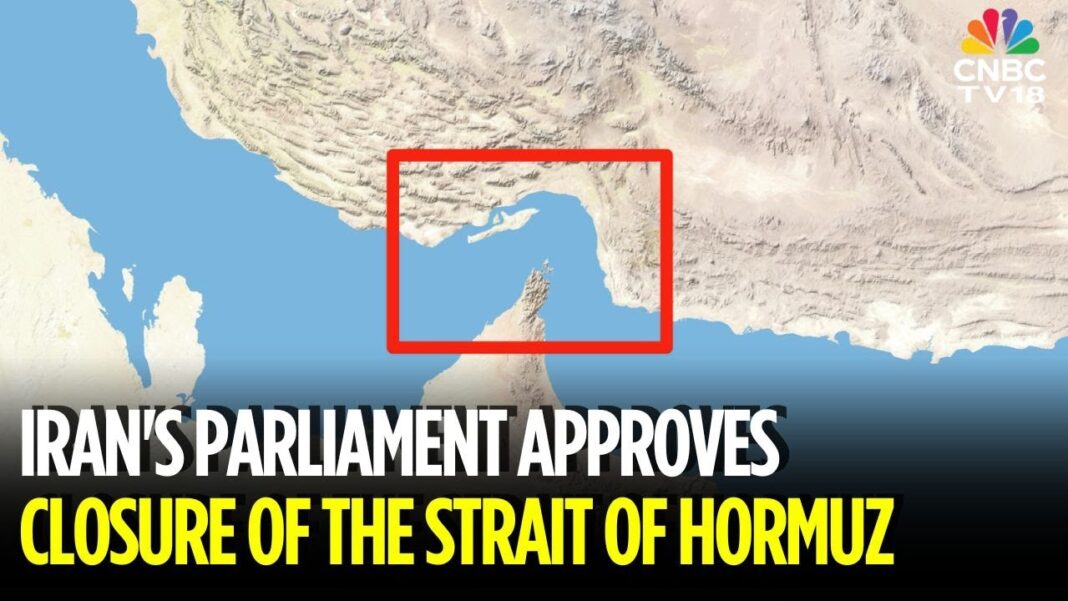
In the wake of the recent U.S. airstrikes targeting Iran’s Fordo nuclear facility, Tehran has once again resurrected its most menacing threat: the closure of the Strait of Hormuz. This narrow waterway, only 21 miles wide at its narrowest point, commands a pivotal role in global energy flows. Every day, approximately 21% of the world’s petroleum trade—some 21 million barrels of oil and vast quantities of liquefied natural gas (LNG)—transit through its heavily patrolled waters.
The Strait of Hormuz is not merely a geographic feature; it is the fulcrum upon which the economic survival of the Gulf region, and much of the industrialized world, precariously balances. A sudden disruption could bring the global energy market to its knees. Yet paradoxically, the actor most frequently threatening this closure—Iran—is also the one most exposed to its consequences. In threatening Hormuz, Iran is effectively brandishing a gun to its own head.
The six Gulf Cooperation Council (GCC) countries—Saudi Arabia, the United Arab Emirates, Kuwait, Qatar, Bahrain, and Oman—differ greatly in their capacity to absorb or mitigate the shock of a Hormuz blockade. Their strategies for navigating the crisis range from robust to nonexistent, and their vulnerabilities are as divergent as their political trajectories.
Saudi Arabia, long aware of its dependency on maritime routes, has invested heavily in the East-West Pipeline, also known as Petroline. This 1,200-kilometer conduit transports crude oil from the kingdom’s Eastern Province to the Red Sea port of Yanbu, bypassing the Persian Gulf entirely. With a maximum capacity of 5 million barrels per day—approximately 40% of Saudi Arabia’s current export volume—it offers a partial buffer against a Hormuz shutdown. The kingdom has also constructed the Abqaiq-Yanbu pipeline for natural gas liquids, adding redundancy to its energy security.
Nevertheless, even these measures fall short of full protection. Expanding this infrastructure would require years and billions in capital expenditure. Still, with vast sovereign reserves and technical expertise, Saudi Arabia remains the best-positioned Gulf state to withstand a prolonged closure of Hormuz.
The United Arab Emirates has taken similar steps with the Abu Dhabi Crude Oil Pipeline (ADCOP), linking the Habshan oil fields to the port of Fujairah on the Gulf of Oman. This pipeline, capable of transporting 1.5 million barrels per day, offers the UAE a sliver of independence from the chokepoint. But while it covers a portion of the UAE’s export volume, the country remains entirely dependent on Hormuz for its imports, including essential goods such as food, industrial components, and medicine. Dubai—an entrepôt economy—would suffer grievously from any extended blockade.
Iraq occupies a more precarious position. The Iraq-Turkey Pipeline, connecting Kirkuk to the Mediterranean port of Ceyhan, has the potential to bypass Hormuz altogether. However, its efficacy is undermined by political friction between Baghdad and the Kurdistan Regional Government, through whose territory it runs. Additional theoretical routes via Syria or Jordan are fraught with logistical, security, and political barriers. In a twist of bitter irony, Iraq might find itself needing to negotiate with Iran to ship oil out of Iranian ports—an absurdity that underscores the region’s tangled energy web.
Kuwait and Qatar, meanwhile, face the worst-case scenario. Both countries lack any alternative pipeline infrastructure. A Hormuz closure would paralyze their ability to export hydrocarbons. For Qatar, the world’s largest exporter of liquefied natural gas, the consequences would be especially dire. LNG, unlike crude, is not easily rerouted via overland pipelines. The technology and logistics simply don’t allow it.
Qatar’s only land border is with Saudi Arabia—a relationship strained by years of diplomatic tensions and the recent blockade, only lifted in 2021. Thus, Doha’s ability to pivot its exports westward is nearly nonexistent. Any potential cooperation would be slow, costly, and politically fraught.
While the world’s attention often focuses on the GCC states’ vulnerability to a Hormuz shutdown, the greater strategic paradox lies within Iran itself. For all its rhetoric and saber-rattling, Iran remains deeply tethered to the very waterway it threatens to close.
Iran exports between 2 and 3 million barrels of oil daily, virtually all of which must pass through the Strait. Unlike Saudi Arabia or the UAE, Iran lacks any alternative pipelines leading to other international markets. A closure would sever its own arteries, halting the inflow of petrodollars that finance the Islamic Republic’s military apparatus, public services, and vital imports.
Making matters worse, Iran’s domestic refineries are insufficient to meet internal demand for refined fuels. The nation still relies on imported gasoline, diesel, and other products—all of which arrive by sea, through Hormuz. Shutting down the Strait would starve its own economy, triggering immediate shortages, rampant inflation, a collapse in the rial, and likely a wave of civil unrest.
In short, Iran’s most potent geopolitical weapon is also a suicide pact.
The United States and its allies are not blind to this dynamic. The U.S. Navy’s Fifth Fleet, headquartered in Bahrain, exists in large part to ensure freedom of navigation through Hormuz. While capable of repelling asymmetric threats such as fast-attack boats and drones, it remains unclear whether even a superpower can fully neutralize a determined Iranian campaign to disrupt shipping via sea mines, missile barrages, or proxy sabotage.
Nonetheless, the mere presence of American forces serves as a powerful deterrent, reducing the likelihood of an actual closure. For the United States, the Strait of Hormuz is not just a strategic interest—it is a global imperative.
Despite their deep mutual distrust, both Iran and the GCC states are joined in their vulnerability. None can afford the economic devastation that would follow a prolonged closure of Hormuz. Yet history in the Middle East is rife with miscalculations, ideology-driven gambits, and violent overreach.
The alternatives to Hormuz—pipelines to the Red Sea, new ports, diversified economies—offer a measure of resilience, but no substitute. The global energy transition may one day render Hormuz irrelevant, but that future remains at least a generation away. Until then, the Gulf’s fortunes—and the world’s energy security—will continue to flow through this slender maritime vein.
In the end, the Strait of Hormuz is more than a chokepoint; it is the embodiment of the region’s geopolitical contradictions: immense wealth built on fragile geography, strategic power undermined by mutual dependency, and regional rivalry shackled to shared peril. The threat of its closure, however remote or irrational, will haunt policymakers for decades to come.
