



|
Getting your Trinity Audio player ready...
|
Tehran in Retreat: Israeli Scholar Warns Iran’s Regime Has Entered Its Most Fragile Hour
By: Fern Sidman
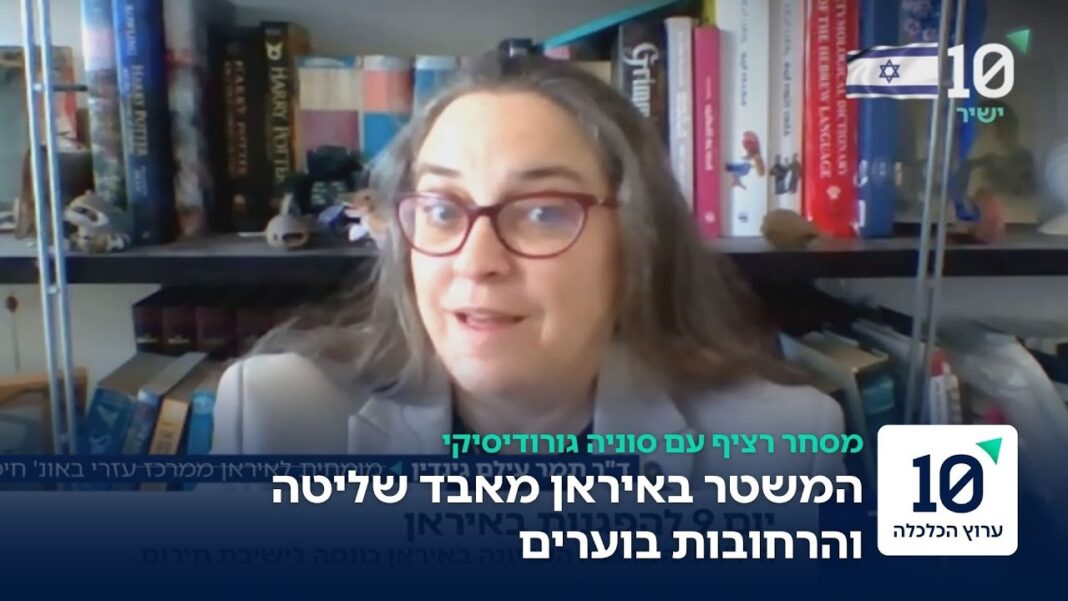
As protests ripple across Iran for a second consecutive week, the Islamic Republic finds itself in a position it has not known since its inception: cornered, exposed, and psychologically unmoored. According to a penetrating analysis published by Israel National News on Tuesday, Dr. Tamar Eilam-Gindin, one of Israel’s foremost experts on Iranian society, believes the regime is no longer merely suppressing dissent but is actively fighting for survival.
In a series of remarks cited by Israel National News, Dr. Eilam-Gindin, who teaches at the Azrieli Academic College at the University of Haifa, described a leadership class paralyzed by fear and reactive improvisation, confronting not only economic collapse and social exhaustion but the unprecedented specter of open threats from Washington and Jerusalem alike.
“This is a defensive regime,” she explained. “It is not confident, not strategic. It is in survival mode—and that is something we have never seen before.”
The Iranian authorities, Dr. Eilam-Gindin noted, have leaned heavily on digital manipulation to project the image of a divided society. On X, formerly Twitter, pro-regime hashtags trend with suspicious regularity, accompanied by condemnations of demonstrators as foreign agents or Zionist proxies. But this, as she insisted in comments to Israel National News, is a mirage.
“If you look only at social media, you might think it’s fifty-fifty,” she said. “But if you analyze the videos coming from the streets, the testimonies from inside Iran, the picture is completely different.”
What those videos reveal is not mass rallies but fragmented, high-risk protests—small clusters of citizens chanting, clashing with police, dispersing quickly before regrouping elsewhere. This pattern, she said, is not evidence of apathy but of calculation. Many Iranians who oppose the regime simply cannot afford to march openly. They tweet instead. They film quietly. They wait.
Dr. Eilam-Gindin regards this phenomenon as an inversion of the regime’s traditional control strategy: Tehran once feared the streets and dominated the internet; now it dominates the internet while fearing the streets.
The regime’s anxiety is magnified by the new tone emanating from the United States and Israel. President Donald Trump’s recent declaration that Washington is “locked and loaded” to respond if peaceful demonstrators are harmed has sent shockwaves through Tehran’s elite. According to the information provided in the Israel National News report, Dr. Eilam-Gindin cannot recall a moment when an American president addressed the Iranian leadership with such unfiltered menace.
“I don’t remember any time when the president of the world’s greatest power threatened the regime like this,” she said. “They have been on the defensive since the ‘Women, Life, Freedom’ protests—and even more so since the 12-day war.”
The reference to the short but devastating confrontation with Israel last year underscores the strategic erosion Iran has suffered. Hezbollah has been battered. Syrian and Iraqi corridors are compromised. Even Tehran’s nuclear program has been visibly impaired. Now, Iranian generals must contemplate a scenario in which sustained internal unrest could invite external intervention.
In a striking reversal of decades of ideological rigidity, Tehran is now hinting at selective compromise. Officials have floated the idea of abolishing Iran’s notorious dual-exchange-rate system—a reform that could marginally stabilize prices but would also undercut powerful economic fiefdoms within the Revolutionary Guards and clerical elite.
This tentative openness, Dr. Eilam-Gindin said, is not reconciliation with the people but negotiation with fear.
“They are trying to calm those who do not disrupt order,” she explained. “But even that is dangerous for them. Every concession weakens the coalition of insiders who keep the regime alive.”
The leadership, she believes, is now trapped between incompatible imperatives: repress hard enough to deter revolt yet appear humane enough to avoid international retaliation. It is a tightrope with no safety net.
The protestors themselves have changed. Unlike the mass demonstrations of 2019 or the galvanizing “Women, Life, Freedom” movement of 2022, today’s unrest is quieter, more intimate—and far more nihilistic.
As quoted by Israel National News, Dr. Eilam-Gindin observed that the language of the demonstrators has shifted dramatically. They speak not merely of reform but of sacrifice. Of dying if necessary. Of reclaiming Iran regardless of the cost.
“They talk about fighting, dying, and taking the country back,” she said. “They understand the price will be heavy. They have a culture of martyrdom—and they have very little to lose.”
This fatalism, she argued, is what terrifies Tehran most. A population that no longer believes in gradual change is unpredictable, uncontrollable, and immune to intimidation.
Could external patrons rescue Iran economically? The regime would like to believe so. But Dr. Eilam-Gindin is unconvinced.
As the Israel National News report noted, she described the notion of rehabilitation through China and Russia as “unlikely”—not impossible, but structurally flawed. Beijing and Moscow may offer trade, but they cannot replace a functioning economy, nor can they feed a population ravaged by inflation, unemployment, and energy shortages.
“There were times when people said, ‘As long as there’s food on the table, it doesn’t matter who rules us,’” she said. “We’re not sure we’re in that situation anymore.”
In other words, legitimacy purchased with bread has expired.
When asked to forecast the outcome of the unrest, Dr. Eilam-Gindin resorted to a chilling biblical metaphor.
“The regime is getting closer to the point of ‘let my soul die with the Philistines,’” she said. “The question is whether they will commit suicide over this—or flee.”
This is not rhetorical flourish. It reflects a genuine strategic dilemma. A leadership that believes its fall is inevitable may choose escalation over reform—whether through mass arrests, regional provocation, or reckless military theatrics designed to rally nationalist fervor.
Already, Iran’s Revolutionary Guards have launched missile and air-defense drills over Tehran and Shiraz, widely interpreted as both intimidation and rehearsal.
Perhaps most poignant is Dr. Eilam-Gindin’s assessment of the Iranian people’s relationship with the outside world. As reported by Israel National News, many demonstrators openly appeal to Prime Minister Benjamin Netanyahu and President Trump to intervene—to strike Iran as they struck Venezuela.
Yet history haunts these appeals.
“They want help,” she said. “But they also know that every foreign intervention in Iran has ended badly.”
She pointed to the restoration of the Shah after the 1953 coup as a cautionary tale—an act that permanently delegitimized subsequent governments and poisoned Iranian politics for generations.
“This has to come from within,” she insisted. “Israel and the U.S. can act in their own interests—and that will pave the way. But the revolution itself must be Iranian.”
The portrait that emerges from Israel National News’s coverage is of a state suspended between paralysis and implosion. Tehran’s rulers can no longer rely on terror alone, nor can they offer reform without unraveling the alliances that sustain them.
They are cornered not by armies, but by their own people—by taxi drivers who film at night, by students who chant briefly then disappear, by merchants who quietly close their shops.
Iran, Dr. Tamar Eilam-Gindin suggests, is not yet in open revolt. But it is closer than it has ever been to a moment of irreversible reckoning.
And this time, the world is watching.
